
Author Michael Shellenberger has raised significant concerns about the global approach to renewable energy in developing regions like Africa and South Asia. He criticizes the contrasting actions of global leaders, who advocate for renewables as a catalyst for economic growth in poorer nations, while simultaneously capitalizing on their fossil fuel resources. He implies that the professed support for renewables is, hypocritically, a maneuver to keep these nations economically restrained, only to exploit their non-renewable resources.
Over the past few years, a notable discussion has taken shape around energy consumption and its direct relationship with wealth. One needs to look no further than the data: Per capita income remains intimately tied with per capita energy consumption. Michael Shellenberger (@Michael Shellenberger), an influential voice in the energy sector, astutely tweeted, “There is no rich low-energy nation just as there is no poor high-energy one.”
The Global Energy Landscape
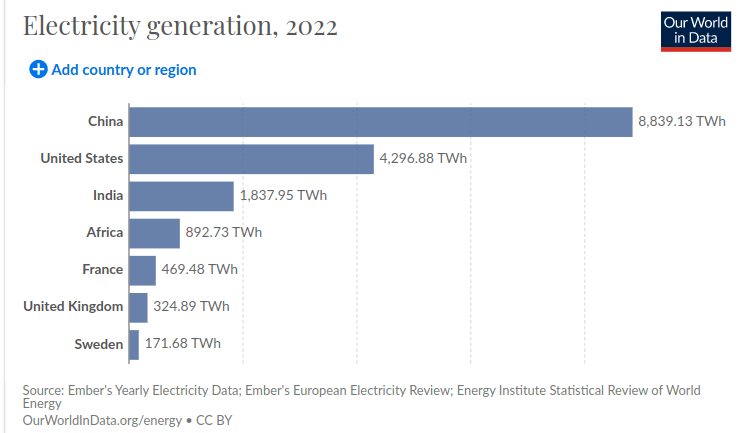
To grasp the full picture, examining 2022 data from Our World in Data is illuminating. China led the pack in electricity generation, boasting an impressive 8.3 pettawatt hours (PWh) in energy generation. Trailing behind was America with 4.2 PWh, India’s 1.8 PWh, and Africa’s 0.9 PWh.
Lifestyle Convenience and Energy
Greater energy usage doesn’t only signify industrial activity or urbanization. It is closely knitted with the conveniences of modern living. From daily commuting to home automation and entertainment, the more energy a nation consumes, the more technologically advanced and convenient its residents’ lifestyles tend to be.
However, the equation of energy and life satisfaction isn’t always linear. Multiple studies affirm that higher energy consumption does enhance life satisfaction in both affluent and developing nations. But beyond a specific point, the surges in energy utilization haven’t proportionally augmented population well-being.
Sustainable Consumption for a Brighter Tomorrow
Experts believe that by curbing overconsumption, we could maintain 2040’s energy utilization at 2010 levels. Furthermore, by addressing social inequalities, it’s possible to boost life quality with minimal additional energy consumption.
For nations and businesses, energy efficiency is no longer a luxury—it’s a necessity. Enhanced efficiency can dramatically reduce greenhouse gas emissions, pollutants, and even water usage. On a more micro-level, it implies decreased utility bills for individuals, job creation, and stable electricity rates. With looming environmental challenges like air and water pollution, climate change, thermal pollution, and waste disposal, rethinking energy is paramount.
Bitcoin is Sustainable Energy
Progressive Bitcoin mining operations are embracing sustainable energy sources. In doing so, they’re not just minimizing their carbon footprint, but also showcasing how modern technology can harmoniously co-exist with our planet.
The narrative around Bitcoin and energy consumption is thus shifting. From being viewed as a potential environmental problem, it’s progressively seen as part of the solution—a bridge towards a more sustainable, efficient, and equitable energy future.
Bitcoin Versus is not a financial advisor. This media platform reports on financial subjects purely for educational and entertainment purposes only. This platform should not is not intended as investment, tax, legal, or other professional advice. You should not rely on this information as a substitute for individual advice from a licensed professional. Do your own due diligence and contact a professional financial advisor for any advice on how to invest your money.

 Bitcoin Versus
Leave a comment