theory
-

From 1997’s top-down GTA to GTA VI’s living Leonida, explore an evidence-based forecast for GTA VII’s cities, physics, AI characters, storytelling and possible future.
-
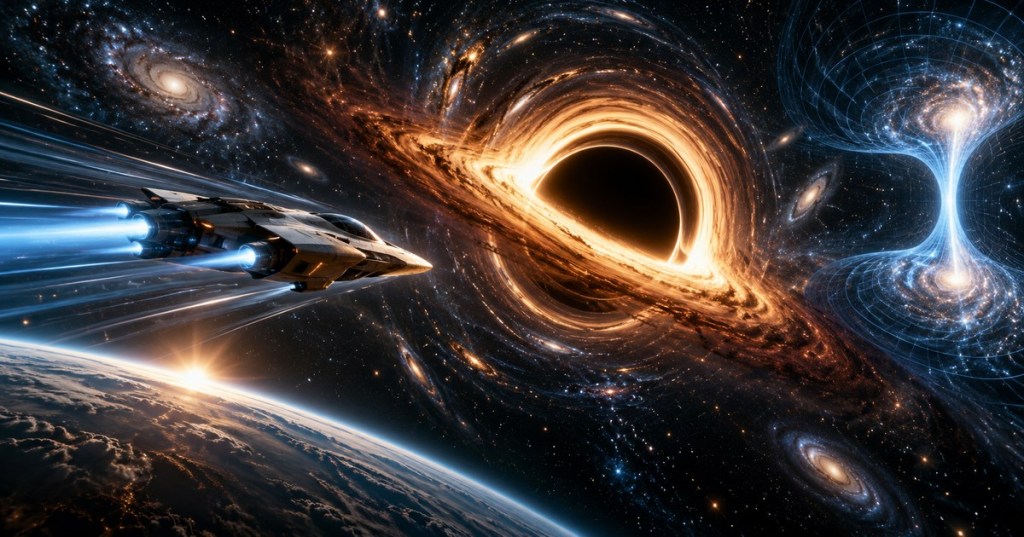
Could 100 years on Earth feel like only a few years in space? Explore the real mathematics of light-speed travel and black-hole time dilation, plus the fascinating science behind hypothetical wormholes.
-

A skeptical Power Efficiency Theory follow-up tests whether Bitcoin mining can reach 1 J/TH by 2046 using constant, accelerating and decaying ASIC-efficiency curves.
-
BlackRock’s digital-asset ETPs drew $7.9 billion in Q3 2026 and ended the quarter with about $79.6 billion in assets under management.
-

Bitcoin Quote of the Day — October 14, 2026 “My hope is that it creates world peace or helps create world peace… you fix that foundational level and everything above it improves.” Jack Dorsey Jack Dorsey made the statement during The ₿ Word panel on July 21, 2021. A transcript of the discussion places the…
-

Bitcoin Verse of the Day — October 14, 2026 “As long as it stays decentralized and secure, it is measuring the productivity flowing to society in the form of lower prices.” Jeff Booth Jeff Booth made this point during BTC157: Personal AI Models and Bitcoin with Preston Pysh. I verified the wording against the official…
-

Bitcoin Verse of the Day — October 14, 2026 “So essentially a node enforces the rules of the network, the consensus rules.” Peter McCormack Peter McCormack said this in Beginner’s Guide #14: Bitcoin Things You Need to Know, published February 25, 2020. The episode transcript places the sentence at about 31:02. The wording above is…
-

Bitcoin Verse of the Day — October 14, 2026 “We want Bitcoin to be a system where anyone in the world can send money to anybody. That is the whole point.” Gloria Zhao Gloria Zhao said this during her Transaction Relay Policy for L2 Developers talk at Adopting Bitcoin 2021. The line appears near the…
-

Bitcoin Verse of the Day — October 14, 2026 “Bitcoin is, very simply, separation of money and state.” Alex Gladstein Alex Gladstein gave this line during a 2023 episode of The Great Simplification. The official transcript places it at about 1:25:17, during a discussion about digital cash, privacy and peer-to-peer payments. The original video is…
-

Bitcoin Verse of the Day — October 14, 2026 “Cryptocurrencies are the first step to a world with a global programmable money.” Neha Narula Neha Narula delivered this line in her 2016 TED talk, The Future of Money. In the original recording, the sentence begins at about 11:58. Seconds later, she explains the idea in…
-

Bitcoin Verse of the Day — October 14, 2026 “The one thing that’s missing, but that will soon be developed, is a reliable e-cash. A method whereby on the Internet you can transfer funds from A to B without A knowing B or B knowing A.” Milton Friedman, 1999 Milton Friedman said this in a…
-

Bitcoin Verse of the Day — October 14, 2026 “Bitcoin is a shining city in cyberspace, and you can go there once you understand it.” Michael Saylor This verse works because it turns a technical network into a simple image: a place people can choose to enter once they understand what the system offers. Saylor…

