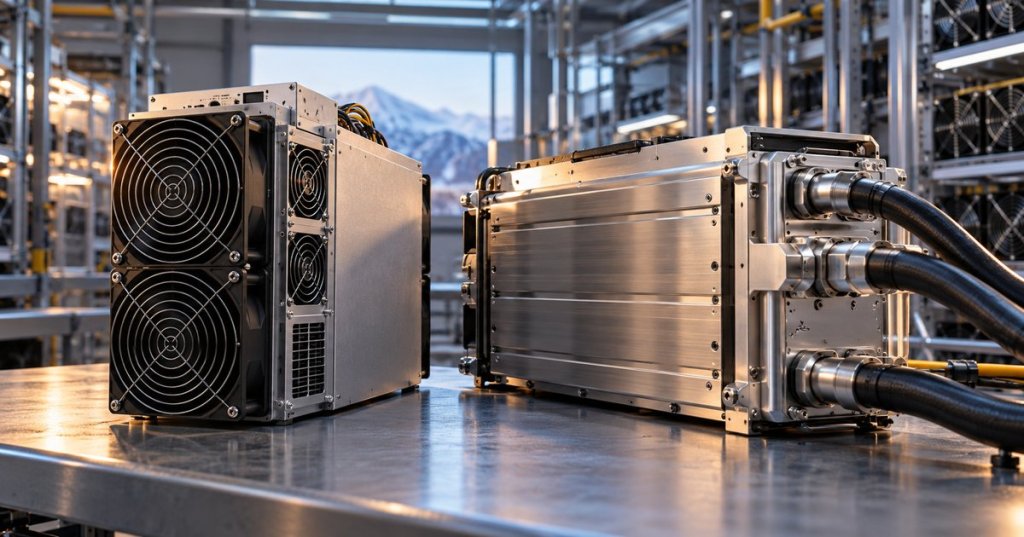
Bitcoin mining machines have become dramatically more powerful and more energy efficient. That does not mean they are becoming progressively lighter. Historical ASIC specifications show that chassis mass, mass-specific hashrate, physical volume and joules per terahash can move in different directions. This research report tests the hypothesis that future mining hardware will tend toward higher computational density, sometimes with greater machine weight, rather than automatically becoming smaller.
Key Takeaways
- Improving power efficiency in J/TH does not, by itself, reduce the kilograms required for a complete mining machine.
- Bitmain’s air-cooled S21 Pro provides 17% more hashrate than the S21 and uses less energy per terahash, yet its published chassis weight is roughly 30% greater.
- Hydro-cooled miners demonstrate large gains in hashrate per kilogram, but the supporting pumps, coolant and heat-rejection equipment must be considered at facility level.
- New semiconductor and structural materials could help lower mass; they are not a necessary condition because architecture, packaging and thermal engineering can also change it.
- Power Efficiency Theory can provide hashrate and J/TH scenarios. A separately measured mass variable is required to forecast weight accurately.
The question follows our October 11 hashrate-to-weight ranking and extends the original Bitcoin Mining Singularity dissertation and Power Efficiency Theory methodology clarification. The accompanying BitcoinVersus research post on X is reproduced below as source commentary, not independent verification of a technological forecast.
Definitions and Measurement Boundaries
Machine mass is the net kilograms of the mining unit, including the components covered by the manufacturer’s specification. Mass-specific computational throughput is nominal hashrate divided by net machine mass, measured in TH/s per kg (TH/kg). Volumetric computational density divides hashrate by chassis volume in liters (TH/L). Material density instead refers to kilograms per unit volume of a substance or assembled object. They are not interchangeable.
A lighter unit can provide more computation per kilogram; a heavier unit can also provide more computation per kilogram. Because liquid-cooled machines may move substantial supporting infrastructure outside the chassis, published miner weights are not necessarily comparable with the installed mass of an entire mining system.
Historical ASIC Specifications
The following selected specifications come from Bitmain’s S21 product specification, S21 Pro specification, S19 Pro Hydro specification, S21 XP Hydro product listing, and the site’s prior manufacturer-specification comparison. The S23 series includes manufacturer-rated products whose real-world performance and precise mass depend on model and shipping status.
| Selected ASIC | Hashrate | Net mass | Efficiency | TH/kg |
|---|---|---|---|---|
| S19 Pro Hydro (184T) | 184 TH/s | 13.0 kg | 29.5 J/TH | 14.2 |
| S21 air | 200 TH/s | 15.4 kg | 17.5 J/TH | 13.0 |
| S21 Pro air | 234 TH/s | 20.0 kg | 15.0 J/TH | 11.7 |
| S21 XP Hydro | 473 TH/s | 13.8 kg | 12.0 J/TH | 34.3 |
| S23 Hydro* | 580 TH/s | 13.0 kg* | 9.5 J/TH | 44.6* |
| S23 XP Hydro* | 600 TH/s | 15.8 kg* | 8.9 J/TH | 38.0* |
*S23 weights reflect the models cited in the October 11 BitcoinVersus.Tech ranking; different documentation or variants can produce different net-weight figures. S23 series specifications should be treated as manufacturer ratings, not standardized independent fleet measurements. This is a selected sample, not a complete market census.
The S21 vs. S21 Pro Comparison
The S21 is rated at 200 TH/s, 17.5 J/TH and 15.4 kg. Its air-cooled successor, the S21 Pro, is rated at 234 TH/s, 15 J/TH and 20 kg. That means the Pro offers 17.0% higher hashrate, a 14.3% reduction in energy consumed per terahash and 29.9% more machine mass. Its nominal hashrate per kilogram moves from about 13.0 to 11.7, a decline of approximately 9.9%.
This direct manufacturer-to-manufacturer comparison disproves a simple rule that lower J/TH must mean lower machine weight. The larger machine still performs more useful SHA-256 work overall.
The S19 Pro Hydro vs. S23 Hydro Comparison
Using the 184 TH/s, 13.0 kg S19 Pro Hydro and the earlier ranking’s 580 TH/s, 13.0 kg S23 Hydro, the later unit delivers roughly 3.15 times the hashrate at the same listed chassis mass. Even allowing for variant-level differences in weight documentation, the case illustrates substantially increasing compute per kilogram without a sustained decline in machine weight.
The appropriate inference is narrower than a universal trend: ASIC vendors can increase hash capacity considerably while holding nominal miner mass near the same level. Cooling configurations must be controlled before drawing broader conclusions.
What Can a Teardown Reveal?
A machine’s weight comes from far more than semiconductor dies. Cooling metal, enclosures, wiring, PCBs, busbars, power supply components, mechanical supports and connectors all contribute. A teardown helps identify which assemblies grow or shrink between product generations; it cannot alone prove a market-wide trend.
Video: The Hobbyist Miner’s July 2024 S21 Pro teardown shows the internal assembly of a modern air-cooled ASIC. It is an independent visual reference, not a calibrated materials-mass study.
Extending Power Efficiency Theory to Mass
The original Power Efficiency Theory research discusses the progression of computational capacity and energy efficiency. Its methodological clarification distinguishes measurable machine characteristics from network-wide estimates. A machine-weight analysis requires adding an independent observable instead of presuming mass is derived from J/TH.
- Hashrate: H(t), in TH/s, measures computational output.
- Efficiency: E(t), in J/TH, measures the energy consumed per unit of hashing.
- Mass: M(t), in kg, measures the defined miner or allocated installed-system boundary.
- Power: P = H × E, expressed in watts when H is TH/s and E is J/TH.
- Mass-specific compute: DM = H/M = (P/M)/E, in TH/kg.
The last identity is the essential mass-aware extension. If electrical power per kilogram stays constant, better energy efficiency increases hashrate per kilogram inversely to J/TH. But if the machine becomes heavier, lighter, or shifts cooling equipment elsewhere, the mass-specific result changes accordingly.
A Mass-Specific Compute Progression Ratio
A useful supplementary engineering indicator is RM = (Ht/Mt) ÷ (H0/M0). For a value of 2.0, a later machine produces twice as much hashrate per kilogram as the reference machine. This can be decomposed as RM = [(Pt/Mt) ÷ (P0/M0)] × (E0/Et). It distinguishes gains in power-handling per kilogram from gains in hashing efficiency.
This proposed metric supplements, but does not replace, the Power Efficiency Index. The PEI valuation framework uses computational progression and an energy-efficiency ratio over an explicitly chosen baseline. Machine mass is not presently a separate coefficient. Multiplying it into PEI without statistical validation would risk double-counting the same gains. Relevant background includes relative price through PEI, the 18-month PEI study and why longer research windows matter.
Semiconductor Materials and Physical Weight
The theory that substantial weight reductions could require different fundamental materials is plausible for particular design bottlenecks, but is too strong as a general rule. Contemporary miners contain silicon CMOS logic, copper or aluminum heat-transfer components, composite printed circuit boards, polymer insulation and metallic structures. Changing any of those component systems may affect mass without replacing silicon transistors.
| Component | Common material class | Possible route to lower mass |
|---|---|---|
| SHA-256 logic dies | Silicon CMOS | New architectures, better density, fewer packages |
| Cooling assemblies | Copper, aluminum, coolant | Direct liquid cooling, improved thermal interfaces |
| Chassis | Steel, aluminum | Lighter structure, revised mechanical design |
| Hashboards | Copper traces, fiberglass composites | Board consolidation, improved packaging |
| Power conversion | Silicon devices, inductors, copper | Higher-frequency conversion, denser distribution |
Advanced transistor structures illustrate the distinction. TSMC’s A16 technology combines advanced nanosheet transistor structures with backside power delivery. Such engineering aims to improve energy performance and circuit layout, but does not imply that a particular Bitcoin miner using future silicon would automatically be lighter. It is necessary to distinguish the weight of an individual chip from that of the integrated machine.
Gallium nitride and silicon carbide are important candidates for power electronics; thermal composites, improved heat spreaders and other materials could also reduce the quantity of metal required in cooling subsystems. Graphene and carbon nanotubes remain research candidates for some advanced electronic and thermal applications. None is a proven requirement for attaining a particular complete-miner weight or 1 J/TH rating.
For example, simply replacing copper with a lighter metal may reduce component mass but also change heat-transfer performance. A redesigned cooling system must still satisfy temperature, longevity and electrical requirements.
Thermal Engineering and System Boundaries
Nearly all electricity consumed by a mining rig ultimately becomes heat. A 5,340-watt unit creates approximately 5.34 kW of heat that must be dissipated or recovered. Lower J/TH does not necessarily lower that absolute heat load when manufacturers use the efficiency gains to increase hashrate at fixed electrical input.
Heat flux is distinct from total heat load. Greater electrical power concentrated in a smaller semiconductor area can make cooling more difficult even if the total machine wattage remains steady. More demanding cooling may require heavier metal, different coolant channels, larger electrical conductors or external facility machinery.
Hydro cooling also moves material outside the ASIC chassis. Pumps, cooling distribution units, coolant, piping, heat exchangers and dry coolers must be included when comparing installed systems. The relevant full-system metric would be installed kg per PH/s, using an explicitly allocated portion of rack infrastructure and cooling equipment. Chassis TH/kg and site kg/PH/s answer different questions.
For a broader engineering comparison, review the site’s hashrate-to-size ranking, efficiency ranking and ASIC architecture and the 2033–2046 efficiency window.
Video: The Hobbyist Miner’s 2024 S21 Pro field review provides additional context for the complete-machine form factor and operating characteristics.
Principles, Limits, and Research Laws
The Law of Accelerating Returns
Ray Kurzweil’s Law of Accelerating Returns is a proposed technological-progress framework. Applied to mining, it motivates scenarios of quicker chip, manufacturing, cooling and power-electronics advances. It does not mathematically require the complete mining machine to lose weight. Accelerated progress may enable heavier systems delivering vastly more computation.
Diminishing Efficiency Returns
As ASIC J/TH declines, leakage, interconnect effects, operating-voltage limits, packaging, thermal conditions, costs and yields may make further reductions harder. Reaching the next efficiency milestone could require extra physical complexity rather than lighter machines. This is an engineering possibility to test against future products.
Thermoeconomic Capitulation and System Trade-Offs
Within the original research vocabulary, thermoeconomic capitulation connects technical progress with physical and economic resistance. When applied to chassis mass, it suggests a possible succession of weight increases, plateaus and decreases as vendors redesign electronics, cooling and structural systems. It is an explanatory hypothesis rather than a universal physical law.
Landauer’s Principle
Landauer’s principle concerns the thermodynamic cost of logically irreversible information erasure. It does not directly specify a minimum chassis weight or an automatically attainable J/TH figure for SHA-256 ASICs. Likewise, 1 J/TH is a target in the proposed Bitcoin Mining Singularity analysis, not a demonstrated absolute thermodynamic floor.
What 1 J/TH Might Mean for Miner Weight
The 2046 1 J/TH scenario and the more aggressive 2033 chip-test scenario should be understood as assumption-dependent projections. Neither provides an independently measured future mass curve. A constant annual 8.3% reduction applied to 8.9 J/TH over twenty years yields roughly 1.57 J/TH in 2046, not 1.0 J/TH; accelerated rates would be necessary to cross 1 J/TH earlier.
For example, Bitmain lists its S23 XP Hydro at 600 TH/s, 5,340 W and 8.9 J/TH. At a hypothetical constant 5,340 W, lowering energy use to 1 J/TH would allow 5.34 PH/s. That is 8.9 times the throughput at 8.9 J/TH, assuming a physically practical chip and machine architecture can be built.
| Hypothetical 1 J/TH machine mass | Hashrate at 5,340 W | Hashrate per kg |
|---|---|---|
| 7.9 kg (half the reference mass) | 5.34 PH/s | 676 TH/kg |
| 15.8 kg (unchanged) | 5.34 PH/s | 338 TH/kg |
| 19.75 kg (25% heavier) | 5.34 PH/s | 270 TH/kg |
| 31.6 kg (twice as heavy) | 5.34 PH/s | 169 TH/kg |
The preceding table is an arithmetic illustration, not a verified manufacturing forecast. Power handling, heat flux, semiconductor economics and complete-system reliability would determine what hardware is practical.
Original Research Discussion on X
The following BitcoinVersus.Tech post motivated this additional examination of mass and machine density. The embedded statement is original commentary; conclusions in this report rely on the cited machine specifications and physical equations.
Read the originating BitcoinVersus.Tech X post if your browser does not render the embed.
An earlier discussion from the research accounts addressed longer-run energy-efficiency constraints; it is included for methodological context, not as proof of a particular target year.
Open the earlier Power Efficiency Theory post if social embedding is unavailable.
Proposed Method for Measuring Future Weight
A stronger mass forecast would require a standardized dataset across generations and cooling categories. Every machine should be recorded with exact model and revision, measured TH/s, wall J/TH, input watts, net mass, physical volume, chassis TH/kg, installed cooling allocation, power-supply inclusion, test conditions and sample date.
- Separate air, immersion and hydro-cooled machines before calculating generation-over-generation rates.
- Use manufacturer specification sheets as a starting point and independent field measurements wherever practical.
- Weigh component categories during teardowns to identify what physically changed.
- Include shared cooling, power and structural equipment in a separate full-system analysis.
- Test whether mass is statistically associated with time, power, cooling architecture and compute capability before publishing any weight forecast.
Conclusion
The evidence supports rising computational density, not a universal decrease in miner weight. The S21 and S21 Pro show how greater hashrate and improved electrical efficiency can coincide with greater machine mass; hydro-cooled comparisons show how compute-per-kilogram can rise dramatically without meaningful chassis weight reduction. Neither observation proves that miners must become denser in the material-density sense.
A fundamentally different semiconductor or structural material might eventually enable a lighter system, but improved circuit architecture, packaging, power conversion and cooling can also produce that outcome. Power Efficiency Theory is useful for analyzing the progression of hashrate and J/TH. A credible weight forecast needs its own measured mass series and a precisely defined system boundary.
Additional primary sources: Bitmain S21 specification; S21 Pro specification; S19 Pro Hydro specification; S21 XP Hydro listing; TSMC A16 semiconductor platform.
Research note: Calculations use nominal specification values. Historical comparisons are illustrative, future machine-mass scenarios are hypothetical, and model-level specification differences should be resolved before making definitive market-wide claims. Last reviewed October 24, 2026.
BitcoinVersus.Tech Editor’s Note:
We volunteer daily to ensure the credibility of the information on this platform is Verifiably True. If you would like to support to help further secure the integrity of our research initiatives, please donate using the QR code provided

For best QR-code scanning results, please scan this donation code from a desktop or larger screen. Mobile screens may prevent camera recognition.


Leave a Reply