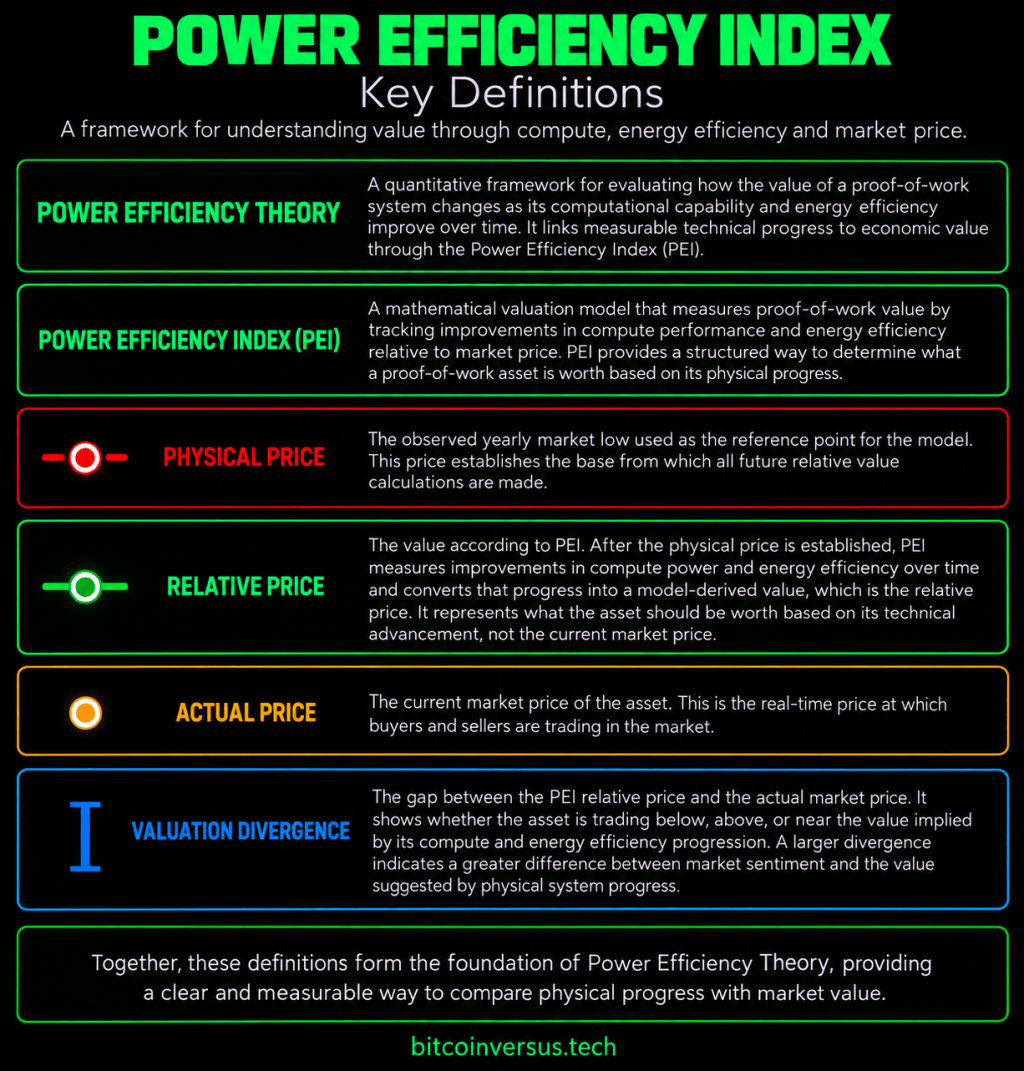
Power Efficiency Theory provides a framework for measuring the value progression of proof-of-work systems using observable changes in computational performance and energy efficiency.
The Power Efficiency Index, or PEI, organizes that framework around several distinct price points: physical price, relative price and actual price.
Physical price establishes the observed reference point, while relative price represents the value according to PEI as the underlying system improves.
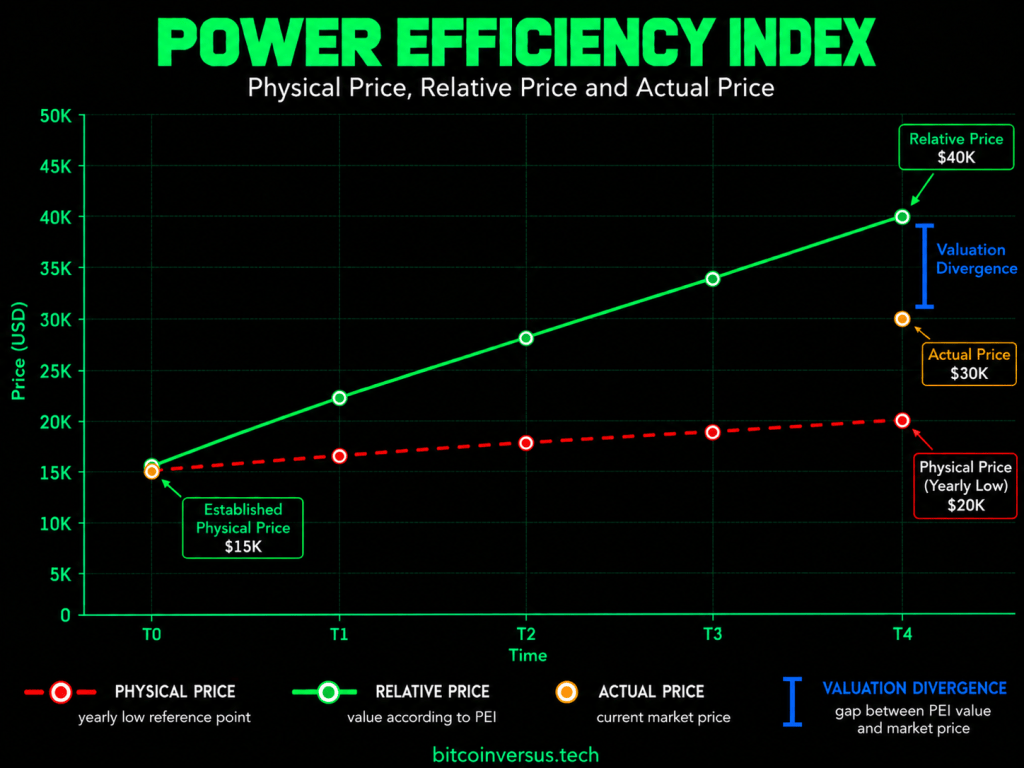
Actual price shows what the market is currently paying, allowing the difference between modeled value and market value to be measured as valuation divergence.
Relative Price is the model-implied price that comes after a proof-of-work system has already established a physical price.
In Power Efficiency Theory, the physical price acts as the observed reference point, usually tied to a meaningful market low.
From there, the model tracks how the system changes over time by measuring progress in compute power and energy efficiency. As those variables improve, PEI produces a new implied valuation called the relative price.
A simple way to think about it is that the physical price tells us where the system started, while the relative price tells us where the model suggests value should have moved based on measurable technical progress.
The actual price is then compared against that relative price. If the market price is below the relative price, PEI may suggest the asset is undervalued relative to its compute and efficiency progress.
If the market price is above the relative price, the model may suggest the asset is trading ahead of that measured progress.
Relative Price is therefore not the market price and it is not a replacement for the physical price.
It is the valuation path created after the physical price is established, giving researchers a way to compare technical improvement with market progression over time.
BitcoinVersus.Tech Editor’s Note:
We volunteer daily to ensure the credibility of the information on this platform is Verifiably True. If you would like to support to help further secure the integrity of our research initiatives, please donate here: 3C9o19EH5HSiwEPyCTmEKzxhNCbo2X6TTb
BitcoinVersus.tech is not a financial advisor. This media platform reports on financial subjects purely for informational purposes.
Disclaimer: The underlying inputs, calculations, and mathematical relationships used in the Power Efficiency Index are intended to be transparent and verifiable. The math is verifiable; the interpretation is experimental. PEI is a research framework, not a prediction of future price, guaranteed fair value, or financial advice. Actual market prices are influenced by many variables outside the model, including supply, demand, liquidity, regulation, adoption, speculation, and broader economic conditions.


Leave a Reply