
Physical price is the lowest observed market price of a proof-of-work digital asset during a defined measurement period, typically a calendar year, and is used in Power Efficiency Index (PEI) analysis as the market’s closest observable expression of a network’s underlying digital-physical value at that time.
Rather than representing the total replacement cost of mining hardware, electrical infrastructure, energy consumption, or network equipment, the physical price functions as a measurable market reference point from which changes in computational power and energy efficiency can be evaluated.
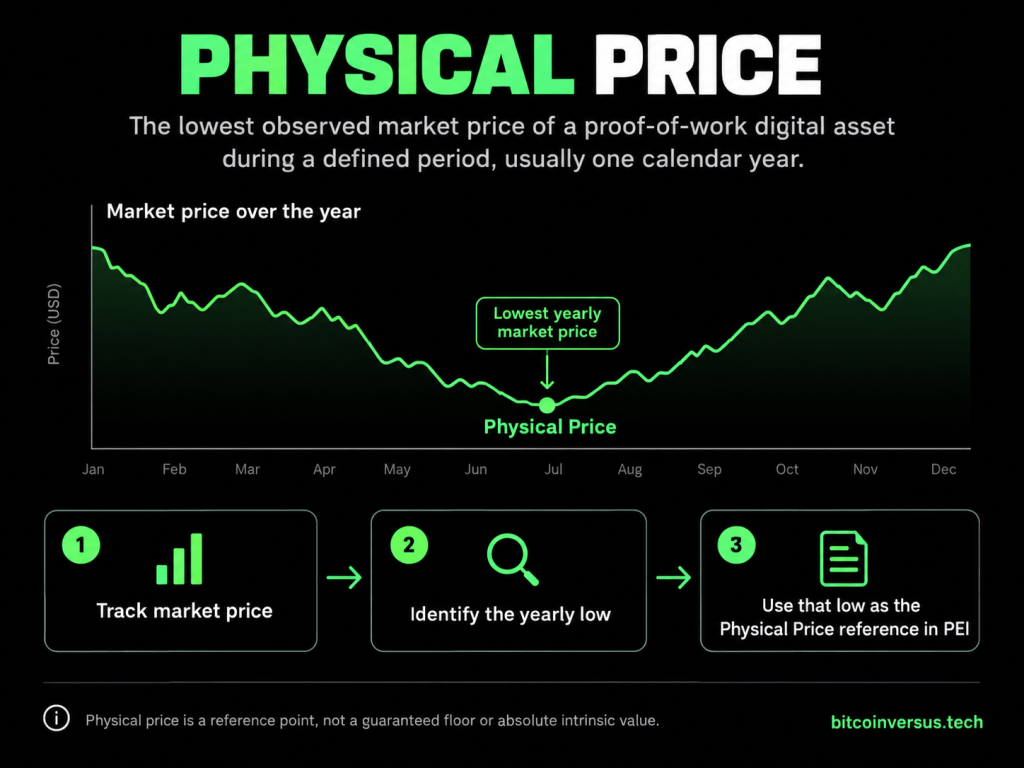
In annual PEI analysis, each year’s physical price is identified from the asset’s recorded yearly market low and compared with the corresponding rate of network compute and mining-hardware efficiency.
The concept is intended to connect a freely traded digital asset to the physical proof-of-work system responsible for producing and securing it, allowing the progression of that system to be measured against subsequent market valuation.
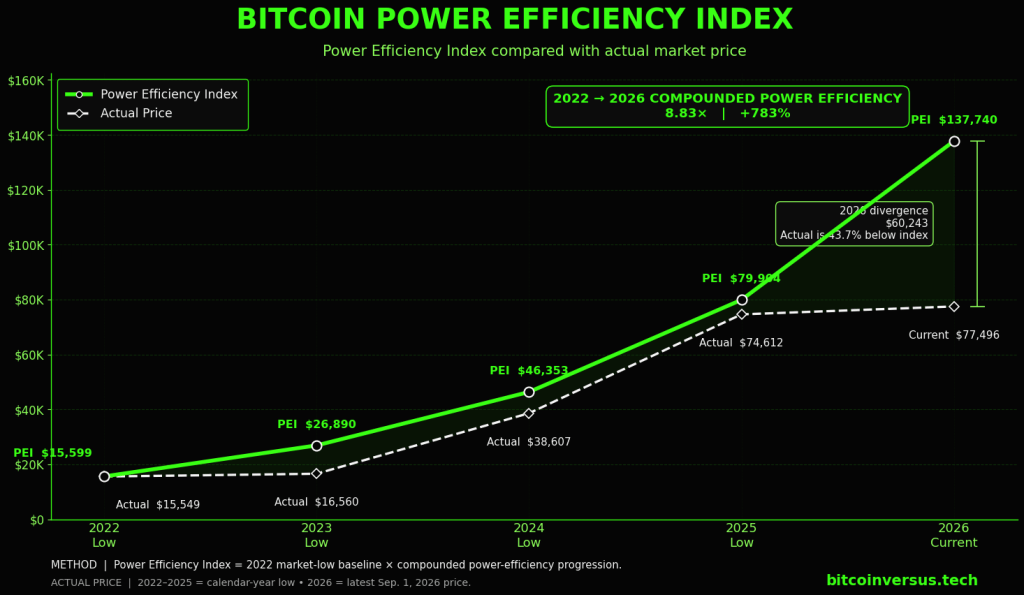
The physical price should not be interpreted as an absolute intrinsic value or guaranteed price floor, but as an empirical reference price used to study whether market value is advancing faster, slower, or approximately in line with the measurable power-efficiency progression of the underlying network.
BitcoinVersus.Tech Editor’s Note:
We volunteer daily to ensure the credibility of the information on this platform is Verifiably True. If you would like to support to help further secure the integrity of our research initiatives, please donate here: 3C9o19EH5HSiwEPyCTmEKzxhNCbo2X6TTb
BitcoinVersus.tech is not a financial advisor. This media platform reports on financial subjects purely for informational purposes.
Disclaimer: The underlying inputs, calculations, and mathematical relationships used in the Power Efficiency Index are intended to be transparent and verifiable. The math is verifiable; the interpretation is experimental. PEI is a research framework, not a prediction of future price, guaranteed fair value, or financial advice. Actual market prices are influenced by many variables outside the model, including supply, demand, liquidity, regulation, adoption, speculation, and broader economic conditions.


Leave a Reply