Power efficiency becomes more informative when we zoom out.
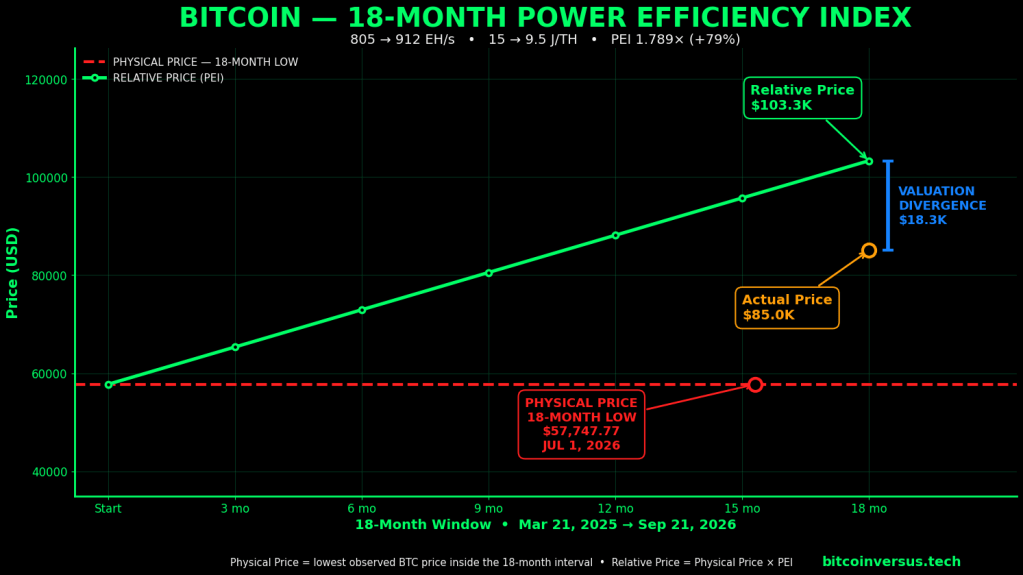
Bitcoin’s corrected 18-month Power Efficiency Index analysis places its model-derived Relative Price near $103,300, compared with an Actual Price near $85,007. Under Power Efficiency Theory, that leaves Bitcoin approximately 17.7% below its PEI Relative Price. The reading describes valuation relative to PEI and is not a guarantee that Bitcoin will reach $103,300.
The Physical Price changed the reading
The corrected methodology defines Physical Price as the lowest observed Bitcoin market price anywhere inside the selected 18-month interval. For the March 21, 2025 through September 21, 2026 analysis window, Bitcoin reached an intraday low of $57,747.77 on July 1, 2026. The low therefore belongs inside the measurement period rather than automatically at its starting point.
That distinction materially changes the PEI calculation. An earlier version used roughly $74,400 as the reference and produced a Relative Price above $133,000. Replacing that reference with the actual 18-month low reduces the model-derived Relative Price to approximately $103,300.
Bitcoin records roughly 79% PEI progression
The analysis uses a compute measurement increasing from approximately 805 EH/s to 912 EH/s and a selected mining-efficiency input improving from approximately 15 J/TH to 9.5 J/TH. Compute progression is approximately 1.133× while the efficiency improvement contributes approximately 1.579×. Multiplying the two produces approximately 1.789× compounded power-efficiency progression, or about 79%.
Applying that 1.789× PEI factor to the $57,747.77 Physical Price produces a Relative Price of approximately $103,300. Compared with the approximately $85,007 market reading used in the analysis, the Valuation Divergence is about $18,293.
PEI reads Bitcoin as undervalued
Under Power Efficiency Theory, Actual Price below Relative Price is classified as undervalued relative to PEI. Bitcoin’s approximately $85,000 market price is about 17.7% below the $103,300 Relative Price in the corrected 18-month analysis. The classification is specific to the model and should not be interpreted as a conventional analyst price target.
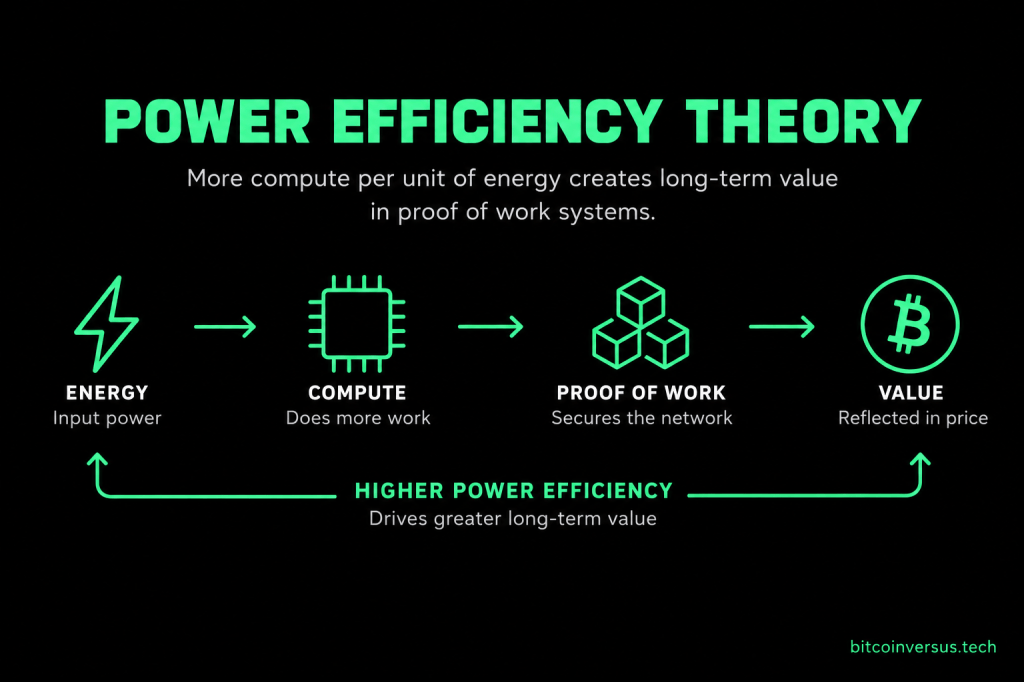
The longer interval is useful because Power Efficiency Theory measures physical progression rather than short-term price movement. Compute capability and energy efficiency can develop on a different path from market valuation. The resulting divergence provides a measurable relationship that can be tracked as future Bitcoin prices, network compute and mining efficiency change.
Why zooming out matters
The corrected reading strengthens the methodology by anchoring Physical Price to the lowest observed market price inside the full analysis window and identifying exactly when that low occurred. July 1, 2026 now serves as the clearly labeled Physical Price observation for the 18-month study.
The result is a simpler claim to test over time: PEI currently places Bitcoin’s Relative Price near $103,000 while the market trades near $85,000. Whether the gap narrows is a market outcome that Power Efficiency Theory does not guarantee. The divergence instead provides a quantitative benchmark for continued observation.
BitcoinVersus.Tech Editor’s Note:
We volunteer daily to ensure the credibility of the information on this platform is Verifiably True. If you would like to support to help further secure the integrity of our research initiatives, please donate here: 3C9o19EH5HSiwEPyCTmEKzxhNCbo2X6TTb


Leave a Reply