
Kaspa is trading near $0.0296 while a four year Power Efficiency Index analysis from BitcoinVersus.tech places its 2026 implied physical price near $0.1175.
The gap puts the PEI reading at roughly 3.97 times the current market price, representing a divergence of about 297%. KAS also remains far below its August 2024 record of $0.2074, while its lowest recorded price during 2026 is approximately $0.0251.
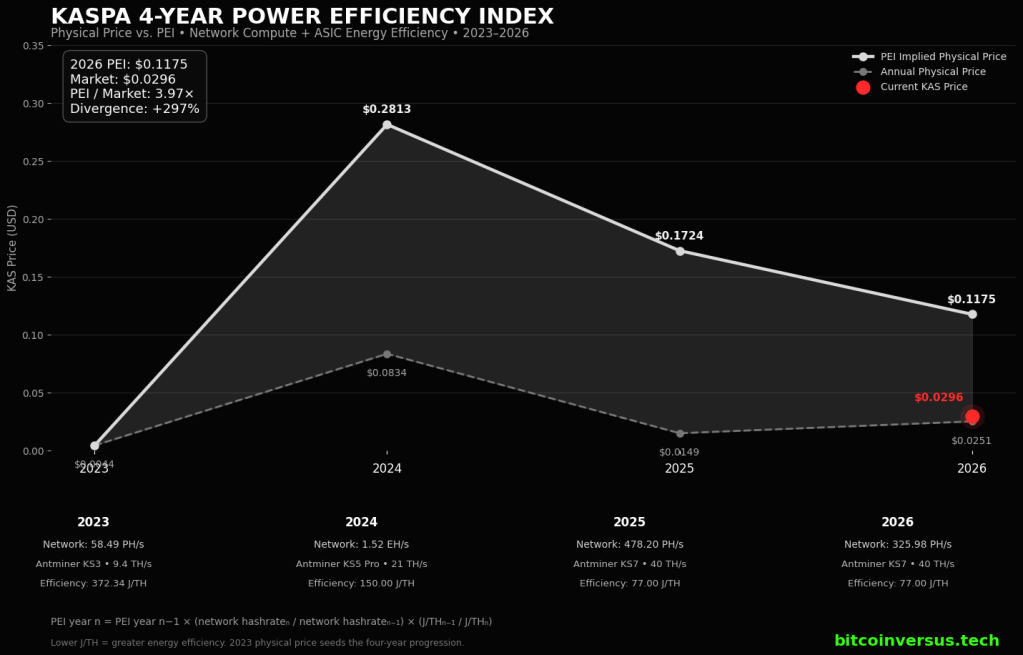
PEI therefore suggests Kaspa is undervalued relative to the measurable progression of its proof of work computing infrastructure, although the reading should be treated as a model based interpretation rather than a market price forecast.
BitcoinVersus.tech defines physical price as the lowest observed market price of a proof of work asset during a measured year. Kaspa’s physical prices were approximately $0.00436 in 2023, $0.0834 in 2024, $0.0149 in 2025 and $0.0251 so far in 2026.
Rather than treating price appreciation alone as evidence of increasing value, PEI compares those market observations with changes in the rate of network compute and the energy required to produce that computation. CoinLore’s historical records also show Kaspa reached annual highs of $0.1534 in 2023, $0.2074 in 2024, $0.1562 in 2025 and $0.0531 so far in 2026.
Kaspa experienced one of the largest expansions in proof of work compute among major mined cryptocurrencies during 2024. Research from CoinEx and ViaBTC measured network hashrate rising from 132.19 PH/s to 1.486 EH/s during 2024, an increase of 1,024%.
A November 2023 institutional research snapshot measured Kaspa at 58.49 PH/s, while the BitcoinVersus.tech chart uses roughly 1.52 EH/s for the late 2024 network point. Kaspa’s own year end publication reported a comparable 1.52 figure for Dec. 31, while CoinEx and ViaBTC provide the clearer EH/s unit classification.
ASIC development amplified the rate of compute while lowering the energy required per terahash. Bitmain’s Antminer KS3 delivered 9.4 TH/s at 3,500 watts, equal to roughly 372 J/TH, while the later KS5 Pro increased output to 21 TH/s at 3,150 watts and 150 J/TH.
The Antminer KS7 generation reached 40 TH/s at about 3,080 watts and 77 J/TH. A KS7 therefore performs more than four times the computational work of a KS3 while drawing slightly less electrical power, reducing energy consumption per terahash by roughly 79% across the compared generations.
Network compute has not maintained its 2024 peak. Kaspa hashrate was reported near 599.55 PH/s in early December 2025, while a late December measurement cited approximately 478.2 PH/s.
Current mining data places the network near 325.98 PH/s, meaning deployed compute has contracted sharply even as the efficiency of leading mining equipment remains far ahead of the 2023 generation. PEI penalizes that contraction rather than assuming every hardware improvement automatically produces a higher implied valuation.
The BitcoinVersus.tech PEI calculation begins with the 2023 physical price and advances it according to the relative change in network hashrate and ASIC energy efficiency.
Using the chart inputs, the implied progression is approximately $0.00436 in 2023, $0.2813 in 2024, $0.1724 in 2025 and $0.1175 in 2026. The declining PEI after 2024 reflects Kaspa’s falling network hashrate, while the remaining premium over market price reflects the much larger computational and energy efficiency capability retained compared with the early ASIC period.
Kaspalytics independently defines network hashrate as a measure of the total computational power mining on Kaspa and derives the metric from network difficulty and block production rate.
The resulting interpretation is more nuanced than a conventional bullish price target. PEI suggests Kaspa is currently undervalued relative to its measured power efficiency, but the network’s loss of compute since the 2024 peak prevents a stronger conclusion.
A recovery in hashrate combined with continued improvements in ASIC efficiency would strengthen the physical valuation argument, while further declines in deployed compute would push the model in the opposite direction. At approximately $0.03, KAS is trading close to its 2026 physical price even though modern kHeavyHash hardware can perform substantially more computation per unit of energy than equipment available during the early ASIC era.
BitcoinVersus.Tech Editor’s Note:
We volunteer daily to ensure the credibility of the information on this platform is Verifiably True. If you would like to support to help further secure the integrity of our research initiatives, please donate here: 3C9o19EH5HSiwEPyCTmEKzxhNCbo2X6TTb
BitcoinVersus.tech is not a financial advisor. This media platform reports on financial subjects purely for informational purposes.
Disclaimer: The underlying inputs, calculations, and mathematical relationships used in the Power Efficiency Index are intended to be transparent and verifiable. The math is verifiable; the interpretation is experimental. PEI is a research framework, not a prediction of future price, guaranteed fair value, or financial advice. Actual market prices are influenced by many variables outside the model, including supply, demand, liquidity, regulation, adoption, speculation, and broader economic conditions.


Leave a Reply