Power Efficiency Index Explained

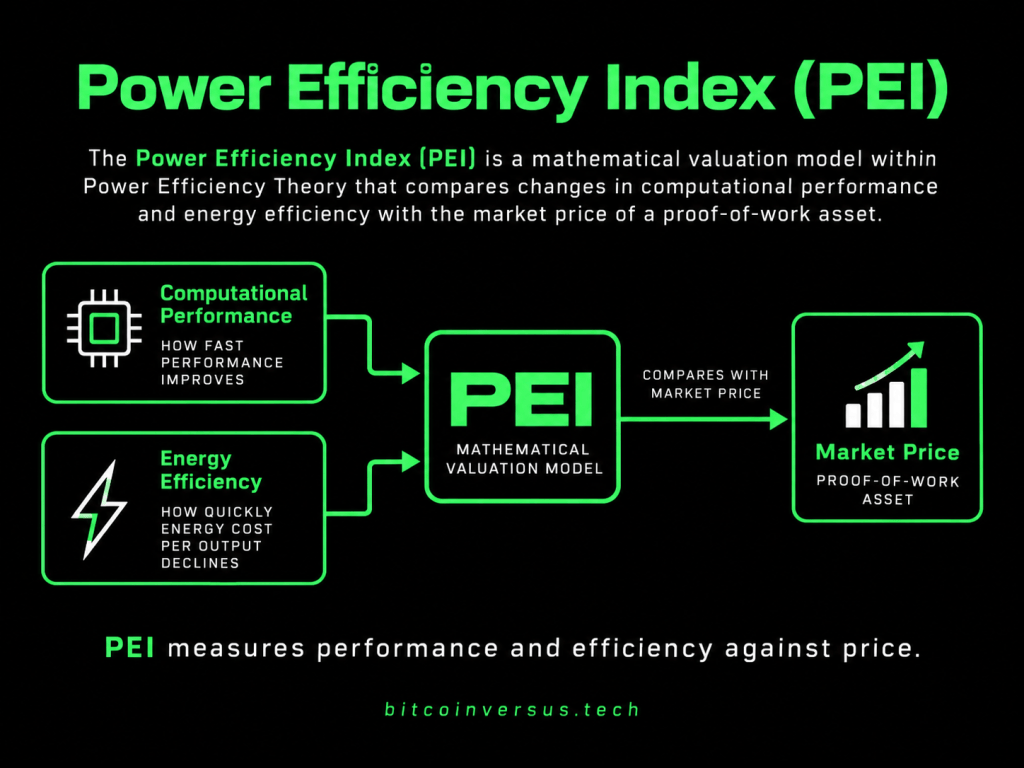
The Power Efficiency Index (PEI) is a mathematical valuation model within Power Efficiency Theory that compares changes in computational performance and energy efficiency with the market price of a proof-of-work asset.

Developed by bitcoinversus.tech, PEI measures the growth in a network’s rate of compute alongside improvements in the energy required per unit of computation.

In its comparative form, the model multiplies an initial physical price by the ratio of current to initial hashrate and the ratio of initial to current energy consumption per unit of compute.

Physical price refers to the observed annual market low selected as the model’s starting price.
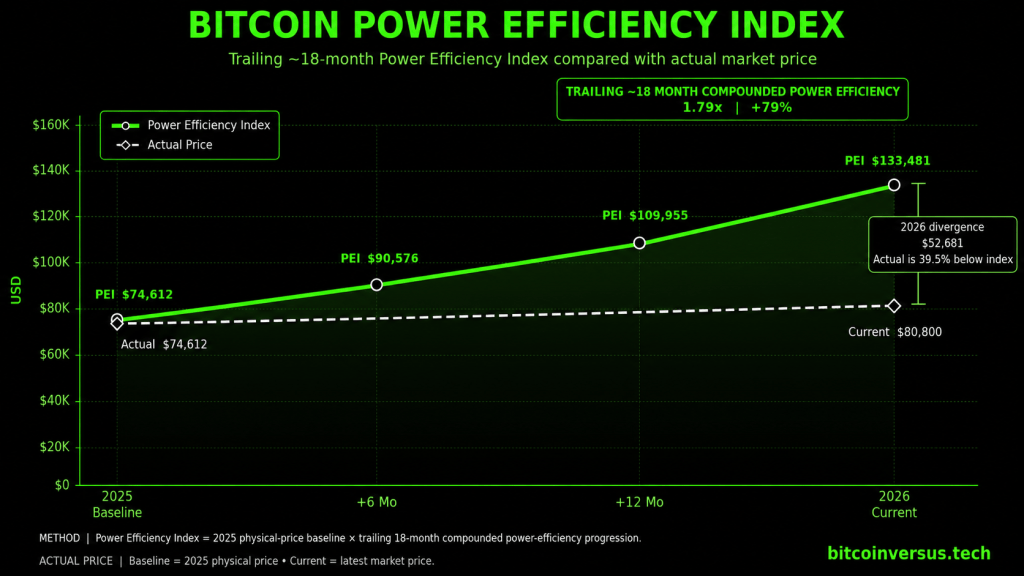
Bitcoin’s 18-month PEI chart places the market quote 39.5% below the model’s $133,481 reading. The gap supports a model-relative undervaluation opinion; the news investigation identifies monetary uncertainty and uneven fund demand as plausible contributors.

The calculation produces an indicative valuation that rises as computational capacity increases and energy efficiency improves, while declining performance or worsening efficiency can reduce the reading. Market prices below the PEI estimate suggest undervaluation relative to the model, prices above it suggest overvaluation, and prices near it indicate approximate parity.

The difference between market price and the PEI estimate is called PEI divergence.

The current implementation applies to proof-of-work systems and depends on clearly identified computational measurements, representative efficiency data and aligned observation dates.

PEI provides a framework for interpreting valuation differences, with conclusions remaining conditional on the model’s assumptions.

BitcoinVersus.Tech Editor’s Note:

We volunteer daily to ensure the credibility of the information on this platform is Verifiably True. If you would like to support to help further secure the integrity of our research initiatives, please donate here: 3C9o19EH5HSiwEPyCTmEKzxhNCbo2X6TTb

BitcoinVersus.tech is not a financial advisor. This media platform reports on financial subjects purely for informational purposes.

9 responses to “Power Efficiency Index Explained”

  1. […] Power Efficiency Index, developed by BitcoinVersus.tech, approaches valuation from the physical side of proof of work by […]

    Like

  2. […] context, read our Bitcoin ASIC architecture overview and Power Efficiency Index explainer. Understanding the units helps readers distinguish hardware performance, energy consumption and the […]

    Like

  3. […] Power Efficiency Index combines a selected physical price with two ratios: current network compute divided by starting […]

    Like

  4. […] the Power Efficiency Index (PEI), two independent calculations measure Bitcoin’s technological progress between March 21, […]

    Like

  5. […] Power Efficiency Index (PEI) now gives a different signal from the longer 18-month reading. Using same-date network […]

    Like

  6. […] 12-month PEI reading near $61.6K is useful, but it also shows why the Power Efficiency Index is usually stronger over spacious windows such as 24 or 48 […]

    Like

  7. […] assumption as mining hardware moves toward the proposed 1 J/TH milestone. The related Power Efficiency Index (PEI) remains a separate experimental valuation framework rather than a hardware […]

    Like

  8. […] related Power Efficiency Index remains a separate experimental framework for studying the relationship between computational […]

    Like

  9. […] Power Efficiency Theory separates the Rate of Compute from the Rate of Energy Efficiency. Compute can rise through machine hashrate or network hashrate, while energy efficiency improves as J/TH falls. Their compounded progression can then be measured with the Power Efficiency Index. […]

    Like

Leave a Reply