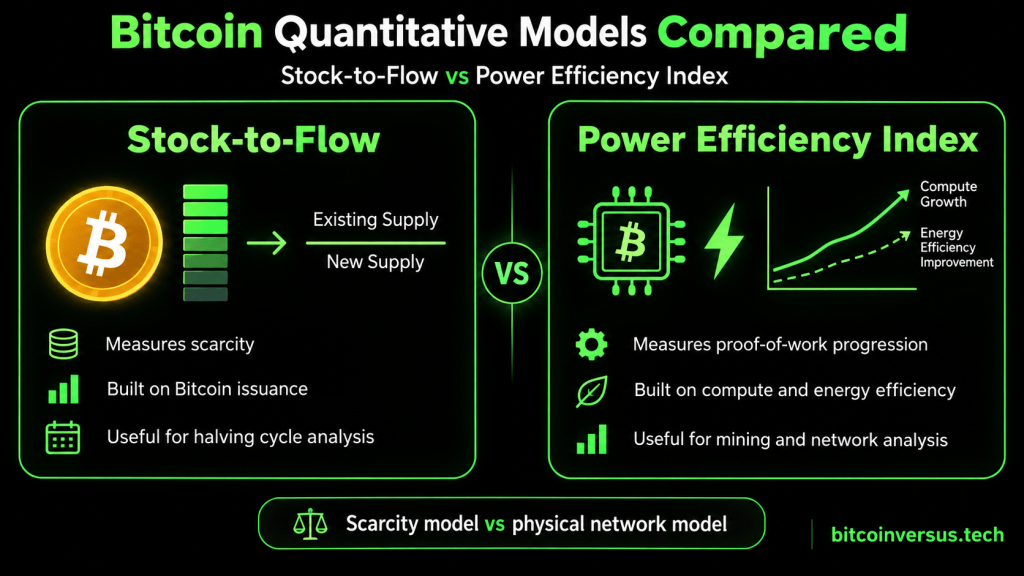
Bitcoin valuation models often begin with the same problem and arrive at very different answers.
PlanB, known online as @100trillionUSD, introduced the Bitcoin Stock-to-Flow model in 2019 as a way to quantify scarcity and relate Bitcoin’s programmed supply schedule to market value.
The Power Efficiency Index, developed by BitcoinVersus.tech, approaches valuation from the physical side of proof of work by measuring changes in computational power and mining hardware energy efficiency against an observed market reference price.
Both models isolate measurable characteristics of Bitcoin, but each describes a different part of the system.
Stock-to-Flow begins with a simple ratio: existing stock divided by annual new production. Bitcoin is particularly suited to a scarcity framework because issuance follows a predetermined schedule, with the block subsidy cut in half every 210,000 blocks.
The April 2024 halving reduced the subsidy from 6.25 BTC to 3.125 BTC, increasing Bitcoin’s Stock-to-Flow ratio as annual new issuance declined relative to existing supply.
PlanB’s original regression connected higher Stock-to-Flow readings with higher Bitcoin market value and reported an R² of about 95 percent across the historical dataset used in the 2019 study.
The primary strength of Stock-to-Flow is simplicity. Bitcoin’s issuance schedule is transparent, deterministic and largely independent of short-term market sentiment, giving analysts a stable variable that can be projected years in advance.
Academic research has produced evidence that scarcity can carry explanatory value for cryptocurrency returns, and Fidelity Digital Assets has argued that Stock-to-Flow remains useful for illustrating Bitcoin’s supply imbalance around halving events even while cautioning against relying on the model alone for forward price expectations.
For investors primarily studying Bitcoin as a scarce monetary asset, S2F provides a clear framework for understanding how diminishing issuance changes the monetary structure over time.
Stock-to-Flow also carries important limitations. Bitcoin demand, adoption, liquidity, interest rates, regulation, institutional participation and investor behavior are not direct inputs in the traditional model.
A 2024 study examining Bitcoin return prediction found that apparent Stock-to-Flow significance became statistically insignificant after time fixed effects were introduced, supporting concerns that part of the historical relationship may reflect Bitcoin’s progression through time rather than an independent causal pricing mechanism.
Fidelity reached a similar practical conclusion, arguing that scarcity matters but a supply-only model leaves out demand, which remains essential to market pricing.
The Power Efficiency Index asks a different question. PEI starts with an observed physical price, generally the lowest market price recorded during a defined period, and then measures how the underlying proof-of-work system progresses from that point.
The comparative calculation combines growth in network computational power with improvement in the energy required per unit of computation.
For Bitcoin, hashrate represents the rate of compute while ASIC efficiency can be expressed in joules per terahash, allowing PEI to measure whether mining infrastructure is producing more computational work while requiring less energy for each unit of work.
PEI’s advantage is greater visibility into Bitcoin’s physical computing infrastructure. Stock-to-Flow can increase because issuance falls even if mining hardware makes little technological progress, while PEI can increase because the network produces substantially more computation and newer machines reduce energy consumption per unit of output.
Independent academic research has examined similar variables and found meaningful relationships among Bitcoin price, hashrate and mining efficiency during some historical periods, although results have varied across market regimes.
Research by Dean Fantazzini and Nikita Kolodin also found evidence that price often leads hashrate rather than hashrate consistently leading price, an important warning against interpreting mining expansion as automatic proof of future price appreciation.
PEI has a different set of limitations. BitcoinVersus.tech explicitly describes the index as an experimental research framework rather than a guaranteed fair value, price floor or prediction.
The physical price originates in the market itself, while changes in hashrate can partly result from prior changes in Bitcoin price because higher mining revenue can encourage miners to deploy additional equipment.
PEI also excludes many major price variables, including monetary policy, liquidity, regulation, adoption, leverage and market demand.
No independent peer-reviewed validation of PEI was identified in the literature reviewed for the briefing, giving Stock-to-Flow a considerably longer history of external statistical testing and criticism.
Choosing between the models therefore depends on the analytical question.
An investor studying Bitcoin primarily as digitally scarce money may prefer Stock-to-Flow because Bitcoin’s issuance schedule and halving mechanism sit at the center of the model.
A mining analyst, engineer or researcher studying how proof-of-work infrastructure evolves may prefer PEI because hashrate and energy efficiency are directly represented.
Stock-to-Flow asks how increasingly scarce Bitcoin becomes relative to new issuance, while PEI asks how much the physical network has improved relative to an earlier measured state.
Neither framework needs to invalidate the other.
Bitcoin simultaneously operates as a scarce monetary asset and a computational network secured by specialized machines consuming real energy.
Stock-to-Flow can provide a monetary scarcity lens while PEI can provide a computational productivity lens, and disagreements between the two may reveal which underlying variable is moving fastest during a given period.
A broader valuation process can use both alongside adoption, liquidity, macroeconomic conditions and network activity rather than expecting a single equation to explain every market cycle.
BitcoinVersus.Tech Editor’s Note:
We volunteer daily to ensure the credibility of the information on this platform is Verifiably True. If you would like to support to help further secure the integrity of our research initiatives, please donate here: 3C9o19EH5HSiwEPyCTmEKzxhNCbo2X6TTb
BitcoinVersus.tech is not a financial advisor. This media platform reports on financial subjects purely for informational purposes.


Leave a Reply