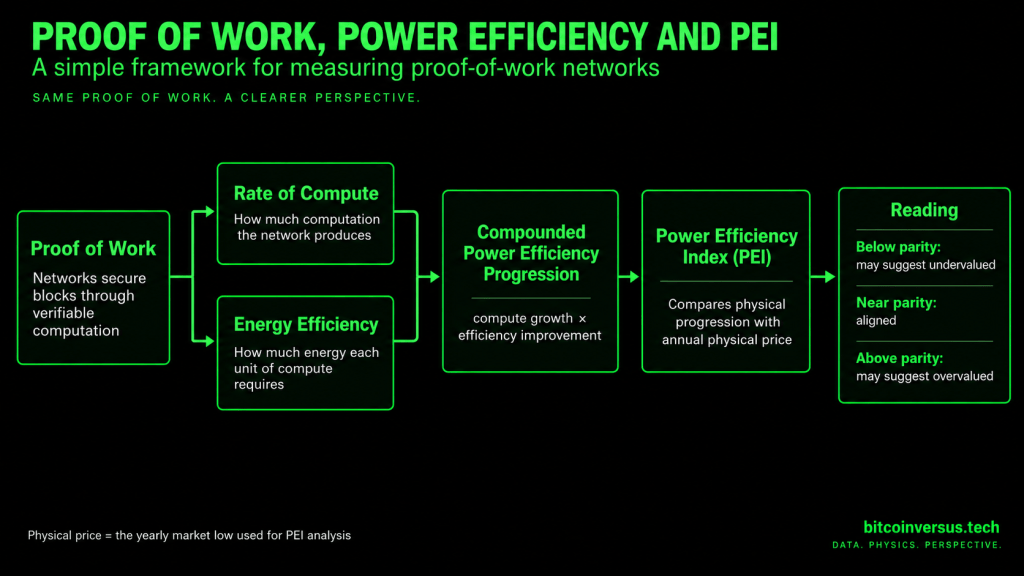
Proof of work is a consensus system in which computers compete to perform verifiable computational work in order to secure a blockchain, validate transactions, and produce new blocks.
In practical terms, that work is expressed through the network’s rate of compute—such as hashes per second—and the amount of energy required to produce that computation.
A proof-of-work network therefore has a measurable physical side: machines, electrical input, computational output, and hardware efficiency. That makes proof of work especially useful for P Theory, because the network can be observed through changes in both computational capability and energy efficiency over time.
Under the power efficiency model, the key question is not simply whether a network uses more energy or produces more hashrate. The important question is whether it can generate more useful computation while requiring less energy per unit of output.
If the rate of compute rises while joules per unit of compute decline, the network is improving on both sides of the equation.
The Power Efficiency Index (PEI) measures that compounded progression and compares it with the asset’s annual physical price. PEI therefore provides a way to examine whether market valuation is keeping pace with measurable improvement in the underlying proof-of-work system.
From that perspective, proof of work becomes more than a security mechanism; it becomes a measurable physical economy of computation. P Theory suggests that persistent gains in compute and energy efficiency should matter to long-term value, while PEI tests that idea against observed market behavior.
When physical progression advances faster than valuation, PEI may suggest undervaluation; when valuation runs substantially ahead of measurable progression, it may suggest overvaluation. The conclusion remains a science-based opinion grounded in observable network data rather than a claim that price must mechanically follow the model.
BitcoinVersus.Tech Editor’s Note:
We volunteer daily to ensure the credibility of the information on this platform is Verifiably True. If you would like to support to help further secure the integrity of our research initiatives, please donate here: 3C9o19EH5HSiwEPyCTmEKzxhNCbo2X6TTb
BitcoinVersus.tech is not a financial advisor. This media platform reports on financial subjects purely for informational purposes.
Disclaimer: The underlying inputs, calculations, and mathematical relationships used in the Power Efficiency Index are intended to be transparent and verifiable. The math is verifiable; the interpretation is experimental. PEI is a research framework, not a prediction of future price, guaranteed fair value, or financial advice. Actual market prices are influenced by many variables outside the model, including supply, demand, liquidity, regulation, adoption, speculation, and broader economic conditions.


Leave a Reply