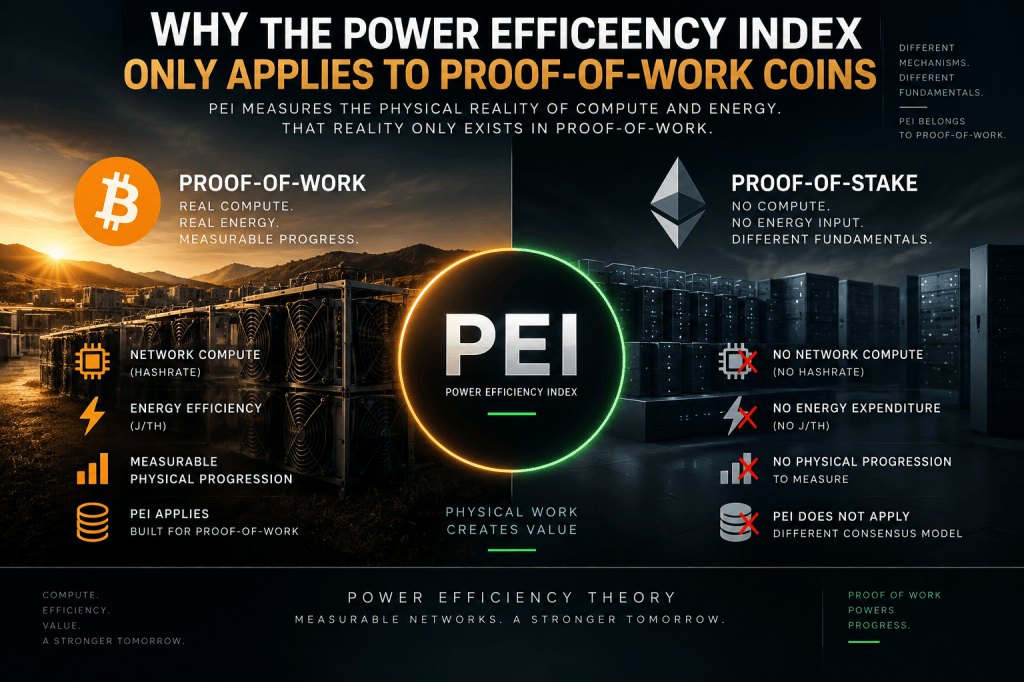
The Power Efficiency Index (PEI) is designed specifically for proof-of-work cryptocurrencies because proof of work produces a measurable physical relationship between computation and energy.
Bitcoin, Litecoin, Zcash and other mineable networks require machines to perform continuous cryptographic work.
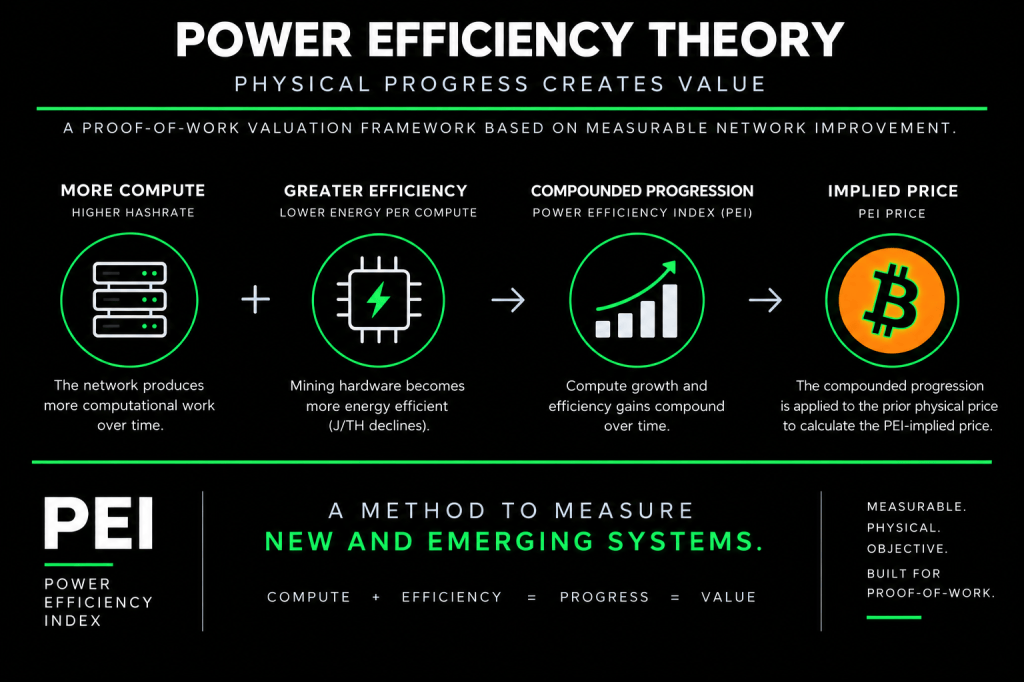
That gives PEI two physical variables it can track over time: network computational power and the energy efficiency of the hardware producing that computation.
As mining hardware becomes more powerful while requiring less energy per unit of work, PEI measures that compounded power-efficiency progression and compares it with the asset’s actual market trajectory.
Proof-of-stake and other non-mining cryptocurrencies do still consume electricity, but they do not have the same measurable mining engine underneath them. There is no network hashrate growing from hundreds of terahashes to petahashes, and there is no ASIC efficiency curve such as joules per terahash that can be followed generation after generation.
Their validators may become more efficient, but electricity consumption is not directly tied to producing increasingly large quantities of cryptographic proof-of-work. In simple terms: PEI needs measurable work and measurable energy efficiency. Proof of work provides both.
This is also why PEI should not be applied to every cryptocurrency. A proof-of-work coin has a physical computational layer that can be measured against its physical price—the market low established during a given year.
The network’s compounded improvement in computational power and energy efficiency can produce a theoretical power-efficiency price.
PEI then compares that implied price with the actual market price to determine whether the market is trading above or below the network’s measured power-efficiency progression.
For a non-proof-of-work asset, that physical mining relationship does not exist in the same form, so applying PEI would remove the very mechanism the index is intended to measure.
BitcoinVersus.Tech Editor’s Note:
We volunteer daily to ensure the credibility of the information on this platform is Verifiably True. If you would like to support to help further secure the integrity of our research initiatives, please donate here: 3C9o19EH5HSiwEPyCTmEKzxhNCbo2X6TTb
BitcoinVersus.tech is not a financial advisor. This media platform reports on financial subjects purely for informational purposes.
Disclaimer: The underlying inputs, calculations, and mathematical relationships used in the Power Efficiency Index are intended to be transparent and verifiable. The math is verifiable; the interpretation is experimental. PEI is a research framework, not a prediction of future price, guaranteed fair value, or financial advice. Actual market prices are influenced by many variables outside the model, including supply, demand, liquidity, regulation, adoption, speculation, and broader economic conditions.


Leave a Reply