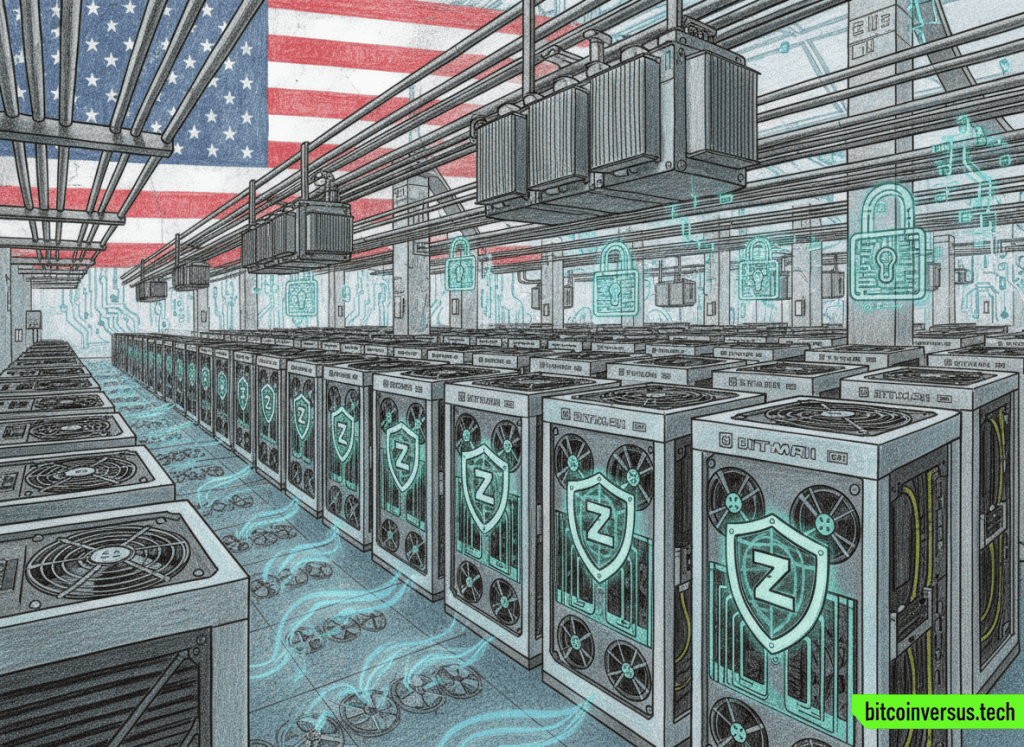
Cypherpunk Technologies’ new Zcash mining fleet has moved from launch story to operating business. After a sharp rise in ZEC and several weeks of live mining, outside estimates now put the fleet near a $125 million annualized gross-revenue rate.
The figure is revenue, not profit, and it can move quickly with ZEC price, network hashrate and mining difficulty. Still, the change illustrates why proof-of-work hardware economics can shift dramatically when coin price moves faster than network competition.
A $33.33 million ASIC fleet now has a much larger gross-revenue run rate
The company launched Cypherpunk Mining in August through a $33.33 million equity-based transaction with Winklevoss Capital. The deal brought roughly 4.2 GSol/s of Equihash hashrate online across U.S. facilities using Bitmain Z15 Pro machines.
Recent analysis estimates the fleet’s gross annualized revenue near $125 million after ZEC’s price climbed sharply. That estimate excludes electricity, hosting, equipment, pool and other operating costs, so it should not be read as annual profit.
Network competition is already responding
When Cypherpunk announced the fleet, its 4.2 GSol/s represented about 18% of Zcash network hashrate. The estimated share has since fallen toward 15% as more Equihash compute joined the network. That is the familiar proof-of-work response to unusually attractive mining economics: more miners compete for the same block rewards.
BitcoinVersus.tech recently covered Fortitude’s funding for 9,000 Z15 Pro ASICs, another sign of new capital moving into Zcash mining. Our earlier Bitcoin-versus-Zcash efficiency analysis examined the underlying energy and proof-of-work tradeoffs.
Cypherpunk has already added mined ZEC to treasury
The operating dashboard records 3,023.13 ZEC as mined on August 31. Cypherpunk’s strategy therefore combines ASIC production with a corporate ZEC treasury instead of treating mining and asset accumulation as separate businesses.
The structure echoes a broader theme across proof-of-work infrastructure. BitcoinVersus.tech has examined why power efficiency is fundamental to proof-of-work networks, Bitcoin and Monero efficiency differences, and how mining algorithms shape hardware competition.
Z15 Pro economics versus the Bitcoin ASIC market
Cypherpunk’s fleet uses Equihash hardware rather than Bitcoin’s SHA-256 machines, so direct hashrate comparisons are meaningless. The useful comparison is economic output per unit of electricity and capital. Bitcoin miners are simultaneously pursuing more efficient SHA-256 hardware, including the 8.9 J/TH S23 XP Hydro generation, while alternative proof-of-work networks can temporarily produce very different returns from specialized ASIC fleets.
Cypherpunk’s own launch materials argued that Zcash mining could outperform both Bitcoin mining and AI colocation at prevailing conditions. That is a company claim rather than a permanent property of the hardware: coin prices, block rewards, electricity rates and incoming network hashrate can rapidly change the calculation.
Zcash mining and proof-of-work hardware
Cypherpunk Mining on X
BitcoinVersus.Tech Editor’s Note: Annualized mining revenue is a snapshot based on current market and network conditions. It is not a profit forecast.
Support independent Bitcoin, mining, ASIC and infrastructure reporting: 3C9o19EH5HSiwEPyCTmEKzxhNCbo2X6TTb
BitcoinVersus.tech is not a financial advisor. This media platform reports on financial subjects purely for informational purposes.


Leave a Reply