
Bitcoin and Monero represent two very different approaches to proof-of-work computation.
Bitcoin uses SHA-256 and has developed around highly specialized ASIC mining hardware, while Monero uses RandomX, an algorithm intentionally designed to keep general-purpose processors competitive and reduce the advantage of specialized machines.
A raw comparison of Bitcoin terahashes and Monero kilohashes would therefore be meaningless.
Power Efficiency Theory instead treats the comparison pound-for-pound: each network is measured against its own historical hashrate and machine-efficiency baseline, and the resulting rates of physical improvement are then compared.
Using the established four-year Bitcoin baseline, network computational capacity increased approximately 3.92× while representative machine efficiency improved from roughly 21.5 J/TH to 9.5 J/TH, a 2.26× improvement in hashes produced per unit of energy.
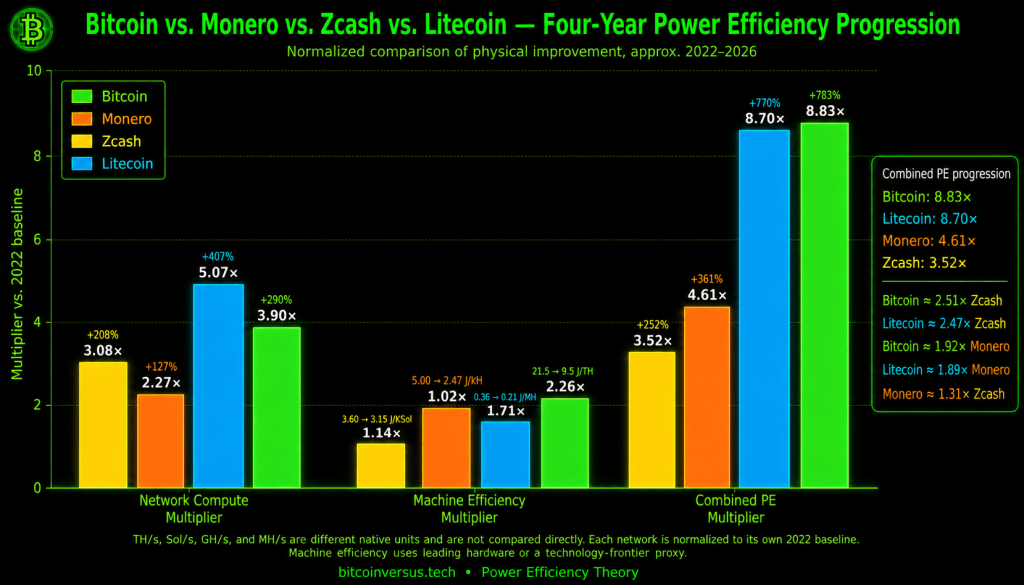
This illustrates how both expanding computational capacity and declining energy cost per unit of work combine to determine pound-for-pound physical progression.
Multiplying those factors produces approximately 8.87× compounded power-efficiency progression. Monero increased from roughly 2.75 GH/s in September 2022 to approximately 6.26 GH/s in September 2026, representing about 2.27× network growth.
Using a high-efficiency 2022 CPU reference of approximately 5.0 J/kH and the 2026 X9 rating of 2.47 J/kH produces another 2.02× improvement, resulting in approximately 4.61× compounded power-efficiency progression.
Using a high-efficiency 2022 CPU reference of approximately 5.0 J/kH and the 2026 X9 rating of 2.47 J/kH produces another 2.02× improvement, resulting in approximately 4.61× compounded power-efficiency progression.
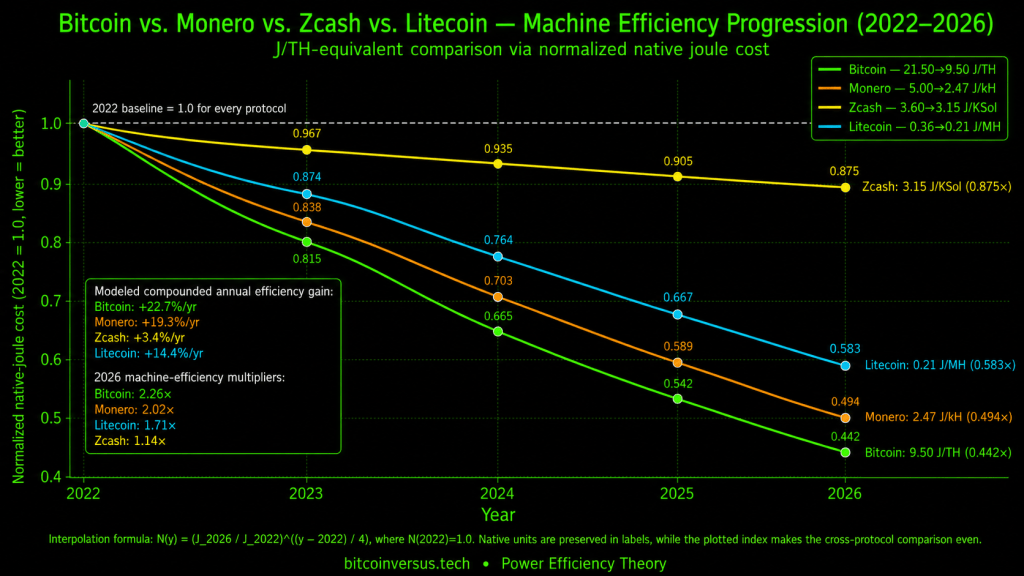
The Rate of Compute analysis isolates the hardware side of Power Efficiency Theory. Instead of treating J/TH, J/kH, J/MH and J/KSol as interchangeable, each network begins from its own normalized 2022 position and measures how far its energy requirement falls by 2026. Bitcoin reaches roughly 0.442× its original energy cost, Monero 0.494×, Litecoin 0.583×, and Zcash 0.875×, making Bitcoin the strongest machine-efficiency progression of the four, followed closely by Monero. The downward movement is the important visual: less energy per native unit of computation means greater Rate of Compute efficiency.
Under this framework, Bitcoin remains the stronger proof-of-work system in terms of compounded computational productivity over the period, advancing roughly 8.87× compared with approximately 4.61× for Monero.
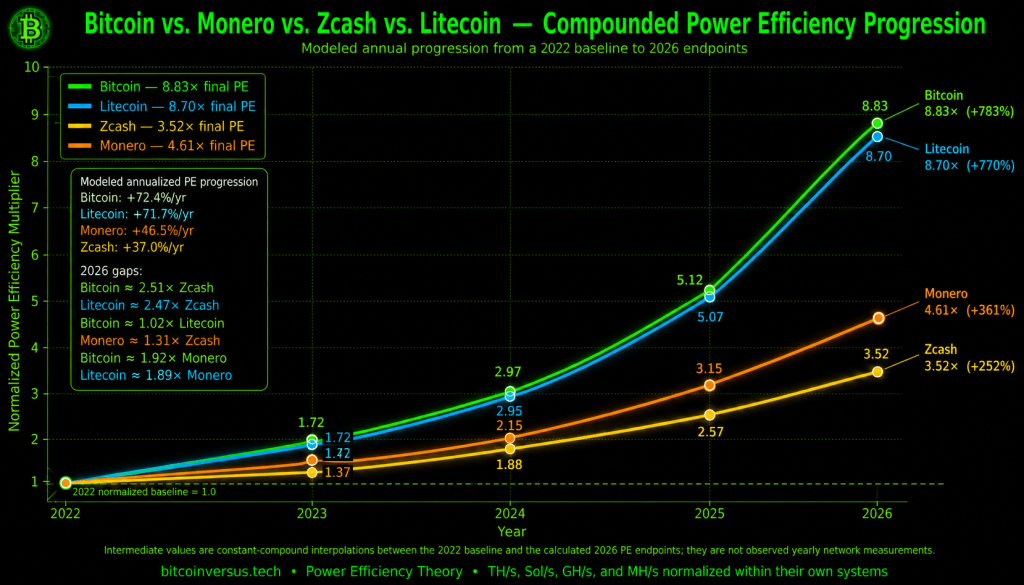
The Monero result is still notable because RandomX was specifically constructed to limit the enormous specialization gains normally associated with ASIC mining.
Bitcoin’s semiconductor ecosystem has therefore produced the larger combined improvement in network scale and machine efficiency, while Monero demonstrates that an ASIC-resistant network can still meaningfully increase the amount of cryptographic work produced per unit of energy.
Power Efficiency Theory does not claim that SHA-256 work and RandomX work are interchangeable; it measures how efficiently each system advances relative to its own physical starting point.
BitcoinVersus.Tech Editor’s Note:
We volunteer daily to ensure the credibility of the information on this platform is Verifiably True. If you would like to support to help further secure the integrity of our research initiatives, please donate here: 3C9o19EH5HSiwEPyCTmEKzxhNCbo2X6TTb
BitcoinVersus.tech is not a financial advisor. This media platform reports on financial subjects purely for informational purposes.


Leave a Reply