Using DASH’s 2022 physical price of $32.11 as the starting anchor produces a very different valuation trajectory from the one visible in today’s market.
DASH’s X11 network was operating around 5.24 PH/s in January 2022, compared with roughly 2.69 PH/s today, representing an approximately 49% contraction in rate of compute.
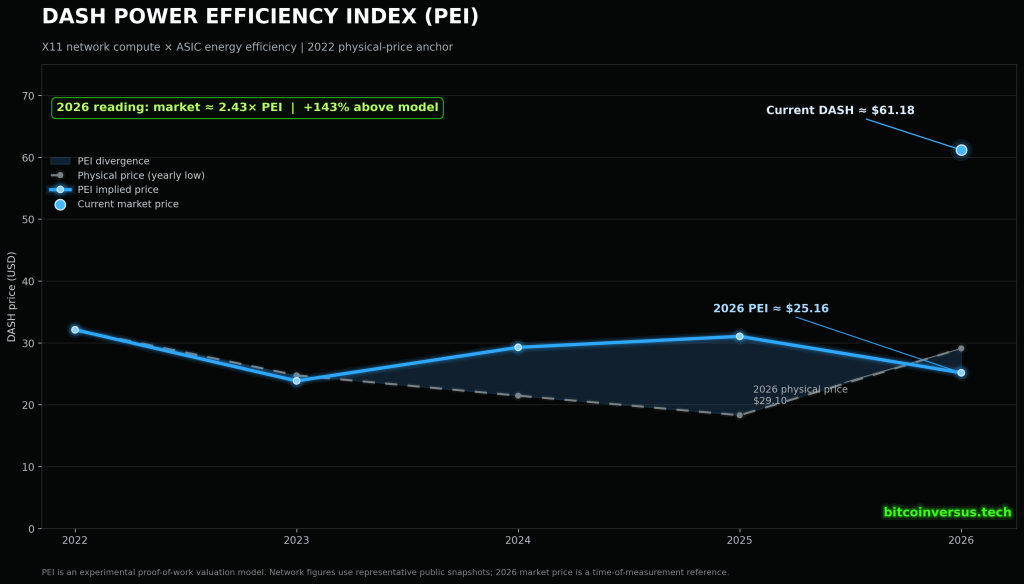
Meanwhile, DASH’s yearly physical prices fell from $32.11 in 2022 to $24.74 in 2023, $21.46 in 2024 and $18.29 in 2025 before recovering to a 2026 physical price near $29.10.
The hardware side tells the opposite story. The Antminer D7, available entering the 2022 measurement period, operated around 2.448 J/GH, while the newer Antminer D9 improved that figure to approximately 1.604 J/GH.
That represents roughly a 34% reduction in energy required per gigahash, or about 1.53× more compute per unit of energy.
But PEI measures 2 sides of the physical system: improving ASIC efficiency matters, yet that improvement has to be considered alongside the amount of computation actually being deployed across the network.
When those two rates are compounded, DASH reaches a 2026 power-efficiency multiplier of only about 0.78× its 2022 reference level. Applied to the $32.11 physical-price anchor, the model produces a 2026 PEI of approximately $25.16.
DASH was trading around $61 at the time of this measurement, putting market price about 2.43× the PEI estimate — roughly 143% above the model. PEI therefore suggests that DASH is currently meaningfully overvalued relative to its measured proof-of-work power-efficiency progression, even though its X11 mining hardware has become substantially more efficient.
What the Chart Is Saying
The unusual part of DASH is that machine efficiency improved while the network itself contracted. The D9 is considerably more efficient than the D7, but DASH has not converted those efficiency gains into sustained growth in total rate of compute. That suppresses the PEI trajectory.
The divergence becomes especially visible in 2026. DASH’s physical price is about $29.10, PEI sits near $25.16, and the market has recently traded around $61.
PEI does not claim that DASH must immediately trade at $25; it says that the present market valuation is substantially ahead of what the measured progression of X11 computation and energy efficiency alone would imply.
BitcoinVersus.Tech Editor’s Note:
We volunteer daily to ensure the credibility of the information on this platform is Verifiably True. If you would like to support to help further secure the integrity of our research initiatives, please donate here: 3C9o19EH5HSiwEPyCTmEKzxhNCbo2X6TTb
BitcoinVersus.tech is not a financial advisor. This media platform reports on financial subjects purely for informational purposes.
Disclaimer: The underlying inputs, calculations, and mathematical relationships used in the Power Efficiency Index are intended to be transparent and verifiable. The math is verifiable; the interpretation is experimental. PEI is a research framework, not a prediction of future price, guaranteed fair value, or financial advice. Actual market prices are influenced by many variables outside the model, including supply, demand, liquidity, regulation, adoption, speculation, and broader economic conditions.


Leave a Reply