
Zcash’s resurgence is interesting because it gives us a useful Proof-of-Work comparison outside of Bitcoin.
Over roughly the past four years, the Zcash network increased from about 8.2 GSol/s to 25.4 GSol/s, while leading Bitmain Equihash hardware improved from roughly 3.60 J/KSol to 3.15 J/KSol.
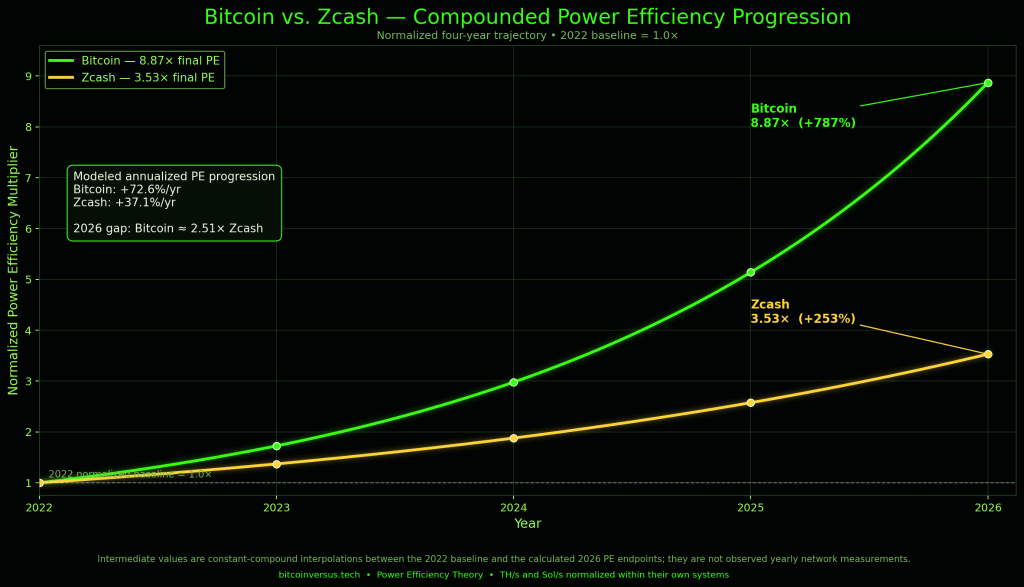
Under the Power Efficiency Theory framework, that produces an estimated 3.53× combined physical progression, or about +253%, once network growth and efficiency improvement are compounded.
ZEC’s price, however, increased nearly 13× over the same general period, which shows that market appreciation can move much faster than the physical system underneath it even when that system is genuinely becoming more capable and efficient.
Bitcoin produces a much stronger physical progression over the same approximate window. Network computation increased about 3.92×, while leading ASIC efficiency improved from roughly 21.5 J/TH to 9.5 J/TH, resulting in an estimated 8.87× combined Power Efficiency progression, or about +787%.
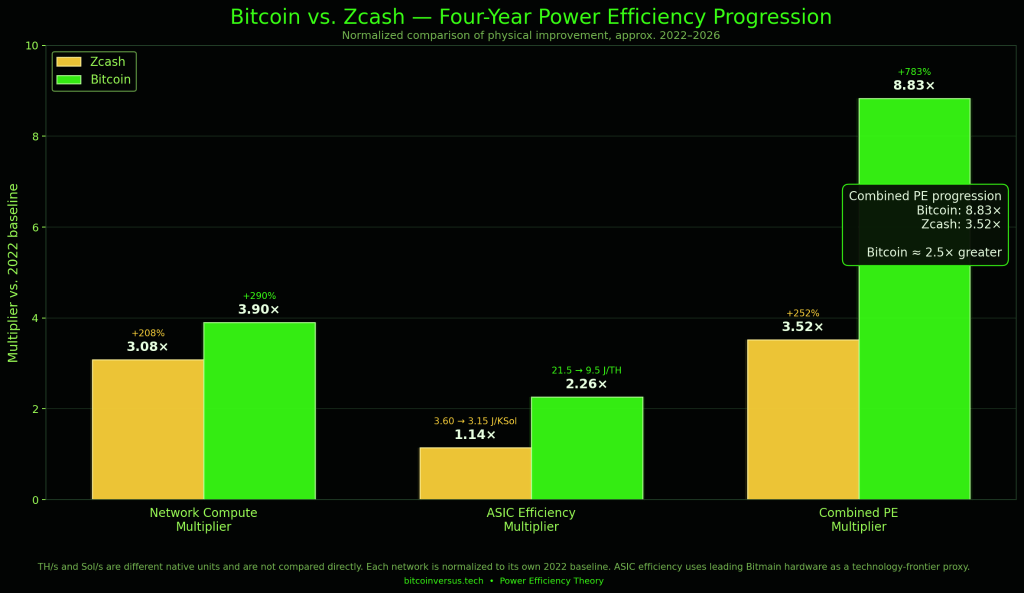
The bar chart breaks that comparison into its components — network computational growth, ASIC efficiency improvement and the final compounded PE multiplier — while the line chart shows how those normalized trajectories diverge over time from the same 2022 = 1.0× baseline.
TH/s and Sol/s are different forms of work and should never be compared directly, but their rates of physical improvement relative to their own systems can be compared, which is the purpose of the Power Efficiency framework.
The conclusion is not that Zcash is irrelevant or that another Proof-of-Work system cannot succeed.
Zcash may represent a legitimate secondary PoW system, just as Kaspa has during other periods, and the broader architecture remains reusable for other forms of validation and security where physical computation can impose a real-world cost on digital activity.
But if P represents increasing computational capability and E represents improving energy efficiency, Bitcoin has advanced substantially faster on both dimensions when they are compounded: approximately 8.87× versus 3.53×, or roughly 2.5 times the physical progression in this comparison.
That is the central Power Efficiency Theory argument: there can be a second-best Proof-of-Work system, but so far Bitcoin remains the more powerful and more rapidly improving implementation.
BitcoinVersus.Tech Editor’s Note:
We volunteer daily to ensure the credibility of the information on this platform is Verifiably True. If you would like to support to help further secure the integrity of our research initiatives, please donate here: 3C9o19EH5HSiwEPyCTmEKzxhNCbo2X6TTb
BitcoinVersus.tech is not a financial advisor. This media platform reports on financial subjects purely for informational purposes.


Leave a Reply