
The Power Efficiency Index (PEI) measures the relative indexed value of Bitcoin and other Proof-of-Work cryptocurrencies from a historical price baseline.
PEI begins with an asset’s yearly market low and compounds that value according to the progression of two underlying variables:
network computational power and mining-hardware energy efficiency, respectively.
In Bitcoin, for example, this can include the progression of total network hashrate and ASIC efficiency measured in joules per terahash (J/TH). The resulting PEI value can then be compared with the asset’s actual market price to measure whether price is trading above or below its efficiency-based index.
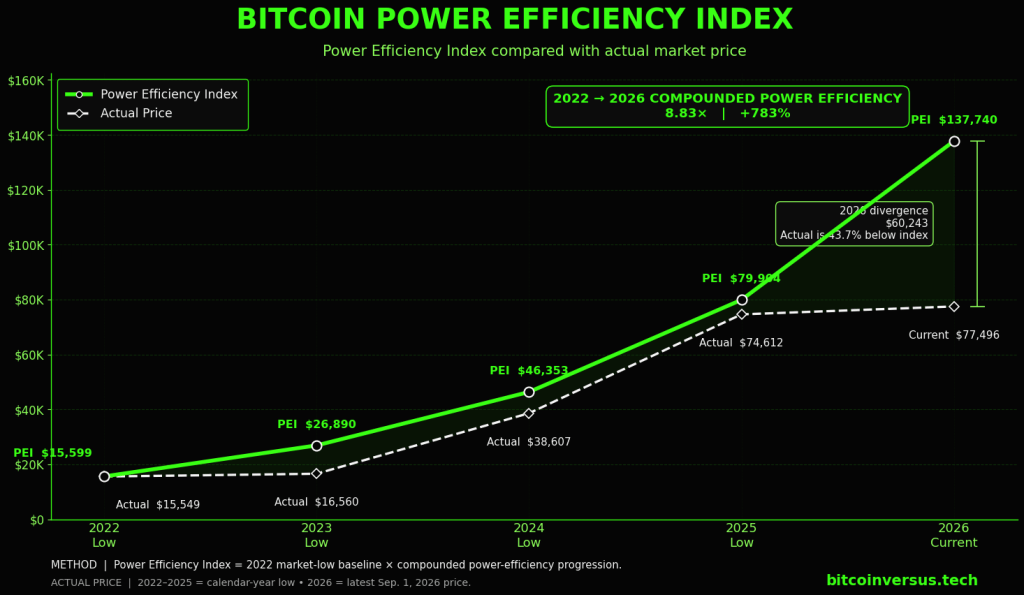
For example, if Bitcoin’s power efficiency improves by 8.83× from a 2022 baseline of about $15,599, the PEI produces an indexed value near $137,740.
If Bitcoin trades below that level, the model suggests it may be undervalued relative to the Power Efficiency Index.
PEI is not a guaranteed fair value or price prediction. It is an experimental model that isolates power efficiency in a vacuum, while real cryptocurrency prices are also affected by supply, demand, liquidity, regulation, speculation, adoption, and broader market conditions.
Bitcoin’s Power Efficiency Index (PEI) provides a way to compare Bitcoin’s market price with the long-term progression of the computational infrastructure securing its network.
Using Bitcoin’s approximately $15,599 market low in 2022 as the baseline, the index applies Bitcoin’s measured 8.83× compounded power-efficiency progression, equivalent to roughly +783%, through 2026.
Under that framework, Bitcoin reaches a 2026 Power Efficiency Index value of approximately $137,740, compared with a current market price near $77,500.
That difference is significant. Bitcoin is presently trading roughly 44% below its Power Efficiency Index value, meaning price has increased substantially since 2022 but has not kept pace with the efficiency progression represented by the index.
Within the boundaries of the model, that suggests Bitcoin may currently be undervalued relative to its computational and power-efficiency development.
The thesis is not that mining efficiency mechanically determines Bitcoin’s price. Rather, increasing computational productivity may represent an underlying form of network advancement that traditional price models do not directly measure.
The distinction is important because the Power Efficiency Index is virtual data calculated in a vacuum.
It intentionally isolates a narrow set of variables so their relationship can be studied.
Bitcoin’s actual market price is influenced by many additional forces, including supply and demand, monetary policy, liquidity, institutional adoption, regulation, leverage, speculation, miner economics, and broader economic conditions.
A PEI value of $137,740 therefore should not be interpreted as a guaranteed fair price, target price, or prediction that Bitcoin must return to that level.
Instead, the index establishes a benchmark.
If Bitcoin’s mining ecosystem can perform progressively more cryptographic computation for the same unit of energy while simultaneously expanding network-scale computational capacity, Power Efficiency Theory asks whether some portion of that technological progression should eventually be reflected in Bitcoin’s economic value.
The current gap between approximately $77,500 in market price and $137,740 in indexed value becomes something that can be observed over time rather than immediately treated as proof of mispricing.
That is the longer-term thesis behind the Power Efficiency Index. Over roughly the next seven years, the objective is to test whether Bitcoin’s price repeatedly converges toward, remains below, or moves independently of its efficiency-based index as mining hardware, network hashrate, energy consumption, and computational productivity continue evolving.
If a durable relationship develops, PEI could become useful as an additional valuation reference for proof-of-work networks.
If no meaningful relationship develops, the data will be equally important because it will help establish the limits of power efficiency as a Bitcoin valuation variable.
BitcoinVersus.Tech Editor’s Note:
We volunteer daily to ensure the credibility of the information on this platform is Verifiably True. If you would like to support to help further secure the integrity of our research initiatives, please donate here: 3C9o19EH5HSiwEPyCTmEKzxhNCbo2X6TTb
BitcoinVersus.tech is not a financial advisor. This media platform reports on financial subjects purely for informational purposes.
Disclaimer: The underlying inputs, calculations, and mathematical relationships used in the Power Efficiency Index are intended to be transparent and verifiable. The math is verifiable; the interpretation is experimental. PEI is a research framework, not a prediction of future price, guaranteed fair value, or financial advice. Actual market prices are influenced by many variables outside the model, including supply, demand, liquidity, regulation, adoption, speculation, and broader economic conditions.


Leave a Reply