Litecoin’s recent mining expansion becomes more significant when placed beside Bitcoin and Zcash under the same Power Efficiency Theory framework.
Rather than comparing the raw hashrates of three fundamentally different proof-of-work algorithms, the model normalizes each network to its own approximate 2022 baseline and measures two forms of physical improvement: growth in network computational output and improvement in leading ASIC Machine efficiency.
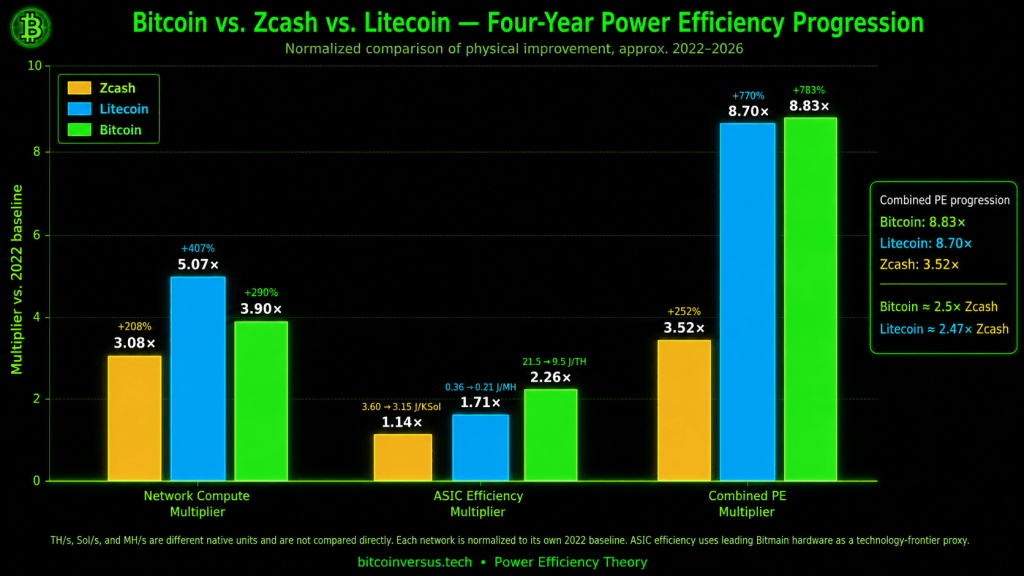
The result puts Litecoin surprisingly close to Bitcoin. From the normalized 2022 baseline, Bitcoin reaches an estimated 8.83× combined Power Efficiency multiplier by 2026, while Litecoin reaches approximately 8.70×.
Zcash, by comparison, reaches roughly 3.52×. Under this framework, Bitcoin’s measured progression is therefore about 2.51× greater than Zcash’s, while Litecoin’s is approximately 2.47× greater than Zcash’s. The difference between Bitcoin and Litecoin, however, is only about 1.02×.
That outcome comes from very different underlying paths.
Bitcoin’s network computational output increased by approximately 3.90×, while representative Bitmain SHA-256 ASIC efficiency improved from roughly 21.5 J/TH to 9.5 J/TH. That hardware improvement represents an efficiency multiplier of approximately 2.26×.
Compounding network growth with hardware improvement produces the modeled 8.83× Bitcoin Power Efficiency progression.
Litecoin arrives at almost the same endpoint through a different combination. Litecoin’s Scrypt network compute expanded by approximately 5.07×, considerably faster than Bitcoin’s normalized network growth over the comparison period.
Meanwhile, representative Scrypt ASIC efficiency improved from approximately 0.36 J/MH with the Antminer L7 generation to about 0.21 J/MH with the L9, producing an efficiency multiplier of roughly 1.71×.
Multiplying those components gives Litecoin an estimated:
5.07× network growth × 1.71× ASIC efficiency improvement ≈ 8.70× combined PE progression.
This is where the Bitcoin comparison becomes especially interesting.
Bitcoin experienced the stronger semiconductor-efficiency improvement, while Litecoin experienced the stronger increase in network computational capacity.
Under Power Efficiency Theory, the two effects nearly cancel one another out, producing remarkably similar normalized productivity endpoints.
Zcash follows a noticeably different trajectory. Its network solution rate increased by approximately 3.08×, while representative Equihash ASIC efficiency improved from around 3.60 J/KSol to 3.15 J/KSol, an improvement of only about 1.14×.
Together, those factors produce an estimated 3.52× combined Power Efficiency multiplier.
| Network | Network Compute | ASIC Efficiency | Combined PE |
|---|---|---|---|
| Bitcoin | 3.90× | 2.26× | 8.83× |
| Litecoin | 5.07× | 1.71× | 8.70× |
| Zcash | 3.08× | 1.14× | 3.52× |
The comparison does not mean Bitcoin performs more useful hashes than Litecoin or that Litecoin performs more computational work than Zcash in absolute terms.
Bitcoin uses SHA-256 and is measured in TH/s, Litecoin uses Scrypt and can be expressed in MH/s or GH/s, while Zcash uses Equihash and is commonly measured in Sol/s.
Those native units describe different cryptographic workloads and should not be compared directly.
Instead, each network is measured against itself.
A 1.0× baseline represents the approximate 2022 state of each system. The model then asks how much its computational capacity and leading hardware efficiency have changed relative to that starting point.
This makes the comparison one of technological progression, rather than raw hashrate.
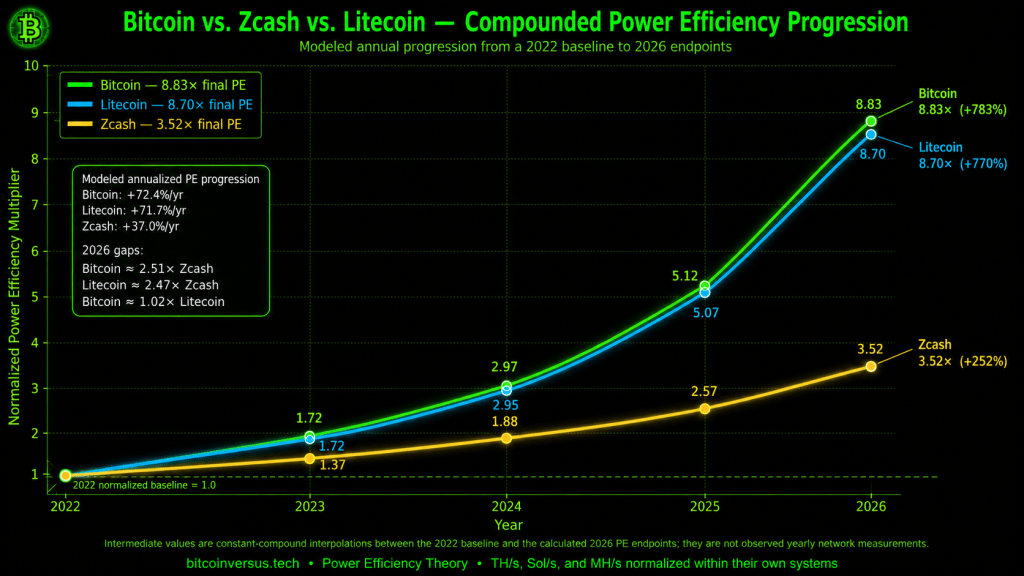
The modeled annual progression illustrates the difference clearly. Beginning at 1.0× in 2022, Bitcoin’s compounded trajectory reaches approximately 1.72× in 2023, 2.97× in 2024, 5.12× in 2025 and 8.83× in 2026.
Litecoin follows almost directly alongside it at approximately 1.72×, 2.95×, 5.07× and 8.70×. Zcash progresses more gradually to approximately 1.37×, 1.88×, 2.57× and 3.52×.
Those intermediate figures are constant-compound interpolations, not observed annual network measurements. Their purpose is to visualize the rate of physical progression between the normalized starting point and measured or estimated endpoints.
Litecoin also introduces another dimension that neither chart fully captures: merged mining with Dogecoin. Scrypt miners can use essentially the same proof-of-work computation to participate in securing both Litecoin and Dogecoin.
From a Power Efficiency Theory perspective, this potentially increases the utility generated from the underlying electrical and computational input without requiring an equivalent duplication of mining work.
That characteristic makes Litecoin particularly interesting.
Its ASIC efficiency gains have not been as aggressive as Bitcoin’s, but enormous network growth and merged-mining capability allow the Scrypt ecosystem to produce a comparable normalized increase in computational productivity.
The broader conclusion is that proof-of-work development cannot be understood from electricity consumption alone. Bitcoin, Litecoin and Zcash are all consuming energy to perform cryptographic computation, but the amount of computation obtainable from hardware is changing.
Bitcoin demonstrates what happens when network expansion and rapid semiconductor efficiency gains compound together.
Litecoin demonstrates how exceptionally strong network compute growth can compensate for more moderate ASIC efficiency gains. Zcash demonstrates meaningful improvement as well, although its hardware-efficiency frontier has advanced more slowly during the same period.
Under Power Efficiency Theory, the central measurement is therefore not simply how much electricity a network consumes.
It is how much cryptographic work the system becomes capable of producing from that energy as technology advances.
By that measure, the approximate 2022–2026 period produces a striking result: Bitcoin and Litecoin have followed different technological paths to almost the same 8.7–8.8× normalized computational-productivity improvement, while Zcash has achieved a still-significant 3.5× progression.
BitcoinVersus.Tech Editor’s Note:
We volunteer daily to ensure the credibility of the information on this platform is Verifiably True. If you would like to support to help further secure the integrity of our research initiatives, please donate here: 3C9o19EH5HSiwEPyCTmEKzxhNCbo2X6TTb
BitcoinVersus.tech is not a financial advisor. This media platform reports on financial subjects purely for informational purposes.


Leave a Reply