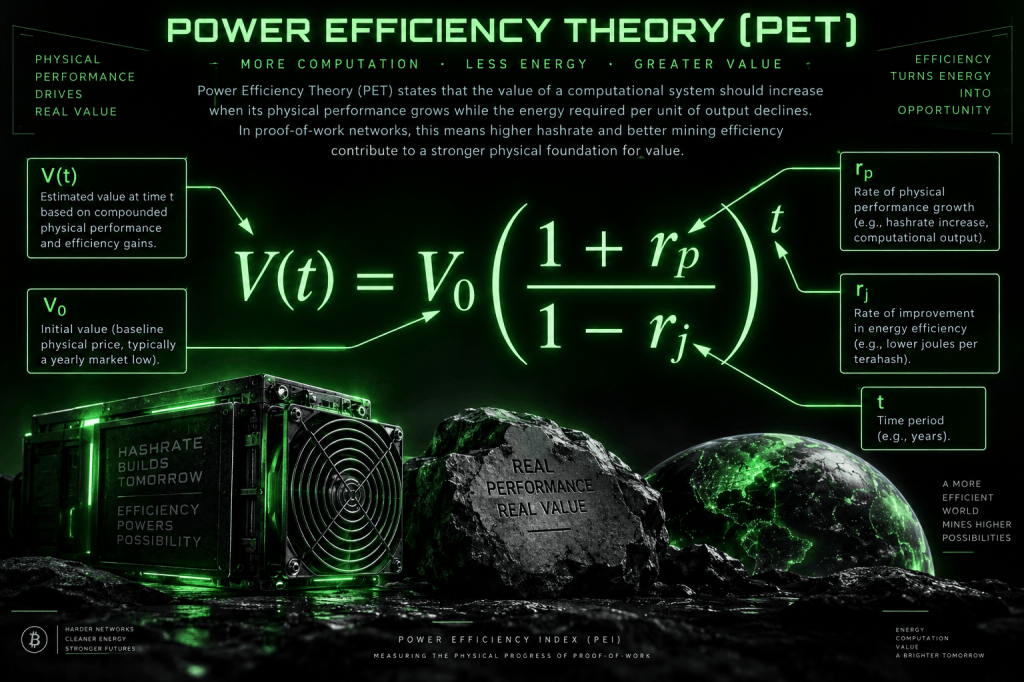
Power Efficiency Theory (PET) argues that the value of a physical or computational system should be influenced by two things improving at the same time: its performance increases and its energy cost per unit of output declines.
In proof-of-work networks, this can be measured through factors such as network hashrate, mining-machine output, and ASIC efficiency.
A network that can produce substantially more computation while requiring less energy for each unit of work has improved its physical capability, and PET treats that improvement as a measurable component of value rather than relying only on market sentiment or price history.
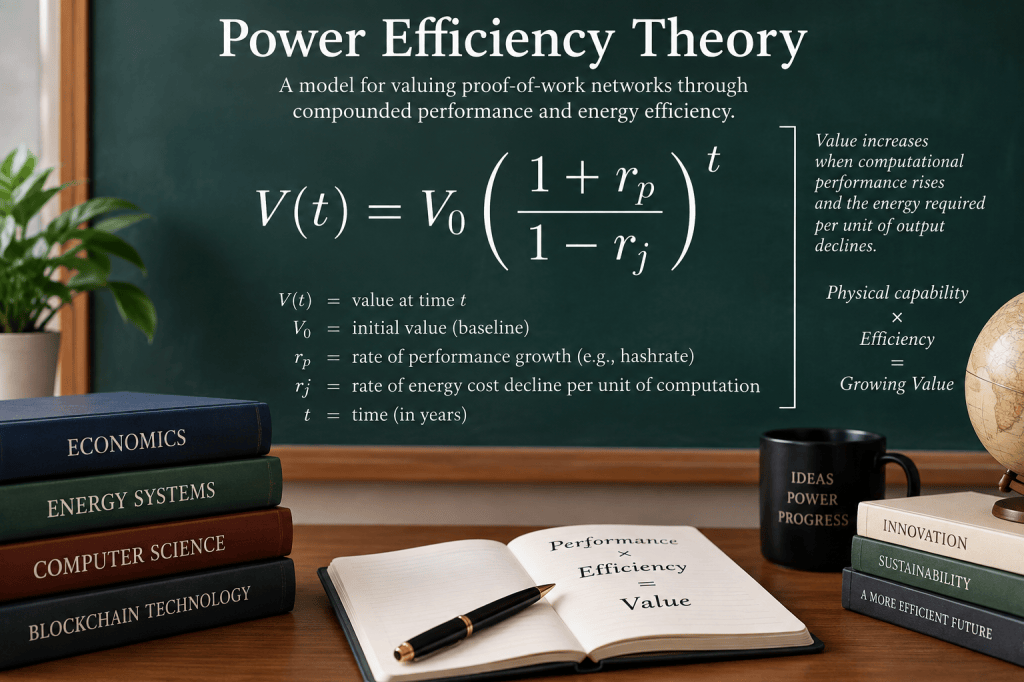
The Power Efficiency Index (PEI) is the practical interpretation layer built from PET. PEI begins with a proof-of-work asset’s physical price, meaning its calendar-year market low, and then compounds the network’s growth in computational capacity with the improvement in mining efficiency.
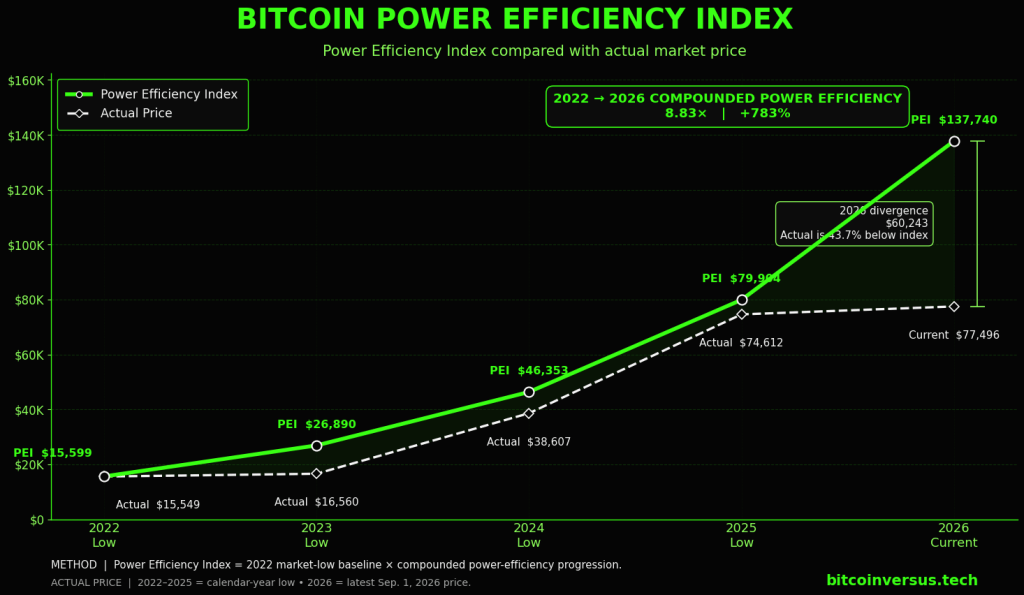
The result is a physical benchmark that can be compared against actual market price year by year. In simple terms, PEI asks whether the price of an asset has kept pace with the improvement of the mining infrastructure beneath it.
If the network becomes much more powerful and much more energy efficient while price remains relatively flat, PEI may indicate that the asset is trading below its physical progression.
PET is therefore the broader theory of value progression, while PEI is the measurement framework used to visualize and compare that progression across proof-of-work assets. PEI is not meant to prove an exact fair market price; it is better understood as a pound-for-pound physical benchmark showing how market value compares with compounded power-efficiency gains over time.
BitcoinVersus.Tech Editor’s Note:
We volunteer daily to ensure the credibility of the information on this platform is Verifiably True. If you would like to support to help further secure the integrity of our research initiatives, please donate here: 3C9o19EH5HSiwEPyCTmEKzxhNCbo2X6TTb
BitcoinVersus.tech is not a financial advisor. This media platform reports on financial subjects purely for informational purposes.
Disclaimer: The underlying inputs, calculations, and mathematical relationships used in the Power Efficiency Index are intended to be transparent and verifiable. The math is verifiable; the interpretation is experimental. PEI is a research framework, not a prediction of future price, guaranteed fair value, or financial advice. Actual market prices are influenced by many variables outside the model, including supply, demand, liquidity, regulation, adoption, speculation, and broader economic conditions.


Leave a Reply