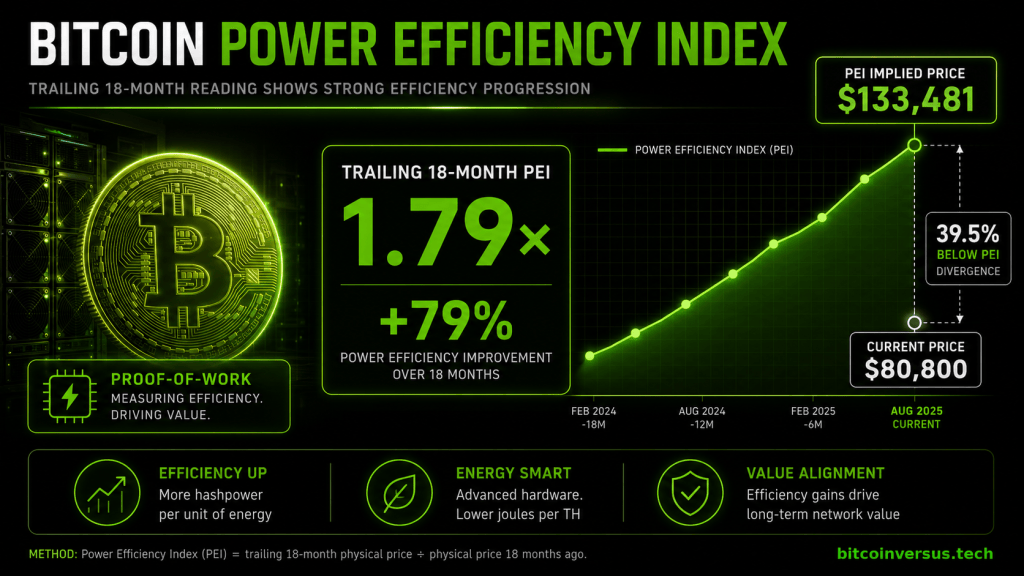
The Power Efficiency Index (PEI) is a proof-of-work measurement derived from Power Efficiency Theory.
The theory states that the physical value of a proof-of-work network is influenced by two measurable variables: the rate of compute produced by the network and the rate of energy efficiency required to produce that computation.
When network compute increases while the energy required per unit of work declines, PEI records the combined change as a compounded power-efficiency progression.
For Bitcoin, the measurement begins from a prior physical price, meaning the actual market low used for the period being analyzed.
The subsequent change in network compute and mining efficiency is then applied to that physical price to produce a PEI-implied price, sometimes described as a power-efficiency price.
This does not represent a guaranteed future market price. It is a comparative valuation measure showing how far Bitcoin’s market price has progressed relative to the measurable physical improvement of the proof-of-work network.
Over the latest roughly 18-month period, Bitcoin’s compounded power-efficiency progression increased by approximately 1.79×, or 79%.
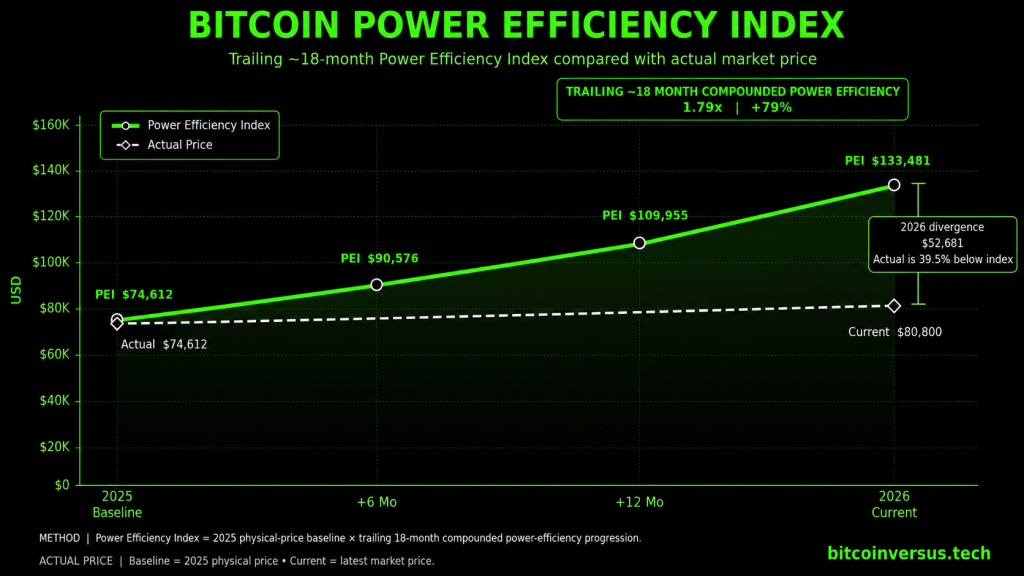
Applied to the 2025 physical price of $74,612, the current PEI-implied price is approximately $133,481. With Bitcoin trading near $80,800, the market price is roughly 39.5% below the PEI reading, creating a divergence of approximately $52,681.
The increase reflects simultaneous improvement in the physical performance of the network.
Bitcoin’s rate of compute increased over the measurement period, while mining hardware became more energy efficient, reducing the amount of energy required to produce each unit of cryptographic work.
PEI combines those changes into a single compounded progression so that the movement of the underlying proof-of-work system can be compared directly with market price.
The current reading therefore shows that Bitcoin’s physical progression has advanced faster than its market price during the same period.
The size of the divergence is the most important analytical feature of the chart. If compute and energy efficiency continue improving faster than price, the gap would widen.
If market price begins to advance faster than the physical variables, the spread would narrow. At the present reading, Bitcoin remains materially below the price implied by its trailing power-efficiency progression.
BitcoinVersus.Tech Editor’s Note:
We volunteer daily to ensure the credibility of the information on this platform is Verifiably True. If you would like to support to help further secure the integrity of our research initiatives, please donate here: 3C9o19EH5HSiwEPyCTmEKzxhNCbo2X6TTb
BitcoinVersus.tech is not a financial advisor. This media platform reports on financial subjects purely for informational purposes.
Disclaimer: The underlying inputs, calculations, and mathematical relationships used in the Power Efficiency Index are intended to be transparent and verifiable. The math is verifiable; the interpretation is experimental. PEI is a research framework, not a prediction of future price, guaranteed fair value, or financial advice. Actual market prices are influenced by many variables outside the model, including supply, demand, liquidity, regulation, adoption, speculation, and broader economic conditions.


Leave a Reply