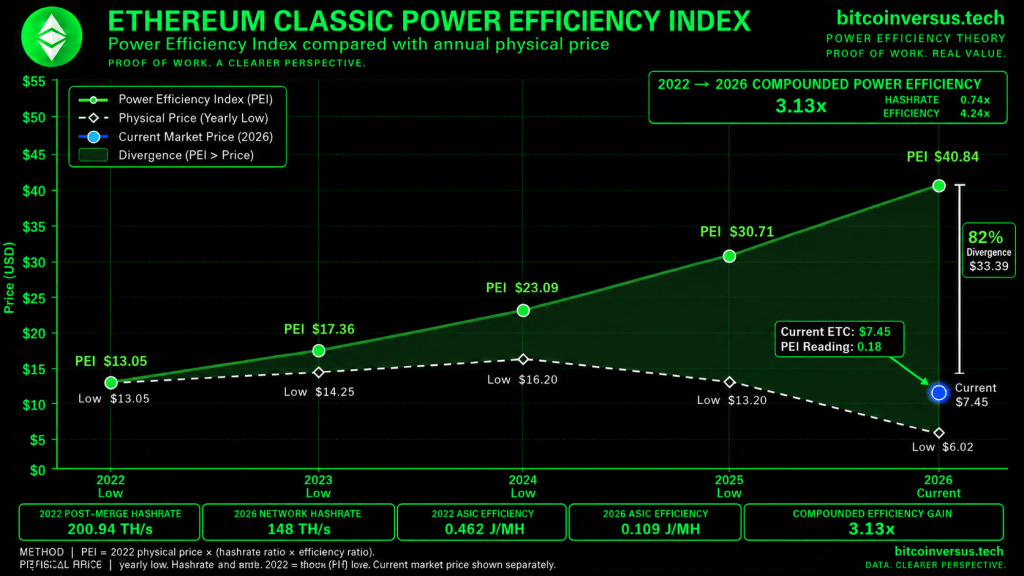
Ethereum Classic presents one of the more unusual Power Efficiency Index (PEI) profiles among major proof-of-work networks.
Over the four-year window, ETC’s rate of compute has not expanded in a straight line.
In fact, network hashrate remains below the extraordinary post-Merge surge seen in 2022.
At the same time, EtHash mining hardware has become dramatically more energy efficient. That combination matters because PEI does not look at hashrate alone; it measures how changes in compute and energy efficiency compound together over time.
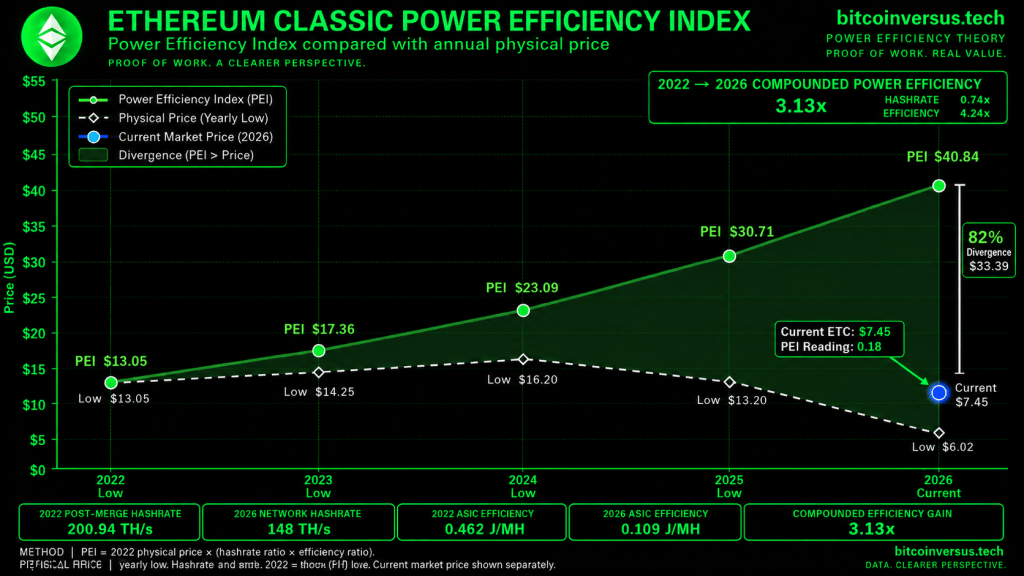
Across the four-year period, Ethereum Classic’s rate of compute is roughly 26% lower than the selected 2022 post-Merge reference point, while leading EtHash ASIC efficiency has improved by more than 4×.
When those two measurements are compounded, ETC produces roughly 3.1× power-efficiency progression, or about +212%. That is a strong result despite the weaker hashrate picture.
In other words, Ethereum Classic is not advancing primarily because the network is throwing more raw compute at the chain; it is advancing because the machines producing that compute have become far more efficient.
The 18-month window tells a different story. By early 2025, a large portion of the major efficiency gains had already occurred, so the move from then to 2026 is considerably smaller.
That makes the shorter PEI reading more moderate and suggests the rate of physical improvement may be slowing compared with the much larger four-year jump.
This contrast is important: the long-term picture shows major structural efficiency advancement, while the shorter-term picture begins to test whether that advantage is still accelerating or starting to mature.
Based on those measurements, PEI suggests Ethereum Classic may be materially undervalued relative to its underlying physical progression.
The network is processing less aggregate compute than it did during the 2022 post-Merge spike, but it can now produce each unit of that compute far more efficiently.
That creates a sizable divergence between measurable power-efficiency advancement and market valuation. The conclusion is not that ETC must immediately reprice, but that the numbers support the view that its physical development has moved further than the market appears to recognize.
The Ethereum Classic case is therefore less about explosive hashrate growth and more about efficiency-driven value progression.
If future 6-, 12-, 18-, 24-, and 48-month readings continue to show the same type of divergence, the argument becomes stronger that PEI is capturing something persistent rather than a one-period anomaly.
For now, the four-year data makes a compelling case: Ethereum Classic has become substantially more efficient as a proof-of-work system, and PEI suggests its valuation may still be lagging behind that physical improvement.
BitcoinVersus.Tech Editor’s Note:
We volunteer daily to ensure the credibility of the information on this platform is Verifiably True. If you would like to support to help further secure the integrity of our research initiatives, please donate here: 3C9o19EH5HSiwEPyCTmEKzxhNCbo2X6TTb
BitcoinVersus.tech is not a financial advisor. This media platform reports on financial subjects purely for informational purposes.
Disclaimer: The underlying inputs, calculations, and mathematical relationships used in the Power Efficiency Index are intended to be transparent and verifiable. The math is verifiable; the interpretation is experimental. PEI is a research framework, not a prediction of future price, guaranteed fair value, or financial advice. Actual market prices are influenced by many variables outside the model, including supply, demand, liquidity, regulation, adoption, speculation, and broader economic conditions.


Leave a Reply