Zcash has experienced a sharp separation between its Power Efficiency Index (PEI) and its actual market price in 2026.
Using Zcash’s 2022 physical low of $33.83 as the baseline, the PEI applies the network’s compounded power-efficiency progression to estimate how its “digital-physical” value has changed over time.
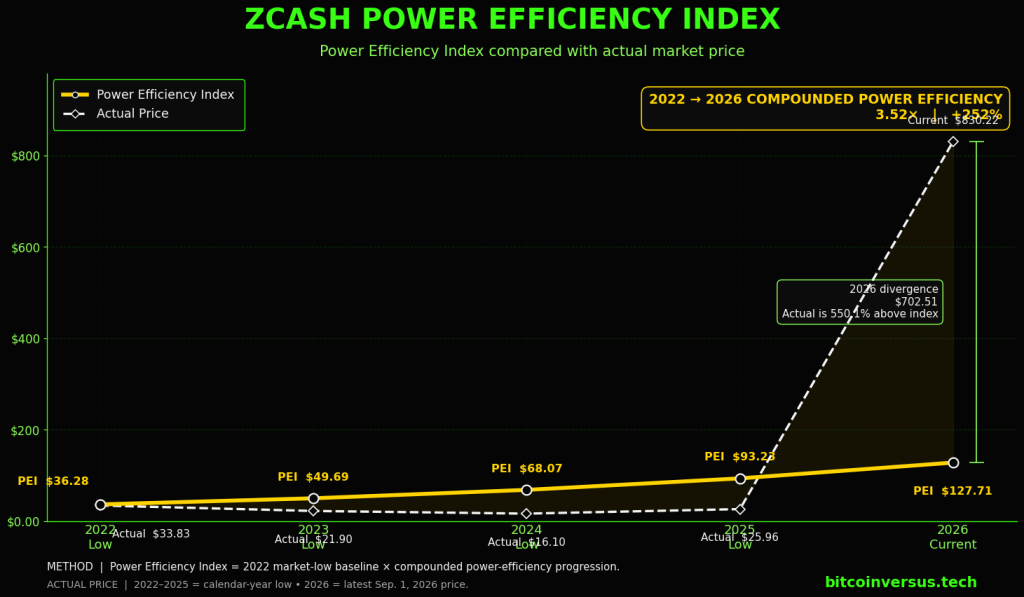
From 2022 through 2026, Zcash recorded approximately 3.52× compounded power-efficiency progression, or +252%, placing its 2026 PEI at approximately $127.71.
The progression is relatively steady. Zcash’s PEI rises from $36.28 in 2022 to $49.69 in 2023, $68.07 in 2024, $93.23 in 2025, and finally $127.71 in 2026.
This represents the value implied by Zcash’s underlying improvement in computational capacity and energy efficiency rather than by market demand alone. In Power Efficiency Theory, the comparison is essentially pound for pound: how much has the network’s physical computational capability improved relative to the amount of energy required to produce that computation?
Zcash’s market price has moved much faster. After annual lows of $33.83 in 2022, $21.90 in 2023, $16.10 in 2024, and $25.96 in 2025, ZEC reached approximately $830.22 in September 2026.
Against a PEI value of $127.71, the market price is approximately $702.51 higher, or roughly 550% above the index. Under this framework, Zcash is therefore trading significantly above the value implied by its compounded physical power-efficiency progression.
That does not mean Zcash must fall to $127.71. PEI is not designed to reproduce short-term market pricing or account for speculation, liquidity, adoption, monetary narratives, regulation, or investor demand.
Instead, it provides a physical benchmark derived from the network itself. In Zcash’s case, the 2026 data shows one of the clearest examples of market price outrunning underlying power-efficiency progression: the network improved roughly 3.52×, while ZEC’s market valuation expanded far more aggressively.
BitcoinVersus.Tech Editor’s Note:
We volunteer daily to ensure the credibility of the information on this platform is Verifiably True. If you would like to support to help further secure the integrity of our research initiatives, please donate here: 3C9o19EH5HSiwEPyCTmEKzxhNCbo2X6TTb
BitcoinVersus.tech is not a financial advisor. This media platform reports on financial subjects purely for informational purposes.
Disclaimer: The underlying inputs, calculations, and mathematical relationships used in the Power Efficiency Index are intended to be transparent and verifiable. The math is verifiable; the interpretation is experimental. PEI is a research framework, not a prediction of future price, guaranteed fair value, or financial advice. Actual market prices are influenced by many variables outside the model, including supply, demand, liquidity, regulation, adoption, speculation, and broader economic conditions.


Leave a Reply