Litecoin’s Power Efficiency Index (PEI) currently presents one of the largest gaps between efficiency-based indexed value and actual market price among the Proof-of-Work networks we have examined.
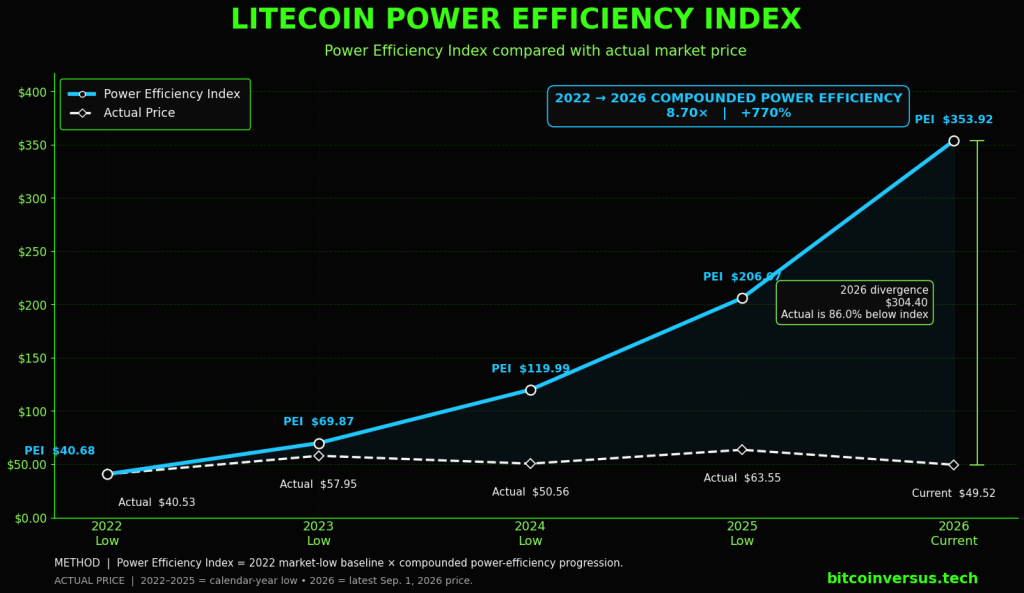
The model begins from Litecoin’s 2022 physical low—roughly $40.5–$40.7—and compounds that baseline according to Litecoin’s measured progression in network power and mining efficiency.
From 2022 through 2026, that progression reaches approximately 8.70×, or +770%, producing a 2026 Power Efficiency Index value of about $353.92.
That indexed progression looks very different from Litecoin’s actual price history. CoinLore records Litecoin trading between approximately $40.53 and $153.14 in 2022, $57.95 and $114.52 in 2023, $50.56 and $146.62 in 2024, and $63.55 and $140.61 in 2025.
So far in 2026, Litecoin has traded between approximately $39.39 and $84.79, with the market recently around $49.
Those yearly highs are important because they show that even Litecoin’s strongest market prices since the 2022 baseline have remained well below the $353.92 PEI level.
Litecoin price range vs. Power Efficiency Index
| Year | Actual yearly low | Actual yearly high | PEI value |
|---|---|---|---|
| 2022 | ~$40.53 | ~$153.14 | $40.68 |
| 2023 | ~$57.95 | ~$114.52 | $69.87 |
| 2024 | ~$50.56 | ~$146.62 | $119.99 |
| 2025 | ~$63.55 | ~$140.61 | $206.07 |
| 2026 | ~$39.39 YTD | ~$84.79 YTD | $353.92 |
Annual market ranges are from CoinLore; 2026 figures are year-to-date.
Within Power Efficiency Theory, the comparison works like the car analogy: power is similar to MPH, while efficiency is similar to MPG.
If a system becomes substantially more powerful while also becoming substantially more efficient, its underlying productive capability has changed. PEI asks whether the value assigned to that system has progressed at a comparable rate.
Litecoin’s network-and-efficiency progression produces an 8.70× indexed increase, yet its actual price has failed even to retest its 2022 yearly high of roughly $153, much less approach the 2026 PEI value near $354.
Taken strictly within the model, Litecoin appears significantly undervalued relative to its Power Efficiency Index.
At a market price near $49, LTC trades roughly 86% below its indexed 2026 value. More importantly, even Litecoin’s 2026 yearly high of $84.79 remains about 76% below the PEI level.
That strengthens the observation that the divergence is not simply the product of comparing PEI with a temporary market low; Litecoin’s entire recent trading range remains materially below the efficiency-based index.
That does not prove Litecoin should trade at $353.92. PEI is intentionally virtual data calculated in a vacuum: it isolates the progression of power and efficiency while real market prices are influenced by adoption, liquidity, demand, competition, monetary policy, speculation, regulation, and broader crypto-market conditions.
4The Litecoin case may ultimately show that mining efficiency is an underrecognized component of Proof-of-Work value—or it may show that efficiency improvements alone are insufficient to generate market demand.
BitcoinVersus.Tech Editor’s Note:
We volunteer daily to ensure the credibility of the information on this platform is Verifiably True. If you would like to support to help further secure the integrity of our research initiatives, please donate here: 3C9o19EH5HSiwEPyCTmEKzxhNCbo2X6TTb
BitcoinVersus.tech is not a financial advisor. This media platform reports on financial subjects purely for informational purposes.
Disclaimer: The underlying inputs, calculations, and mathematical relationships used in the Power Efficiency Index are intended to be transparent and verifiable. The math is verifiable; the interpretation is experimental. PEI is a research framework, not a prediction of future price, guaranteed fair value, or financial advice. Actual market prices are influenced by many variables outside the model, including supply, demand, liquidity, regulation, adoption, speculation, and broader economic conditions.


Leave a Reply