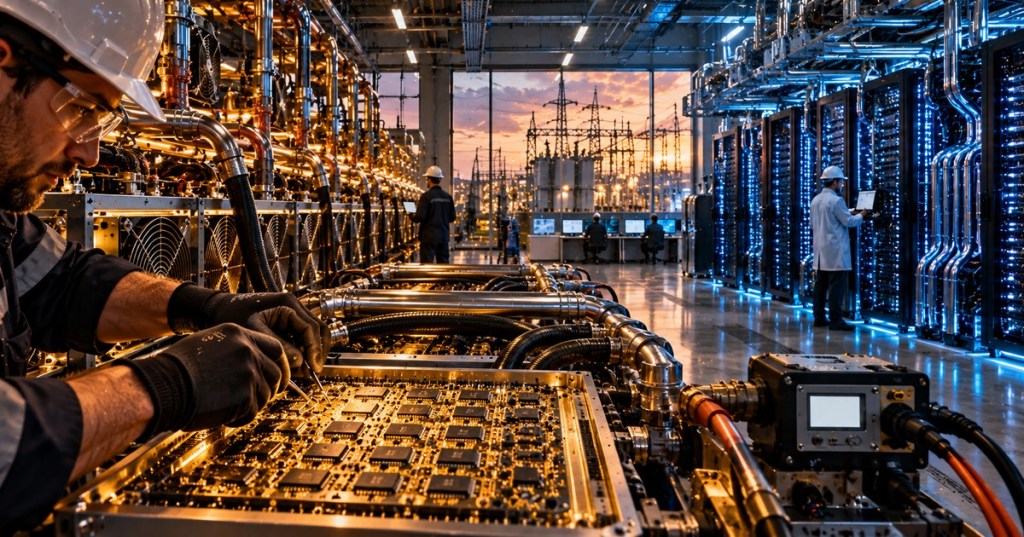
What does one joule of electricity buy in the world of computing? A Bitcoin mining machine and the world’s fastest supercomputer may look like very different technologies, but both obey the same physical constraint: achieving useful computational results requires time, electronic switching, power delivery and heat removal. The question is not whether a FLOP equals a cryptographic hash. It does not. The more interesting question is how processing activity per second and work completed per joule progress as the hardware improves.
This is the deeper premise behind BitcoinVersus.Tech’s long-running Power Efficiency Theory research and its proposed Bitcoin Mining Singularity: raw computing performance is one dimension of technological progress, while the energy needed to perform that work is another. We can study both dimensions across supercomputing, AI and Bitcoin mining without pretending their workloads or benchmark units are interchangeable. The inspiration comes from an editorial clarification about comparing one ASIC miner with one supercomputer. What follows is a new engineering investigation, not a second 51% attack report.
The fundamental question: how fast does a machine actually compute?
Every processor has some physical way of organizing computation: clocked logic, pipelines, arithmetic units, parallel execution lanes, memory systems or specialized circuits. Clock frequency describes how often a synchronous clock ticks; it is not the number of completed instructions or useful tasks. One processor may retire multiple instructions in one tick, another may wait many ticks on memory, and a fully pipelined ASIC can have many independent hash attempts in flight at the same time.
The June 2026 TOP500 reports 13,789,440 cores for China’s LineShine supercomputer, built around 1.55 GHz processors. Multiplying the published nominal cores by clock frequency yields roughly 21.37 quadrillion aggregate core-clock ticks per second if all those cores run at that frequency. This number describes an illustrative summed clock cadence, not floating-point operations or individual transistor transitions. LineShine’s measured High Performance LINPACK result is separately 2.198 exaFLOP/s. Neither number tells us how quickly it would execute Bitcoin’s double-SHA-256 algorithm.
A Bitcoin ASIC takes the opposite design approach: it gives up general-purpose flexibility to dedicate circuitry to SHA-256 work. A miner rated at 1.35 PH/s completes roughly 1.35 quadrillion reported hash attempts per second, but that does not mean its silicon runs at 1.35 petahertz or that one hash takes one clock tick. The chip clock, number of parallel hashing engines and pipeline stages are separate architectural facts. This is why “compute cycles per second” is a useful starting question, but not an accepted universal comparison metric.
One machine against one machine: the original comparison
The correct scale for the headline experiment is one supercomputer installation versus one individual ASIC mining unit, not LineShine versus the combined Bitcoin network. The table below uses the TOP500’s audited HPL performance for LineShine, a reseller-listed WhatsMiner M79S configuration and the manufacturer’s ANTMINER S23 XP Hyd. rating. The M79S 1.35 PH/s at 20 kW description is widely listed by resellers but has not been established here as an independently measured, MicroBT-issued factory benchmark. The S23 XP Hyd.’s 8.9 J/TH is also a manufacturer specification, not fleet-wide field data.
| One physical system | Published work rate | Electrical draw | Work-per-watt metric |
|---|---|---|---|
| LineShine supercomputer installation | 2.198 EFLOP/s, HPL | 42.22 MW | 52.07 GFLOP/s per W (HPL) |
| WhatsMiner M79S, third-party listing | 1.35 PH/s, SHA-256 | 20 kW | 14.815 J/TH, or about 67.5 GH per joule |
| ANTMINER S23 XP Hyd., manufacturer rating | 600 TH/s, SHA-256 | 5.34 kW | 8.9 J/TH, or about 112.36 GH per joule |
LineShine’s 2.198 exaFLOP/s and 1.35 PH/s differ by a numerical factor of approximately 1,628 after stripping off their units—but that quotient is not a valid “1,628 times more computing power” result. It divides floating-point operations by SHA-256 hashes, each of which involves a different collection of logical work. The relevant efficiency figures also have incompatible denominators: LineShine achieves roughly 52.07 billion HPL FLOPs per second per watt, while the S23 XP Hyd. is rated at about 112.36 billion mining hashes per joule. Different tasks, different energy costs. Neither system has an established superiority over the other in the other’s workload.
The video also makes the physical scale visible: a TOP500 “machine” is an enormous coordinated installation of processor nodes and supporting facilities. A hydro-cooled ASIC miner is typically one chassis connected to external pumps and heat rejection. Calling both one machine creates an interesting thought experiment; it does not equalize their mass, floor area, cost, cooling boundaries, power or parallelism.
The measurement that matters: useful work per joule
For Bitcoin mining, joules per terahash (J/TH) can be calculated from the unit’s input watts divided by its delivered terahashes per second. The units simplify correctly because a watt is one joule per second: J/TH = W ÷ (TH/s). Thus 1 J/TH means one joule per trillion mining hashes. A hypothetical miner at that efficiency could sustain 1 TH/s for each watt of miner input power. It does not mean one joule somehow produces a terahash per second without an explicit power-and-time boundary.
A manufacturer-rated 8.9 J/TH miner consumes 8.9 joules to complete a trillion reported hashes, equivalent to approximately 8.9 picojoules per hash attempt. At the proposed 1 J/TH milestone, the same convention becomes 1 picojoule per attempt. For comparison, LineShine’s reported 42.22 MW and 2.198 EFLOP/s imply roughly 19.2 picojoules per HPL FLOP when averaged across that system-level benchmark. These pic joule figures are not interchangeable work units: a FLOP, a double-SHA-256 attempt and a clock tick represent different physical activity.
| Illustrative miner efficiency | Equivalent energy per SHA-256 hash attempt | Hashes per second from 1 MW of miner power |
|---|---|---|
| 17.5 J/TH | 17.5 pJ | 57.14 PH/s |
| 9.5 J/TH | 9.5 pJ | 105.26 PH/s |
| 8.9 J/TH | 8.9 pJ | 112.36 PH/s |
| 1.0 J/TH (hypothetical milestone) | 1.0 pJ | 1,000 PH/s = 1 EH/s |
The fixed-power implication is substantial. At the 8.9 J/TH reference, 1 MW of miner power would sustain about 112.36 PH/s. At 1 J/TH, the same megawatt would theoretically sustain 1 EH/s, almost 8.9 times as much SHA-256 throughput. At a constant 10 MW, the corresponding illustration is approximately 1.12 EH/s versus 10 EH/s. These are engineering scenarios—not a promise that a 1 J/TH miner exists or that the power system needed to support it would be free.
Bitcoin mining’s silicon race is already measurable
The 2024–2026 ASIC record shows how researchers must distinguish chip tests, production-machine ratings and operating-site measurements. Bitdeer’s SEALMINER roadmap lists SEAL01 at 18.1 J/TH, SEAL02 at 13.5 J/TH and SEAL03 at 9.7 J/TH at chip level, followed by a 6–7 J/TH SEAL04 low-voltage chip result. But its A4 Ultra Hydro complete machine is rated at 9.45 J/TH (886 TH/s, 8,372.7 W), not 6–7 J/TH. The integrated miner includes many losses absent from a low-voltage chip test.
On the BITMAIN side, the S23 Hyd. 9.5-to-S23 XP Hyd. 8.9 J/TH comparison represents about 6.32% less energy per terahash in the published specifications. The separate improvement in productive hashes per joule is approximately 6.74%. Neither percentage establishes a verified industry-wide rate because these are different models and manufacturer conditions. The reported SEAL04 chip milestone is useful evidence of research progress, but comparing its 6.5 J/TH midpoint directly with a wall-rated 8.9 J/TH miner would cross measurement boundaries.
That boundary is why our ASIC J/TH versus site J/TH investigation remains essential. Transformers, pumps, heat exchangers, dry coolers, network devices, firmware and uptime influence how much verified SHA-256 work a utility-delivered megawatt actually supports. Even better silicon may produce less practical benefit than advertised if the surrounding facility wastes power or cannot keep the chips at their rated operating point.
Where the Bitcoin Mining Singularity idea came from
This work did not begin with a supercomputer headline. BitcoinVersus.Tech’s early 2023 Bitcoin-versus-singularity essay explored exponential technological change. The May 2025 original Mining Singularity thesis proposed 1 J/TH as a quantitative Bitcoin ASIC milestone; the subsequent June 2025 dissertation extended that idea to the growth of individual-machine hashrate and long-term semiconductor efficiency. Its early target dates were exploratory projections, not measured physical deadlines.
The research then confronted the physical limits of the concept in a 2025 discussion of Landauer’s principle and began separating physical inputs from valuation hypotheses in Power Efficiency Theory’s physical-cost framework. A March 2026 methodological clarification argued that individual-machine performance can be more precisely observed than the entire network’s changing machine inventory and power bill. That distinction now provides the foundation for comparing individual computing systems honestly.
The October research added a machine-weight and computational-density analysis: more computing throughput does not automatically mean a miner becomes lighter or smaller. Higher throughput per kilogram, terahashes per liter, hashes per watt and absolute hashrate are separate observables that should not be silently substituted for each other.
The following original BitcoinVersus research post discusses the importance of computational density and provides context for measuring more work in a fixed physical envelope. It is commentary on the developing theory, not an independent verification of a projected technology milestone.
That original discussion complements the site’s earlier 10 PH/s individual-miner scenario. Future chassis power, electrical service, rack volume, chip count and heat rejection may constrain how fast a single named mining unit can grow, even when its joules per terahash continue to fall.
2033, 2046 or 2052? Three different mathematical paths
With an 8.9 J/TH starting reference in 2026, a simple constant annual reduction model is E(y) = 8.9 × (1 − r)y−2026. A fall to 1 J/TH by 2033 requires about 26.82% annual reduction for seven consecutive years. Arriving by 2046 requires about 10.35% annual reduction over 20 years. A fixed 8.3% reduction—derived as a scenario from 9.5 to 8.9 J/TH over roughly nine months—reaches around 1.57 J/TH in 2046 and crosses 1 J/TH around 2052. These rates are not interchangeable, and none has been measured as a durable long-run industry trend.
The 2046 analysis therefore models slight acceleration from an 8.3% starting rate, rather than falsely asserting that fixed 8.3% produces a 2046 threshold. Our architecture investigation also considers decelerating returns, semiconductor limits and improvements in power delivery. The 2033 chip-test scenario uses a more aggressive annual assumption derived from numbers measured at different chip-versus-machine boundaries, so it is a mathematical stress test, not a verified forecast. A scientific milestone must move as independent field measurements arrive.
The original October 16 research statement below proposed an 8.3% annual efficiency improvement floor as a hypothesis. In the actual models, 8.3% is an assumed scenario parameter, not a physical minimum guaranteed by transistors, ASIC design or markets. This matters because a more-than-20-year forecast is exceptionally sensitive to whether improvement accelerates, remains constant or decays.
Comparative computer science provides context, not a shortcut. A 2025 peer-reviewed reassessment of Koomey’s Law observed continued improvement in high-performance-computing energy efficiency across 2008–2023, with a doubling time near 2.29 years, slower than the earlier 1.57-year estimate. A general observation about FLOP-per-watt growth does not mean SHA-256 ASICs must follow the same curve.
Physical theory sets limits; it does not set a universal 1 J/TH deadline
Landauer’s principle establishes a minimum thermodynamic cost for erasing a bit of information irreversibly under idealized conditions, roughly 2.87 zeptojoules per erased bit near 300 kelvin. But an erased bit is not a complete SHA-256 hash, a floating-point operation, a GPU token or an ASIC clock cycle. Real computing also expends energy moving signals, storing data, converting voltage, controlling clocks and rejecting heat. This is the central caution in our broader investigation of physics and computation. 1 J/TH is a chosen Bitcoin mining engineering milestone, not an asserted thermodynamic limit.
A testable research protocol for computing power and efficiency
A serious cross-domain program would report each system’s architecture, independently measured workload-specific output per second, operating clocks, active execution engines and parallelism, wall power, full facility power, task correctness, cooling overhead and operating conditions. Each generation should be compared with the same workload under the same measurement boundary. We could then compare dimensionless progress rates across different fields—for example, a doubling of SHA-256 hashes per joule versus a doubling of verified HPL FLOPs per joule—while keeping their absolute tasks separate.
The same discipline matters inside a single Bitcoin mine. A site that doubles H/s with the same electrical input improves delivered hashes per joule by 2×; one that doubles H/s by also doubling watts does not. Firmware modes, voltage-frequency curves, thermal conditions and uptime all change realized performance. A computational-cycle audit would require access to actual chip clocks, parallel hash-engine counts and circuit-level switching information; those details cannot be reconstructed from published hashrate and FLOPS figures alone.
Where the Power Efficiency Index fits—and where it does not
BitcoinVersus.Tech’s Power Efficiency Index (PEI) is a separate experimental valuation layer. It combines the normalized Rate of Compute with an energy-efficiency ratio across a defined starting and ending period, then compares an illustrative model-implied Relative Price against an observed Actual Price and an explicitly chosen Physical Price baseline. That approach can be useful as a transparent hypothesis about technological progress and Bitcoin’s valuation, but it is not a proven price-prediction law, and it is not a direct statement about how many transistor cycles a device performs.
Our 18-month PEI analysis demonstrated how different compute and efficiency inputs yield different model readings. The model must also avoid double-counting: a rise in network hashrate may itself reflect more efficient machines, and a machine’s greater TH/s may already depend on larger power draw. Neither hashrate growth nor efficiency gain independently proves that Bitcoin’s price must rise. The physical research and economic thesis remain related but distinguishable.
Conclusion: the real singularity question is what electricity can compute
Bitcoin’s specialized SHA-256 engines and exascale scientific computers should not be reduced to a contest between mismatched unit prefixes. What makes the research compelling is the physical trajectory: more reliable, verifiable computing work in each second and more useful work from every joule. The same engineering logic reaches from transistor switching and hashboards to megawatt cooling plants and entire data centers. This does not guarantee a universal supercomputer-to-miner conversion, a fixed singularity year or a particular Bitcoin valuation. It gives researchers a rigorous measurement program: track the machine, define the workload, meter the power and let the next generation’s measured results update the theory.
For the original security debate behind this investigation, read Bitcoin Mining Versus the World’s Fastest Supercomputer. For the broader technological and economic hypothesis, see whether 1 J/TH could affect hyperbitcoinization; it presents a scenario, not an automatic outcome.
Editor’s Note: This original feature synthesizes BitcoinVersus.Tech’s 2023–2026 Power Efficiency Theory and Bitcoin Mining Singularity research. Manufacturer specifications, reseller figures, independent benchmark results and theoretical projections are labeled separately. The featured cover is original conceptual editorial art; it is not counted as in-story media. The two source videos and the two authentic BitcoinVersus research posts are in-story media, subject to rendering checks. To support independent technical reporting, donate 5,000 sats by scanning the QR code below.

Scan this QR code with a compatible Bitcoin wallet while viewing the article on another device.


Leave a Reply