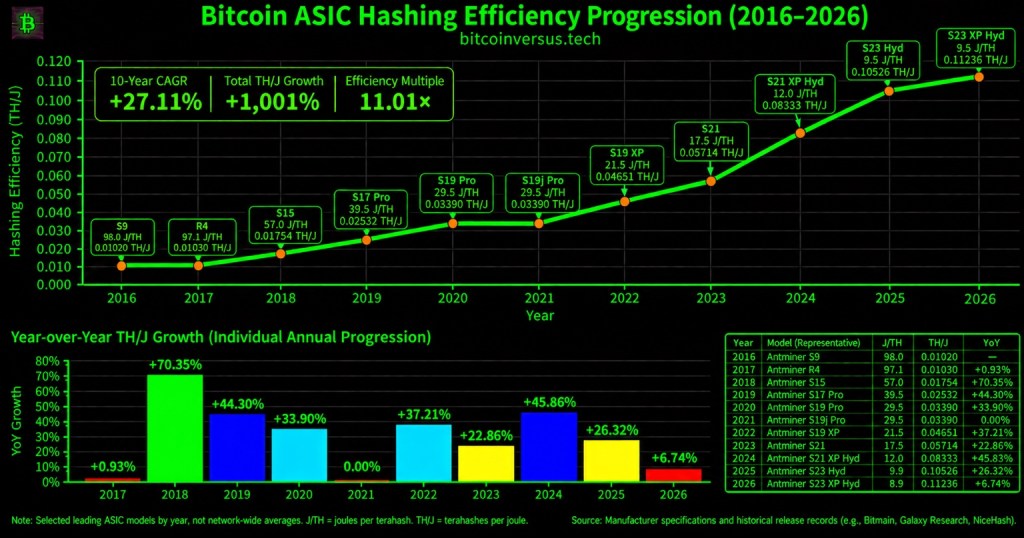
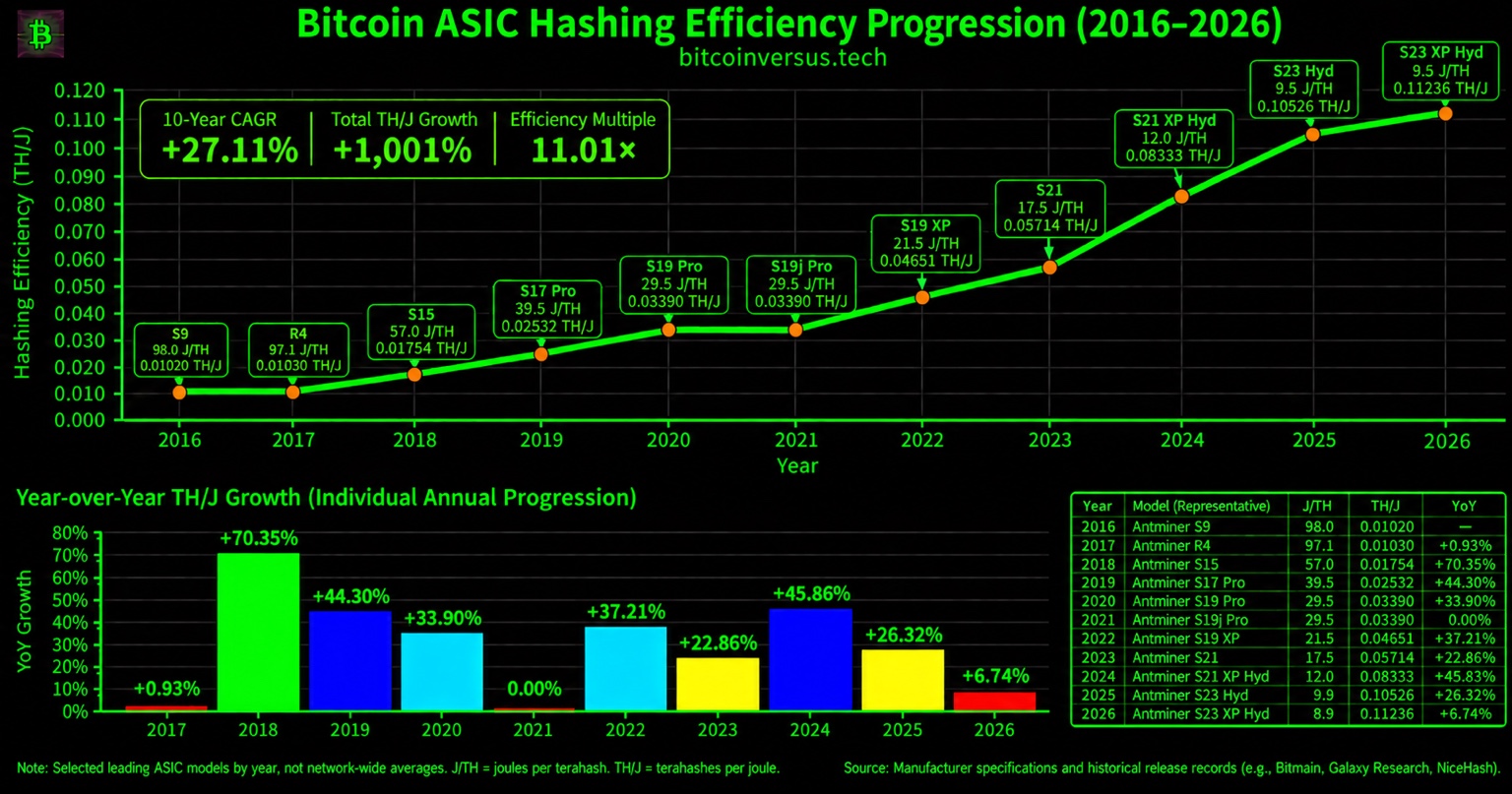
Bitcoin mining hardware has undergone a dramatic transformation over the past decade. A BitcoinVersus.Tech comparison of selected Antminer specifications finds hashing efficiency rising from approximately 0.01020 terahashes per joule (TH/J) in 2016 to 0.11236 TH/J for a 2026-designated model. The endpoints imply an approximately 11-fold improvement, or 27.1% compound annual growth over ten years. The comparison measures selected machines, not the Bitcoin network’s installed fleet.
More hashing work from each joule
An application-specific integrated circuit, or ASIC, performs Bitcoin’s SHA-256 hashing operations using specialized silicon. Mining equipment efficiency is conventionally expressed in joules per terahash (J/TH), where lower figures indicate less electricity consumed for a fixed quantity of hashing. Its reciprocal, TH/J, expresses hashing work delivered per joule; higher figures are better.
The chart begins with the Antminer S9 at 98 J/TH, equivalent to 0.01020 TH/J. It ends with the S23 XP Hyd specification at 8.9 J/TH, equivalent to approximately 0.11236 TH/J. Dividing the latter by the former gives roughly 11.01 times the hashing work per joule. The ten-year CAGR is (98 ÷ 8.9)^(1/10) − 1, or approximately 27.1%.
Annual improvements were uneven. The selected series shows approximately 70% growth in 2018, 44% in 2019, 34% in 2020, 37% in 2022 and 46% in 2024. A flat 2021 comparison reflects the selected models’ matching 29.5 J/TH ratings, not a claim that semiconductor engineering stopped improving. The sequence is illustrative rather than a rigorously sampled annual best-in-market frontier.
The newer hydro-cooled generation
The latest entries reflect the growing importance of cooling, power delivery and ASIC architecture. BitcoinVersus.Tech previously examined the S23 XP Hyd’s 8.9 J/TH rating and the energy implications of moving from 12 J/TH equipment. Manufacturer-rated performance does not guarantee identical field performance under different operating conditions.
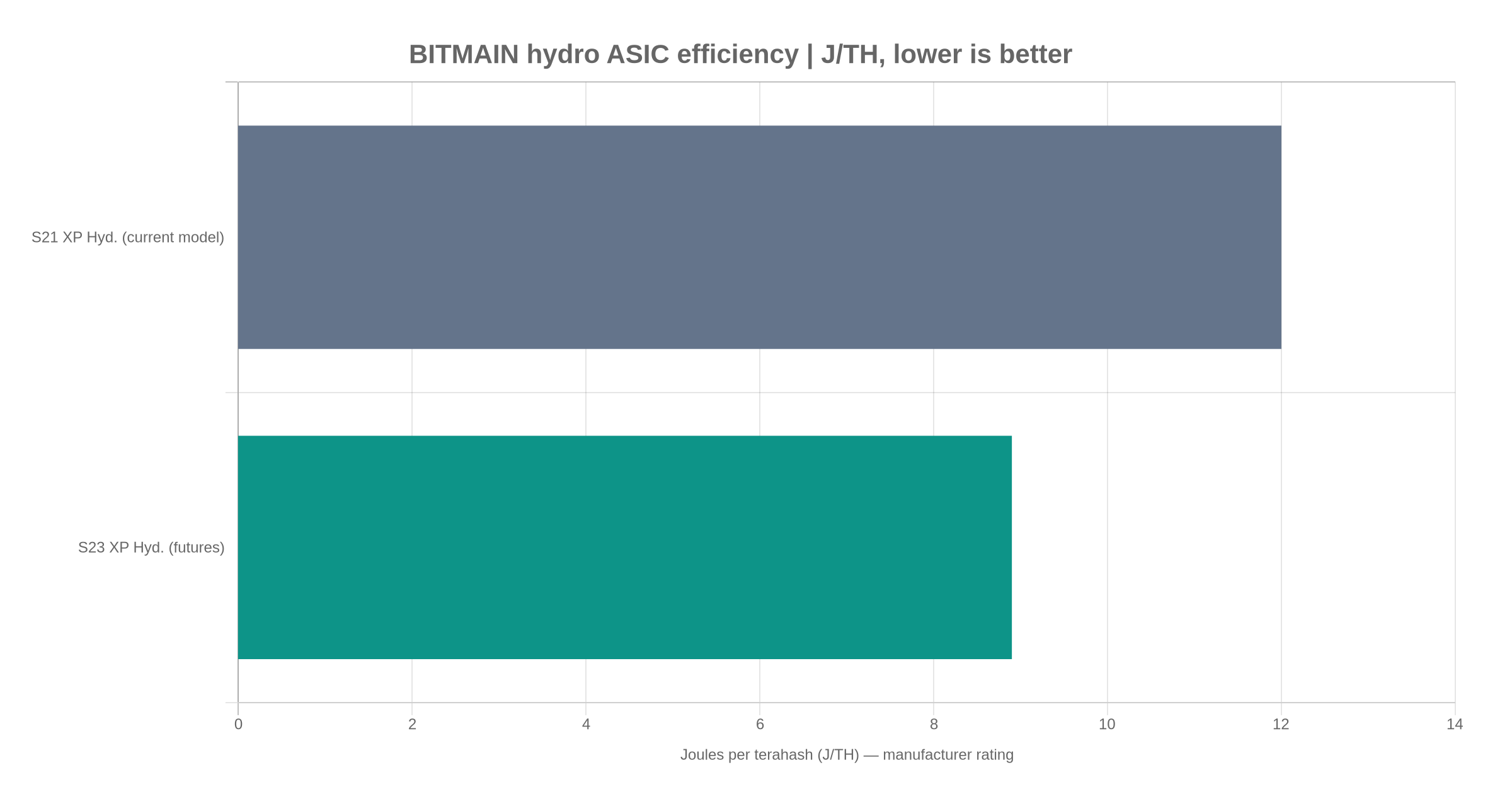
For perspective, a machine rated at 8.9 J/TH requires approximately 8.9 kilowatts per petahash per second of rated hashing capacity, before additional facility overhead. Cooling infrastructure, pumps, distribution losses and operating conditions affect total site consumption. The compute-per-joule framework helps distinguish improvements in hardware efficiency from the amount of electricity used across a growing network.
A decade of progress does not guarantee the next decade
The observed endpoint ratio is not a reliable stand-alone forecast. Product launch timing, announced versus shipped specifications, model selection and measurement boundaries can materially change annual comparisons. Historical improvement also need not continue at the same compounded rate as physical and commercial constraints become more difficult.

Earlier BitcoinVersus.Tech research explored laboratory ASIC efficiency claims and the 1 J/TH outlook. Laboratory chip measurements must remain separate from complete miner wall-plug specifications. A broader Bitcoin mining singularity analysis considers longer-run implications, while the present chart provides a narrower hardware comparison.
The takeaway is substantial but specific: selected ASIC designs now deliver far more hashes for each joule than representative equipment a decade ago. Network-wide energy demand, mining profitability and the next efficiency breakthrough remain separate questions.
Editor’s Note: The chart is a selected-model comparison using nominal J/TH specifications and their reciprocals. Annual percentages depend on model selection and assigned year; 2026 figures include announced specifications. They are not verified annual industry averages or independent field tests. BitcoinVersus.Tech analysis; consult original manufacturer datasheets before using any model rating for engineering procurement.
We volunteer daily to ensure the information on this platform is Verifiably True. If you would like to support the research, please scan the donation QR code provided on BitcoinVersus.Tech.


Leave a Reply