
Could Bitcoin be a natural form of money because human societies compete for scarce resources, yet keep finding ways to use energy more efficiently? The question connects two distinct theories. Jason P. Lowery’s 2023 MIT thesis Softwar frames Bitcoin’s proof of work as a form of power projection. Matthan Burton’s Power Efficiency Theory, developed through BitcoinVersus.Tech research, examines how growing computational capability and improving energy efficiency might affect Bitcoin’s physical-value progression. Together, they form a provocative hypothesis about competition, security and monetary preference, not a demonstrated law of nature.
Jason P. Lowery’s November 20, 2026 original statement proposing Bitcoin proof of work as a possible response to agentic superintelligence. The post is an individual’s proposal, not official U.S. policy.
Competition is natural, but cooperation is too
Competition for food, mates, territory, status and resources has shaped animal and human evolution. Yet human success also depends on cooperation, shared rules, reputation and reciprocal exchange. A major review of human cooperation describes interactions between genetic and cultural evolution. There is no established single genetic mechanism that predetermines a preference for Bitcoin, monetary competition or perpetually rising computing efficiency.
The useful biological analogy is selective pressure: when rewards depend on performance under constraints, participants search for strategies that survive. Bitcoin miners face the same incentives through an engineered protocol. Unlike biological evolution, their incentives, electricity prices, technology and difficulty rules are observable and changeable.
Softwar measures the contest; PEI measures the efficiency race
In Lowery’s framework, the ability to impose physical costs on an adversary matters even when the contested object is digital information. Bitcoin already makes competing miners expend real resources to extend a valid chain of transactions. Its consensus rules allow full nodes to verify the work and reject invalid blocks, while a difficulty adjustment approximately every 2,016 blocks responds to changes in network hashrate. More participating computation does not simply produce more bitcoin per day.
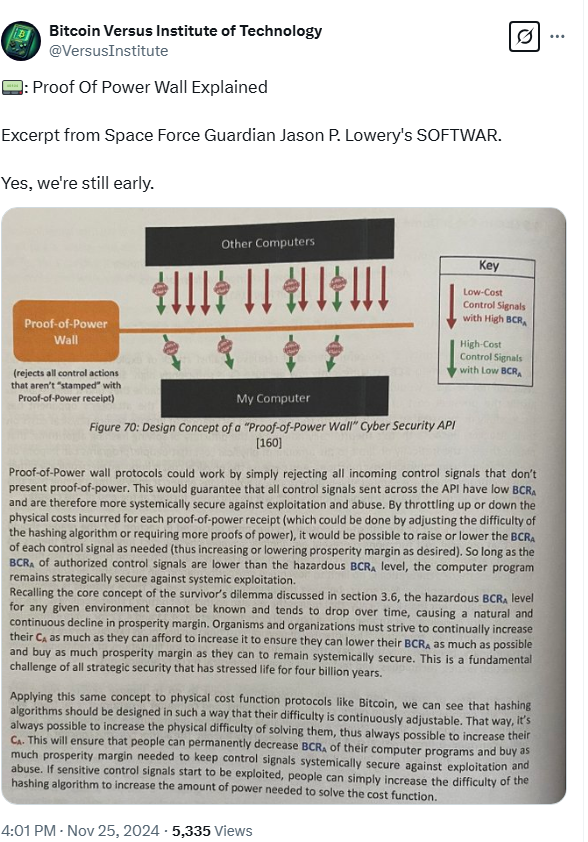
Our November 20 Lowery report explored the AI security extension. The proposed Proof-of-Power Wall would make selected digital requests computationally costly. A receipt proves work was performed, not that a requester is honest or authorized. The wall remains a conceptual design, separate from Bitcoin’s actual monetary consensus.
Power Efficiency Theory asks a different, complementary question: if the network’s physical competition expands, how much progress comes from additional hashing power and how much comes from reducing the energy required per hash? Its measurement layer is the Power Efficiency Index (PEI). For two selected dates, with network hashrate H and equipment energy per terahash J, the published model uses:
PEI = (H₂ ÷ H₁) × (J₁ ÷ J₂). A doubling of network hashrate and a halving of joules per terahash would yield a 4× index reading. The arithmetic is straightforward; the assumption that the resulting multiplier maps proportionally to monetary value is an experimental valuation hypothesis, not a proven pricing relationship.
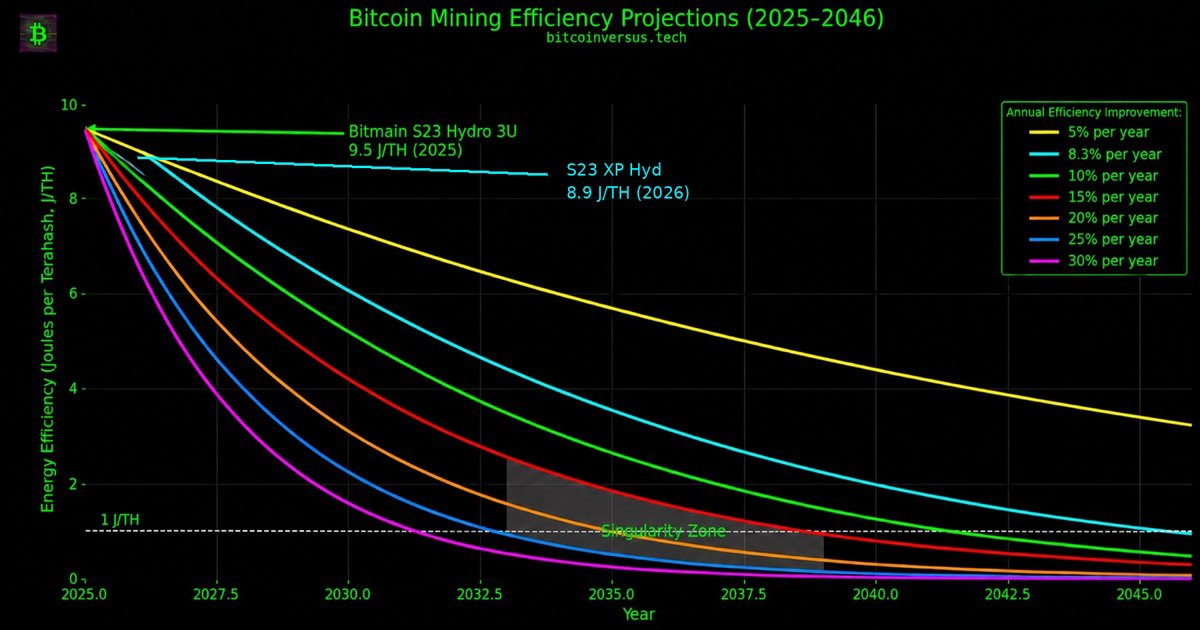
Efficiency competition can be illustrated through different possible rates of improvement rather than one inevitable outcome. The first original Power Efficiency Theory projection traces joules per terahash through 2046.
Why efficiency competition might reinforce Bitcoin
Better ASICs let a miner generate more hashes with the same electricity input, potentially reducing operating cost per hash. Rival miners respond by upgrading hardware, relocating, improving cooling and competing for lower-cost energy. Under some economic conditions, efficiency gains make more hashing economically viable, while the protocol adjusts mining difficulty as competition expands. Lowery’s power-projection lens emphasizes the cost an adversary faces; PEI emphasizes the physical capability and efficiency behind the competitive network.
Archival Jason Lowery interview with Robert Breedlove explaining Softwar and power projection. The video explains the earlier thesis and is not an independent test of PEI.
The bridge becomes especially clear in the published 24-month PEI calculation: network hashrate increased from 640.61 to 1,029 EH/s, while the selected leading ASIC efficiency benchmark improved from 13.5 to 8.9 J/TH. Consequently, (1,029 ÷ 640.61) × (13.5 ÷ 8.9) ≈ 2.436×. Applying the model’s selected $57,747.77 physical-price anchor produced an illustrative $140.7K relative price. That figure reflects the chosen assumptions and endpoints, not established intrinsic value or a market forecast.
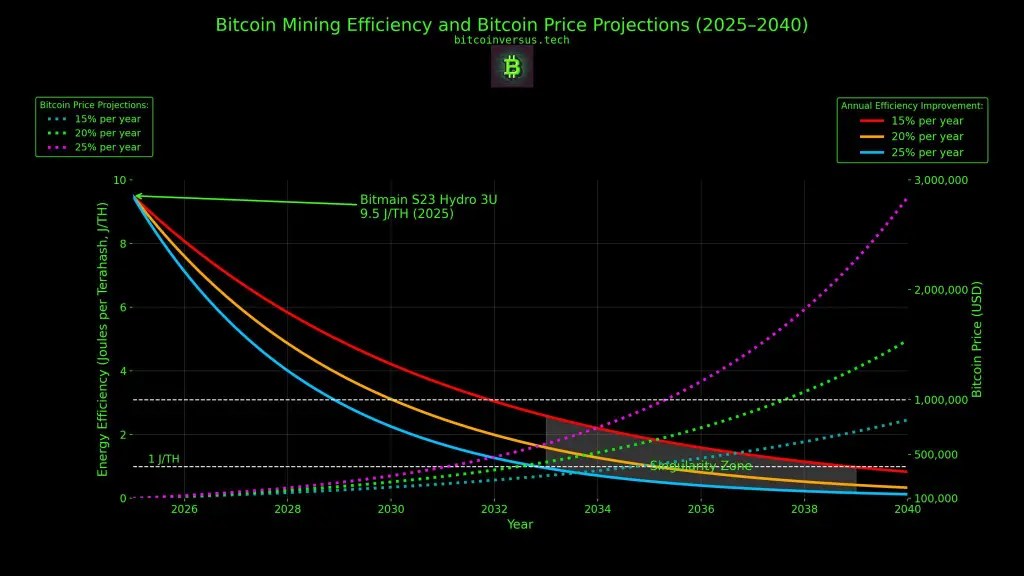
To compare the physical efficiency thesis with a possible monetary outcome, the next original projection places J/TH on one axis and hypothetical Bitcoin prices on another. The price paths are independent assumptions, not values calculated by the PEI formula.
Does competition make Bitcoin natural money?
Burton’s proposed answer is that a monetary network secured by costly, competitive physical work may align with familiar human incentives. Participants need not trust a central issuer to verify the monetary rules, while the production of eligible blocks is open to competition. The claim has philosophical force: people already compete for scarce goods and seek more efficient ways to protect and transfer value. Bitcoin turns one form of competition into a publicly verifiable accounting mechanism.
Yet scarcity and costly security alone cannot establish universal monetary adoption. Money also depends on social acceptance, liquidity, legal institutions, settlement utility and stable expectations. Anthropological research documents competing explanations for money’s origins. Calling Bitcoin “natural money” therefore remains a reasoned interpretive thesis, not a biological classification or an empirical theorem.
The strongest test is where the curve breaks
A competition-driven improvement is not guaranteed to occur every year. The same PEI research found a roughly 0.997× 12-month reading because the chosen daily hashrate endpoints fell even as rated hardware efficiency improved. A short window can reverse the longer structural trend.
Efficiency also does not automatically reduce total electricity use. Bitdeer’s November 10, 2026 earnings report lists average miner efficiency improving from 20.1 to 15.4 J/TH year over year, while quarterly electricity use increased from 1.656 to 3.098 TWh as operations expanded. The figures illustrate why energy per hash, total consumption, network security and financial value must be analyzed separately.
A rigorous synthesis would compare time-aligned network hashrate, measured fleet-weighted J/TH, capital and energy spending, reorganization attack economics, and monetary adoption over multiple cycles. Lowery supplies a theory about what resource-backed competition could secure; Burton’s PEI supplies a quantitative hypothesis about the progression of physical capability. Their convergence is a compelling research agenda. Neither theory establishes that biology guarantees perpetual mining efficiency gains, inevitable Bitcoin adoption or a predetermined price.
Research sources and methodology
Primary work: Lowery, Softwar (MIT, 2023); Burton, Power Efficiency Theory; Bitcoin developer documentation; evolutionary psychology review; and Bitdeer Q3 2026 report. The two displayed charts are author-supplied projection illustrations; historical PEI results and measurements are documented in the linked research articles. Index calculations are illustrative and have not been independently established as a valuation mechanism.
Editor’s Note: We volunteer daily to ensure the credibility of the information on this platform is Verifiably True. If you would like to support to help further secure the integrity of our research initiatives, please scan the QR code below

BitcoinVersus.Tech publishes informational research and journalism, not investment, financial, legal or cybersecurity assurance. PEI relative prices are experimental comparisons rather than financial advice or predictions.


Leave a Reply