Jason P. Lowery’s Softwar thesis, submitted to MIT in February 2023, contains a specific cybersecurity proposal. The thesis lists Figure 70, on page 297, as “Design Concept of a ‘Proof-of-Power Wall’ Cyber Security API.” Figure 71, on page 300, presents a related “Electro-Cyber Dome” concept using such APIs. Both are theoretical designs, not documented commercial firewall deployments.
The proposal attaches an independently verifiable computational cost to selected digital control signals. Commands that cost almost nothing to transmit could become more expensive to issue at scale. Lowery argues that proof-of-work deserves study as physical power projection, beyond Bitcoin’s role in monetary consensus. The engineering question concerns which kinds of commands should pay, how much, and what independent safeguards remain necessary.
Jason P. Lowery’s 2023 interview with Robert Breedlove about Softwar and nonlethal power projection. Archival explanation, not a live demonstration of a firewall.
A wall of power receipts, not a substitute for authorization
Ordinary software enforces permissions through code, credentials and policy. Lowery’s added idea is a proof-of-power receipt showing computational work before a protected system processes a qualifying control signal. Bitcoin miners consume physical resources to find eligible block headers; full nodes verify the work comparatively cheaply. The thesis asks whether analogous costs could protect other precious information and control paths.
The distinction is essential. A valid puzzle result shows that qualifying work was performed. It does not prove the sender’s identity, lawful authority or right to operate an electrical substation, AI model or database. Digital signatures, authentication, authorization and command validation remain separate controls. Our earlier technical review of Softwar explored the same security boundary.
In an illustrative implementation, an API gateway could issue a fresh, short-lived challenge tied to an endpoint and request. The client returns a work receipt; the gateway verifies the puzzle, rejects expiration or replay, and performs ordinary access checks before any protected action. Such a protocol is a modern engineering interpretation, not implementation code or a benchmark published by Lowery. Figure 70 is the proposed API design; Figure 71 extends the theoretical discussion to a broader “Electro-Cyber Dome.”
Archival YouTube reading and commentary based on Chapter 5 of Lowery’s Softwar. An interpretive resource, not evidence that the proposed API has been deployed.
Tor offers a practical, narrower test of computational admission
The Tor Project introduced proof-of-work defense for onion services on August 23, 2023. Under stress, clients submit computational puzzles that influence request priority. Tor’s published protocol describes a dynamically adjusted effort suggestion and a priority queue. A solution can earn priority without proving that the sender is trustworthy.
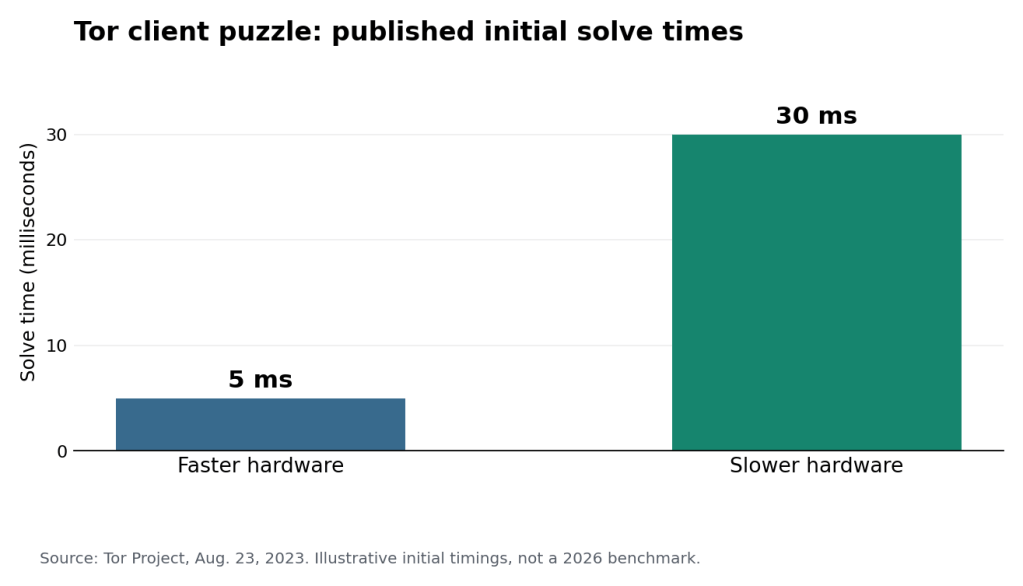
Tor reported initial puzzle-solving times ranging from approximately 5 milliseconds for faster computers to 30 milliseconds for slower hardware. Those 2023 timings illustrate a sixfold hardware difference, not the attack-blocking effectiveness of Lowery’s wall. Tor uses Equi-X with HashX and Blake2b components rather than Bitcoin mining.
What an AI-era trial would still need to prove
An AI agent armed with stolen credentials can solve a puzzle yet perform an unauthorized operation. A botnet can shift computation onto compromised devices. Legitimate users operating older hardware may encounter disproportionate delays. OWASP’s API security guidance therefore calls for bounded resources, rate limits and spending controls in addition to access protection.
A rigorous test should publish abusive requests denied, authorized requests completed, processing capacity saved, added latency across device classes, replay failures, and electricity consumed. Equal puzzle difficulty does not mean equal electrical power, since hardware efficiency and electricity prices vary. Measured performance must be distinguished from Lowery’s theoretical strategic claims.
BitcoinVersus.Tech’s August 2022 archival X commentary quoting Lowery on power projection. Historical context, not independent proof of cybersecurity effectiveness.
How the Proof-of-Power Wall coverage developed
BitcoinVersus.Tech introduced the proposed wall in March 2025, later compared Tor and Cloudflare defenses, reported AI bot traffic to login pages, and examined hijacked cloud AI credentials. The new focus is Lowery’s own figure-labeled API proposal, rather than another attack-volume study.
The enduring lesson is narrower than an invincible digital wall but still significant: computational work can change the economics of overwhelming a service. Work alone cannot make malicious commands legitimate. Lowery’s proposal remains a research direction whose real benefits and costs require controlled implementation and testing.
Primary sources and critical reading
- MIT, Jason P. Lowery, Softwar (February 2023)
- Original MIT thesis PDF, Figures 70 and 71
- Tor Project announcement, August 23, 2023
- Tor’s Equi-X and HashX protocol details
- OWASP API4:2023 resource consumption
- Jameson Lopp’s critical review of Softwar
Editor’s Note: We volunteer daily to ensure the information on this platform is verifiably true. If you would like to support our work and the integrity of our research, scan the QR code below to donate 5,000 sats.

For mobile scanning, open the article on another display and scan the QR code with a Bitcoin wallet. Verify receiving address 3C9o19EH5HSiwEPyCTmEKzxhNCbo2X6TTb before sending.
BitcoinVersus.tech publishes financial and technical journalism for informational purposes and does not provide financial, legal, investment or cybersecurity consulting advice.


Leave a Reply