
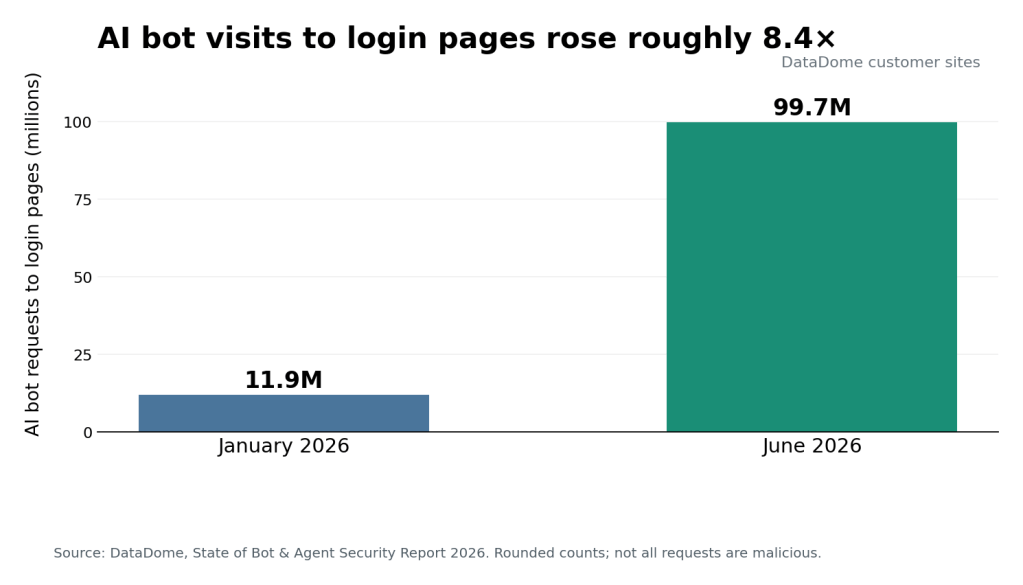
AI agents sent 99.7 million requests to login pages in June 2026 across sites monitored by cybersecurity provider DataDome, up from 11.9 million in January. The rounded figures imply roughly 8.4 times as many monthly login-page requests within five months. As automated software moves from retrieving webpages to interacting with accounts, an old idea from Bitcoin security is acquiring new relevance: making selected digital requests costly to send.
The numbers come from DataDome’s 2026 AI traffic analysis, published with its September 22 State of Bot & Agent Security Report. A login-page request is not necessarily a login attempt, an intrusion or even a malicious action. Legitimate AI assistants may access account workflows with permission; abusive clients can exploit the same pathways.
Official DataDome video published July 27, 2026, describing bot and agent traffic screening. Marketing claims in the video are not independent efficacy measurements.
The numbers behind a changing attack surface
Across the first half of 2026, DataDome classified 605.6 million AI-related requests to sensitive website endpoints, including forms, account registration, shopping carts, payment flows and login pages. Login pages accounted for 51.7%, or approximately 313 million requests. The full annual analysis examined traffic from more than 75,000 customer websites. Neither dataset is a census of worldwide internet activity.
DataDome also tested 21,491 popular websites against ten categories of bots and spoofed AI agents. It classified 65.3% as completely unprotected in its testing and 2.4% as fully protected. Those labels describe the vendor’s chosen tests, not comprehensive certification of every possible website defense. The study counted an 82.3% rise in identified AI traffic and a 124% rise in bad bot traffic over the July 2025 to June 2026 comparison window; the two classifications must not be added together.
What Jason P. Lowery’s Proof-of-Power Wall proposes
Jason P. Lowery’s 2023 MIT thesis, Softwar, proposes studying proof of work as a way to impose physical costs on digital competition. BitcoinVersus.Tech explained the associated Proof-of-Power Wall design in March 2025 and revisited the limits of the broader Softwar thesis in November 2026.
A possible web implementation would issue a fresh, short-lived cryptographic puzzle to a suspicious client before accepting an expensive unauthenticated request. Validating a solution can be inexpensive for a server, while generating many solutions consumes attacker computation. Raising puzzle difficulty as traffic pressure increases could change the economics of mass automation. A solved puzzle proves computational effort, however, not identity, permission or harmless intent. Lowery’s national-security argument remains a research proposal, not proof of a deployed next-generation firewall.
Anthony Scaramucci, November 15, 2026, argues that proof of work could be an AI-era firewall. His X post is commentary, not evidence of measured protection or a deployment.
Where computational gates already exist
The idea has real, narrower precedents. Cloudflare Turnstile documents proof-of-work challenges among several browser and behavioral signals, while BitcoinVersus.Tech’s comparison of Cloudflare and Tor explains how Tor prioritizes onion-service requests using computational effort during congestion. Neither service depends on proof of work alone to decide which commands are authorized.
Official Cloudflare Developers tutorial, June 26, 2025, demonstrating Turnstile integration and server-side validation of challenge tokens.
What an AI-era trial would need to prove
An effective evaluation would measure fraudulent requests blocked, legitimate-agent completion rates, latency on mobile devices, compute and electricity consumed, and the outcome when an attacker uses a botnet or stolen account. Earlier testing guidance explains why computational admission must remain distinct from malware protection. Rate limits, verified agent identity, account permissions, multifactor authentication, API quotas and behavior analysis still carry independent responsibilities.
The separate Google LLMJacking investigation also illustrates a case a public-facing puzzle cannot automatically solve: an attacker using valid stolen cloud credentials. Lowery’s lasting technical question is narrower and testable. Can imposing a small physical cost on high-risk requests reduce abusive automation enough to justify the cost to legitimate users? DataDome’s traffic measurements establish why the experiment matters, but do not answer whether a proof-of-power wall would succeed.
Primary sources
- DataDome, 2026 AI agent traffic by endpoint and month
- DataDome, State of Bot & Agent Security methodology, September 22, 2026
- MIT, Lowery’s Softwar thesis, 2023
- Cloudflare, Turnstile challenge documentation
- Tor Project, proof-of-work protocol specification
Editor’s Note: We volunteer daily to ensure the credibility of information on our platform is Verifiably True. Support our research by scanning the QR code below to donate 5,000 sats.

For mobile scanning, open the article on another display and scan the QR code with a Bitcoin wallet. Verify receiving address 3C9o19EH5HSiwEPyCTmEKzxhNCbo2X6TTb before sending.
BitcoinVersus.tech provides technical and financial journalism for informational purposes only and does not provide investment, legal or cybersecurity assurance.


Leave a Reply