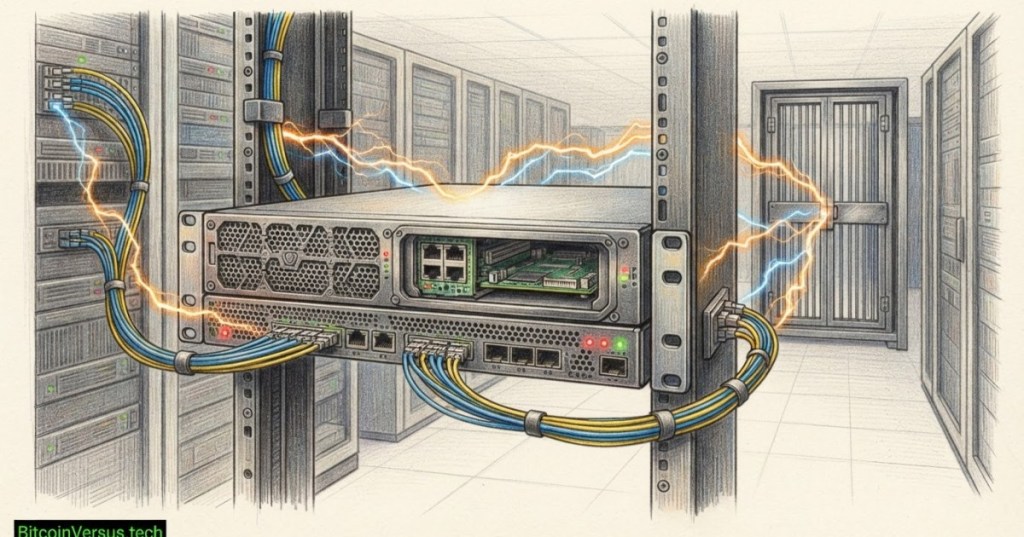
Proof of work can raise the price of automated abuse, but cannot be assumed to prevent most or all malware. An internet service that demands a valid computational puzzle before admitting a request can make mass scanning, spam and some denial-of-service campaigns more expensive. An infected computer, however, can still execute malicious code locally, misuse stolen credentials or solve the same puzzle as a legitimate user.
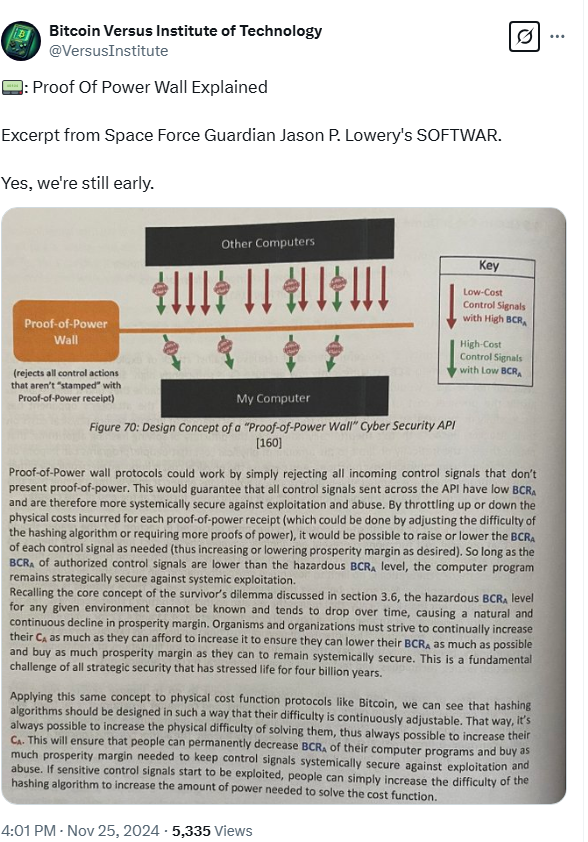
The distinction follows BitcoinVersus.Tech’s original Proof-of-Power Wall proposal from March 2025 and its recent analysis of Jason P. Lowery’s Softwar thesis. Lowery’s 2023 MIT thesis explores physical cost as a constraint on digital action; the idea needs a specific threat model before anyone can claim a measurable malware-prevention rate.
Anthony Scaramucci, November 15, 2026. Original X commentary describing proof of work as a firewall for the AI era. The statement is an opinion about potential applications, not a measured malware-blocking result.
How a computational firewall operates
A gateway issues a fresh challenge tied to a limited lifetime and a particular request. The client searches for a nonce whose hash satisfies the required difficulty; the gateway verifies the answer cheaply before forwarding the operation. Proper deployments need nonce reuse protection, request binding, expiration, rate controls and ordinary authorization checks.
Adam Back’s 2002 Hashcash paper proposed computational stamps against unwanted email and resource abuse. Bitcoin uses a related idea for distributed transaction history, but a normal website puzzle does not automatically use Bitcoin miners, consume blockspace or obtain the security of Bitcoin’s global hashrate.
The cost model engineers should test
Consider a hypothetical challenge requiring an average 0.25 CPU-second on a representative client. Ten requests consume roughly 2.5 CPU-seconds; 10,000 consume about 2,500 CPU-seconds, or 41.7 minutes of aggregate work. Those values are an illustrative calculation, not laboratory measurements or a dollar-cost estimate. Real times vary with processors, parallel execution and puzzle design.
Archival interview: Robert Breedlove’s What Is Money? Show, May 2023. Jason Lowery explains the broader Softwar power-projection theory; the video does not demonstrate a malware firewall.
A botnet operating thousands of compromised hosts could distribute the work, shifting the electricity bill to victims. A well-resourced attacker may also have faster hardware. Conversely, people using older phones or assistive technology may be delayed disproportionately. Raising the difficulty indefinitely would degrade legitimate service availability.
What proof of work can and cannot stop
Tor introduced a proof-of-work defense for onion services in August 2023, prioritizing clients that demonstrate effort when services face denial-of-service pressure. Its technical specification addresses challenge settings and queue behavior. Tor offers a concrete implementation example, but does not claim to eliminate viruses or malicious code on endpoints.
BitcoinVersus.Tech, August 11, 2022. Archival original-source X post quoting Jason Lowery on cooperation and power projection; contextual background, not a firewall demonstration.
A puzzle gateway can deter low-budget repeated submissions, expensive unauthenticated API calls and some opportunistic floods. It cannot identify whether a signed command is harmful, stop malicious attachments executing after download, remove ransomware from an infected host or prevent exfiltration from a session holding valid access tokens.
NIST’s malware incident prevention guide calls for layered protections, including patching, restricted privileges, monitoring and firewalls. Related BitcoinVersus.Tech coverage of API schema validation, Windows agent sandboxing, cryptomining malware and industrial networking vulnerabilities illustrates attacks that computational admission alone cannot neutralize.
A safe validation exercise
- Model one permitted endpoint and a separate gateway in an isolated test environment, with no public targets.
- Compare ordinary and challenge-gated requests at several benign loads. Record request acceptance, challenge verification cost, server CPU time and client delays.
- Repeat using representative lower-powered devices and simulated compromised credentials. Check whether legitimate authorized actions remain usable while invalid or unauthorized actions still fail.
- Enable replay defenses, authentication, software patching and rate limits. Compare protection and energy overhead before considering deployment.
Knowledge check
Question: If a client solves a proof-of-work puzzle, has it proved authorization? Answer: No. It proved effort against the gateway’s challenge, not identity, permission or benign intent.
Question: What would support a claim of preventing 90% of malware? Answer: Reproducible testing against representative malware and traffic with a specified denominator, independent validation and false-positive measurements. No such evidence has been established for the proposed wall.
References
- Jason P. Lowery, MIT: Softwar thesis, 2023
- Adam Back: Hashcash, a denial-of-service countermeasure, 2002
- Tor Project: Proof-of-Work Defense for Onion Services, August 2023
- Tor specification: onion service client puzzles
- NIST SP 800-83 Rev. 1: Guide to Malware Incident Prevention and Handling
Editor’s Note: We volunteer daily to ensure the credibility of the information on this platform is Verifiably True. If you would like to support our work and help further secure the integrity of our research initiatives, please scan the QR code below to donate 5,000 sats.

For mobile scanning, open this article on a laptop or larger display and scan the original QR code using a Bitcoin wallet. Confirm the receiving address 3C9o19EH5HSiwEPyCTmEKzxhNCbo2X6TTb before sending.
BitcoinVersus.tech is not a financial advisor. This media platform reports on financial subjects purely for informational purposes.


Leave a Reply