
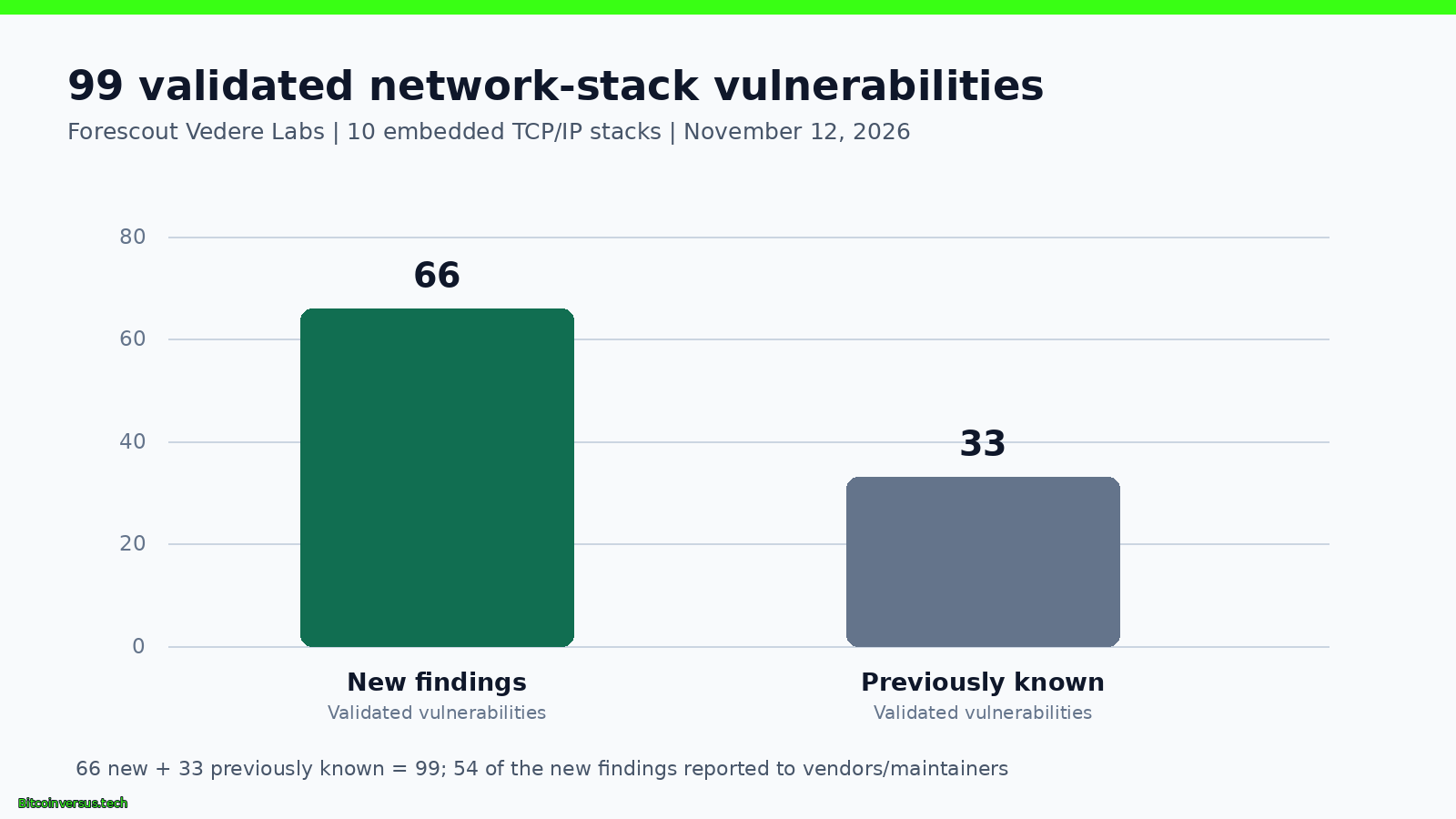
Forescout’s Vedere Labs reported finding 66 previously unknown vulnerabilities in software that connects industrial machines, medical equipment and other embedded devices to networks. The research, announced November 12, 2026, examined 10 TCP/IP stacks and validated 99 flaws overall, including 33 previously known issues rediscovered by the AI-assisted system. Forescout says 54 of the new findings were reported to vendors or maintainers. The study demonstrates faster vulnerability discovery, not 66 confirmed cyberattacks or proof that every product using the software is exploitable.
Forescout Technologies, “How to Make Smart Security Decisions in the AI Era,” September 22, 2026. Company video featuring software-engineering executive Elisa Costante discussing cyber-risk controls. Background context only; not footage of the November vulnerability study. Credit: Forescout Technologies / YouTube.
Why bugs in network stacks can spread across hardware brands
A TCP/IP stack implements network functions such as packet processing and connection management. Equipment makers can reuse the same embedded stack in devices from unrelated product families. One defect in a shared component can therefore affect controllers, network appliances and connected sensors even when their brands differ. Earlier BitcoinVersus.Tech guidance on keeping industrial devices off the public internet explains the dangers of exposed management and control interfaces.
The team examined seven stacks included in earlier Vedere research and three additional stacks. Among the 66 new findings, roughly 52% received high or critical severity ratings, according to Forescout. Severity describes potential technical impact under a scoring model; it does not establish whether an attacker can reach a particular device, whether a fix exists, or whether exploitation is occurring. Unlike a disclosed Zyxel switch patch, many findings are still undergoing coordinated disclosure.
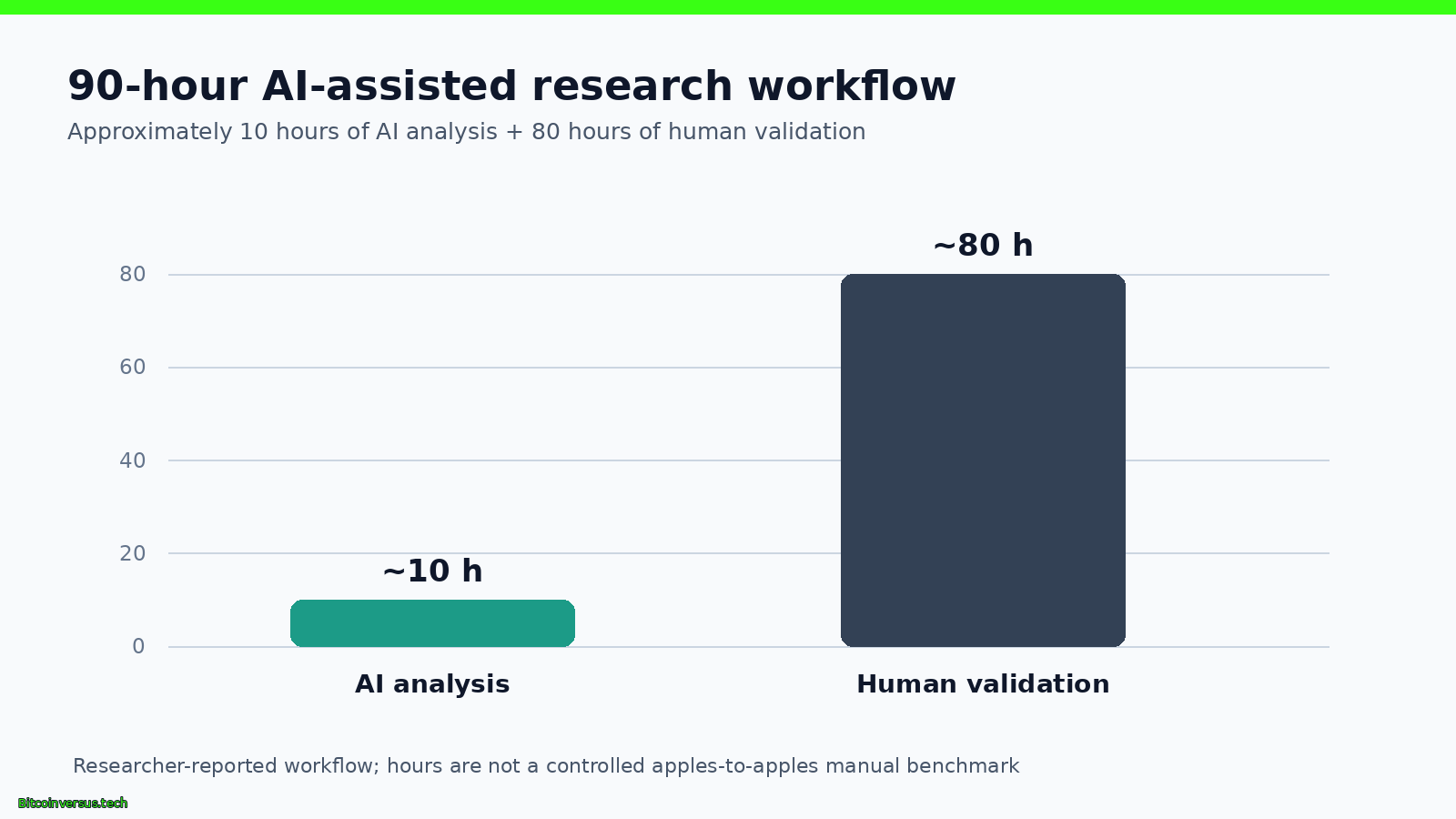
The 90-hour claim includes substantial human work
Forescout says a conventional earlier research effort took approximately nine months, while the AI-assisted exercise required about 90 hours: 10 hours of independent machine analysis and 80 hours of human validation. The workflow involved researchers testing candidate defects rather than blindly trusting generated output. The months-versus-hours comparison is company-reported and does not constitute a controlled benchmark using identical targets, staffing and validation criteria.
The company disclosed approximately $935 in automated static-analysis expense. Labor, hardware and other research costs are not included in that figure. Its announcement also quotes $2.58 per finding, but $935 divided by the 99 validated vulnerabilities equals about $9.44; the lower figure evidently uses a different count of preliminary findings. Without the underlying denominator, $2.58 should not be presented as the verified cost of identifying each confirmed bug.
Vulnerability disclosure is only the start of remediation
A discovered flaw can take months to travel from a stack maintainer through device vendors, firmware qualification and plant maintenance windows. Forescout reported 54 new findings to maintainers but did not say that 54 separate CVEs or 54 ready-to-install patches had been issued. Devices that remain operational long after manufacturer support ends may have no straightforward upgrade path. Previous reporting on industrial robot-controller cybersecurity shows why availability and controlled changes matter on factory floors.
Operators should inventory affected device models and firmware dependencies, identify publicly reachable management services, ask suppliers for advisories and prioritize fixes based on actual network exposure. Where patches cannot be safely installed, restricting unnecessary services and using network segmentation can limit reachable paths. Changes should be tested against operational requirements; disabling protocols indiscriminately can interrupt legitimate systems. Established firmware-update security practices remain necessary even when AI accelerates research.
The experiment adds to an expanding record of AI-assisted code inspection, including AI-discovered Bitcoin Core defects. However, Forescout tested a defined set of networking stacks, not the security of every industrial installation. No verified new exploitation campaign was identified in the announcement. The practical lesson is that detection can accelerate faster than the equipment-replacement and firmware-patching schedules relied upon by critical infrastructure operators.
Sources and calculations: Forescout Research – Vedere Labs announcement, November 12, 2026 (Business Wire); full announcement syndicated by Yahoo Finance; Computer Weekly independent reporting, November 12; Forescout earlier embedded-stack disclosures; official Forescout video indexed September 22, 2026. Original arithmetic: 66 + 33 = 99; 10 + 80 = 90 hours; $935 / 99 validated findings ≈ $9.44. Study numbers remain researcher-reported and do not confirm exploitation in any named deployed device.
Editor’s Note: Forescout’s November 12 release reports 99 validated findings across ten embedded TCP/IP stacks, including 66 newly identified vulnerabilities. The count is not evidence of 66 active attacks, and affected downstream devices have not been independently enumerated. Fifty-four newly discovered issues were reported to maintainers, with some disclosure still ongoing. The reported 90-hour process includes roughly 80 hours of human validation; the nine-month comparison was not an independently controlled benchmark. The quoted $2.58-per-finding marketing metric does not use the 99 validated vulnerabilities as its denominator, so the article provides its own arithmetic and avoids an unsupported interpretation. The featured cover is conceptual cybersecurity artwork, not a photograph of Forescout’s test apparatus. Two original charts are sourced and use zero baselines. The September Forescout video provides historical security guidance; it does not show the November experiment. WordPress’s saved Gutenberg content and rendered HTML confirm the intended Forescout video iframe, chart references, internal links and donation footer. Actual video playback, external public-browser rendering and physical mobile-device layout were not verified.

BitcoinVersus.Tech is volunteer-run and publishes independent educational technology reporting. An optional 5,000-satoshi donation supports continued research. Scan the original QR from a second screen using a compatible Bitcoin wallet; on mobile, use a wallet that supports QR scanning from a saved image. Independently verify the recipient address 3C9o19EH5HSiwEPyCTmEKzxhNCbo2X6TTb and the amount before sending. Bitcoin transactions are generally irreversible.
We volunteer daily to ensure information on the BitcoinVersus.Tech platform is Verifiably True. Coverage is educational and informational and does not constitute financial or investment advice.


Leave a Reply