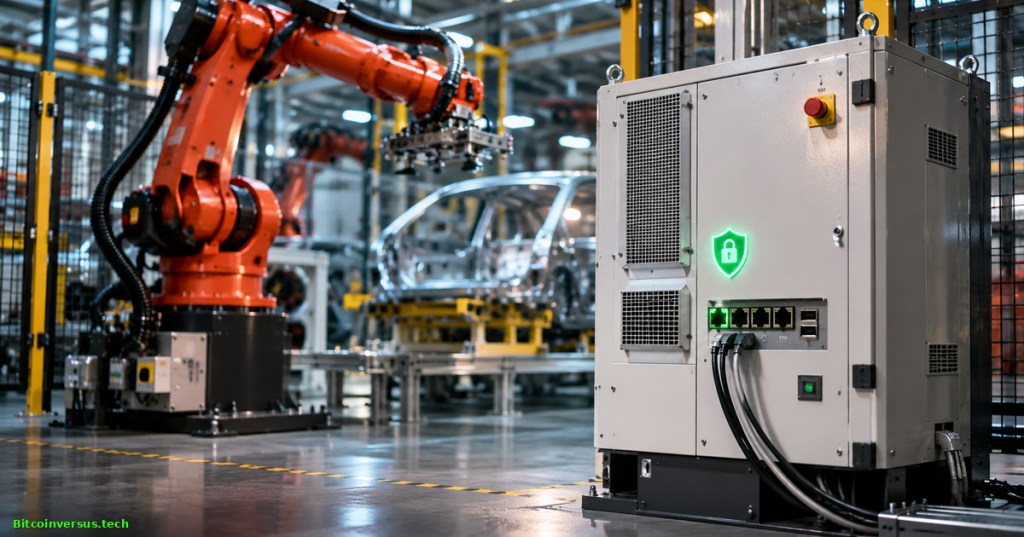
Industrial robot controllers translate motion programs into commands for motors, grippers and production equipment. Once connected to plant networks for diagnostics, data collection and remote maintenance, a controller also becomes a potential cybersecurity entry point. Unauthorized changes can disrupt production even when a robot’s mechanical safety functions still operate as designed.
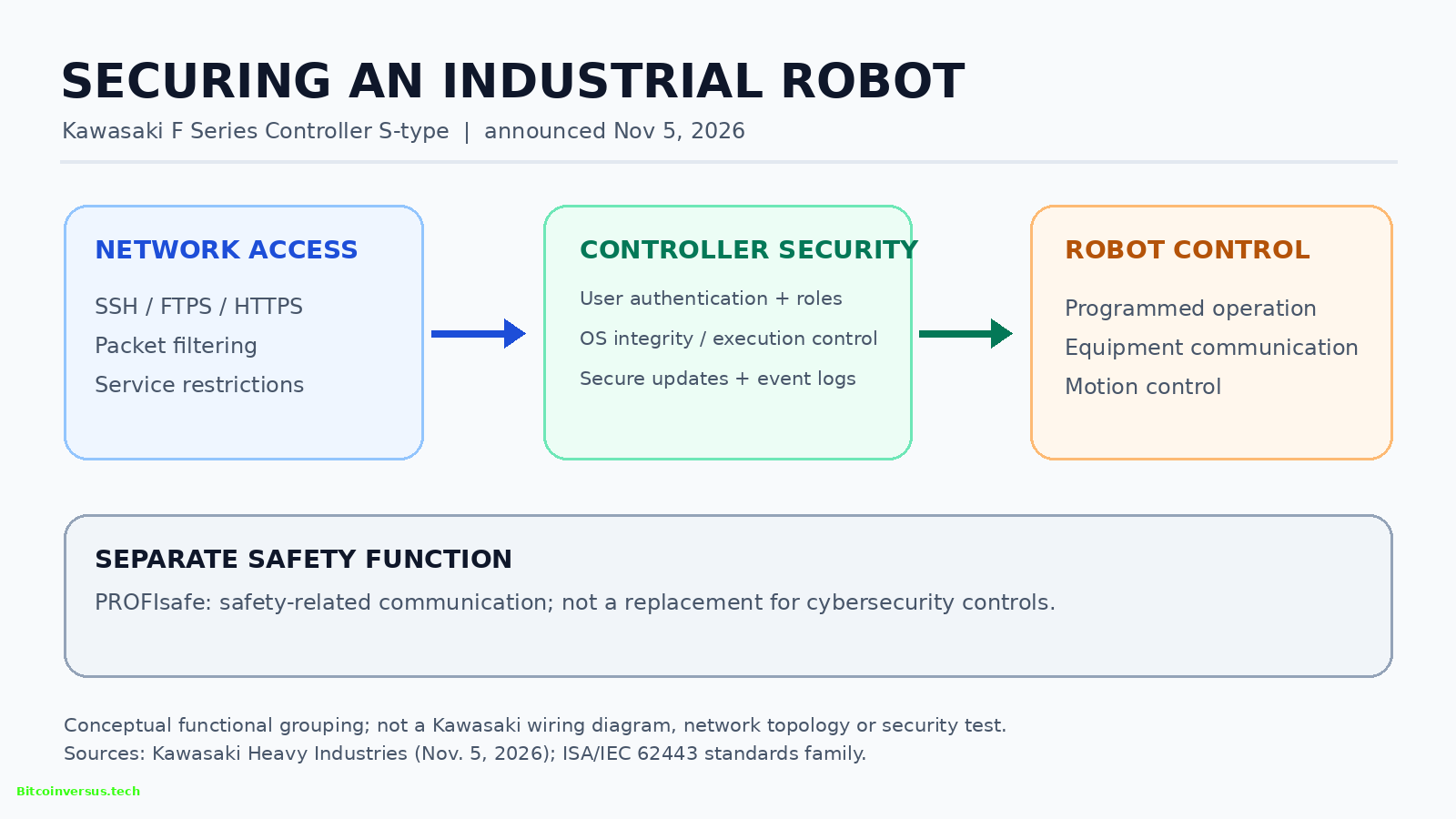
On November 5, 2026, Kawasaki Heavy Industries announced its F Series Controller S-type with additional protections for connected industrial robots. A phased release begins during November, initially for handling applications. The manufacturer lists user authentication, access privileges, packet filtering, security logging, file encryption and secure software updates among the new capabilities.
Access control now reaches the robot cabinet
The S-type supports username-and-password authentication, role-based permissions and session management. Kawasaki also specifies secure communications using SSH, FTPS and HTTPS, alongside restrictions on communication services. Operators can use audit logs to investigate configuration changes, while the controller checks operating-system integrity during startup and restricts application execution.
Protecting the endpoint is only one layer of an industrial network. BitcoinVersus.Tech previously explained why industrial devices should not be exposed directly to the public internet. Authentication cannot compensate for insecure remote-access gateways, shared credentials or unmonitored plant connections. A recent CISA–FBI warning about refrigeration-system attacks illustrates how network-connected operational technology can become a business continuity risk.
Cybersecurity and robot safety have different jobs
Kawasaki says the controller preserves established safety-control functions and supports PROFIsafe, a safety-related communication technology. Safety controls address hazards such as unwanted motion; cybersecurity mechanisms address unauthorized access, tampering and malicious traffic. A controller can therefore need both without treating either as a substitute for the other.
The announcement references IEC 62443-4-1, the secure-development-lifecycle standard. Kawasaki’s Robot Division received third-party certification in 2024, and the company says the certified development process was applied to the S-type. Such process certification should not be mistaken for a publicly demonstrated zero-vulnerability controller or an independent IEC 62443-4-2 certification of every hardware configuration.
Kawasaki Robotics CEE HUB demonstrates an IP54 environmental-protection upgrade for an earlier F60 controller, February 28, 2022. IP54 concerns dust and water ingress, not cybersecurity. The video does not demonstrate the newly launched S-type or its security features. Credit: Kawasaki Robotics CEE HUB / YouTube.
What plant operators still need to verify
Kawasaki has not disclosed a list of supported robot models, prices, measured vulnerability-reduction rates or customer deployment results for the S-type. The manufacturer describes a staged rollout rather than a completed fleet-wide upgrade. Buyers need product-specific compatibility and lifecycle documentation before planning replacements.
Equipment engineers should confirm how security updates affect production scheduling, which user roles can change robot programs and how event logs reach plant monitoring systems. Related Linux-enabled motor-control hardware increases the need for disciplined firmware maintenance. Meanwhile, ISO 21423 robot communications addresses interoperability, a different engineering concern from protection against unauthorized control.
Kawasaki’s product-security program describes a team for responding to reported vulnerabilities. The decisive long-term measures will be patch availability, deployment coverage, configuration quality and operational uptime, not merely the presence of new menu options. Successful factory security still requires segmented networks, backups, tested recovery procedures and accountable maintenance practices.
Primary sources
Kawasaki product announcement (November 5, 2026); Kawasaki IEC 62443-4-1 certification notice (September 30, 2024); ISA/IEC 62443 standards overview; Kawasaki information-security program. The release does not provide independently tested cybersecurity outcomes, pricing or deployment counts.
Editor’s Note: Company-described security features and rollout dates were verified against Kawasaki’s official November 5 announcement. IEC 62443-4-1 concerns the certified development process; controller-specific certification and operational security are separate questions. The featured cover and explanatory diagram are labeled conceptual illustrations, not actual S-type hardware or penetration-test evidence. The embedded 2022 Kawasaki Robotics video concerns environmental ingress protection of an earlier controller.
Support BitcoinVersus.Tech
To contribute an optional 5,000 satoshis, scan the original BitcoinVersus.Tech donation QR below using a compatible Bitcoin wallet. On a phone, view the story on another device or use a supported saved-image scanning feature. Confirm the destination and amount before authorizing payment.
We volunteer daily to ensure the information on this platform is Verifiably True. If you would like to support the research, please scan QR code.


Leave a Reply