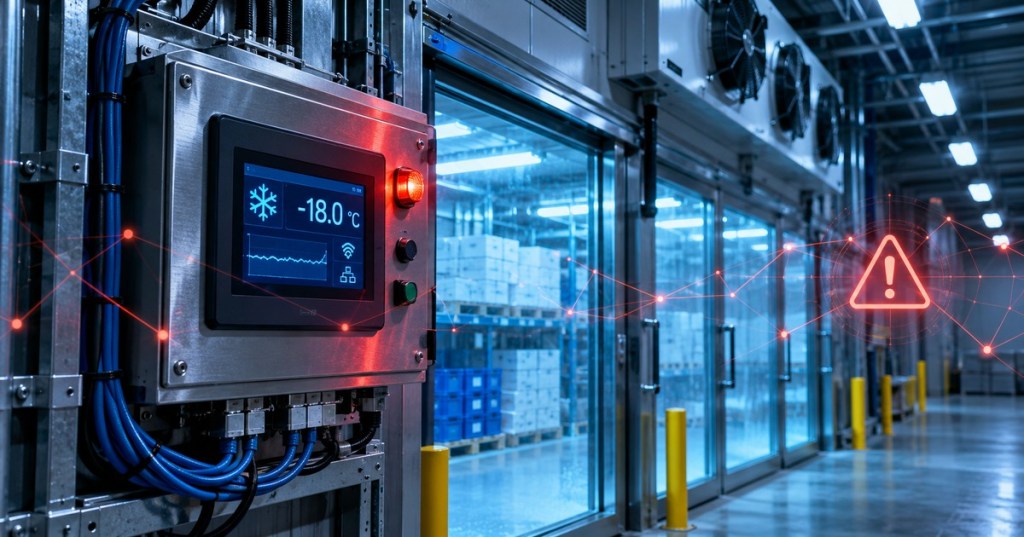
U.S. cybersecurity agencies are warning that attackers are targeting the digital controllers responsible for keeping food, medicine and other temperature-sensitive goods cold. A November 5 joint fact sheet from the Cybersecurity and Infrastructure Security Agency (CISA), FBI, Department of Health and Human Services, Department of Agriculture and Department of Transportation describes malicious activity against refrigeration and cold-chain monitoring systems worldwide.
The warning identifies a physical safety and supply-chain risk, rather than an ordinary data-theft incident. Compromised controllers can be instructed to raise temperatures, run continuous heating or defrost cycles, and conceal temperature readings from operators. Potential consequences include ruined inventories, damaged equipment, fire hazards and unsafe storage conditions.
How digital refrigeration control works
Commercial refrigeration commonly uses electronic controllers to manage temperature setpoints, compressors, evaporator fans, alarms and defrost schedules. A defrost cycle temporarily removes ice from cooling equipment. When correctly configured, the process helps maintain efficiency; when forced repeatedly or indefinitely, stored products can warm beyond their safe limits. BitcoinVersus.Tech previously explained the underlying refrigeration and heat-pump cycle.
The agencies describe several potential entry paths: authentication bypass, arbitrary code injection and insecure configurations. Internet-reachable maintenance interfaces and outdated firmware can turn a routine remote-service feature into an attack surface. An attacker who changes control settings may affect physical processes even without compromising an organization’s main business network.
European incidents raise the stakes
The federal notice follows reported refrigeration incidents across Europe. The Food and Drug Administration separately cited disruptions to grocery stores and a refrigeration supplier serving the French Blood Establishment. Reuters reported on November 4 that workers moved blood to unaffected refrigeration equipment, preventing an impact on supplies. The incident’s cause and any relationship to other attacks remain matters for investigators.
Earlier BitcoinVersus.Tech reporting covered attacks that defrosted French supermarket equipment. The new U.S. advisory addresses a broader risk across food, health, chemicals and transportation. It does not identify a perpetrator or establish a common attacker across every reported incident.
What operators should do now
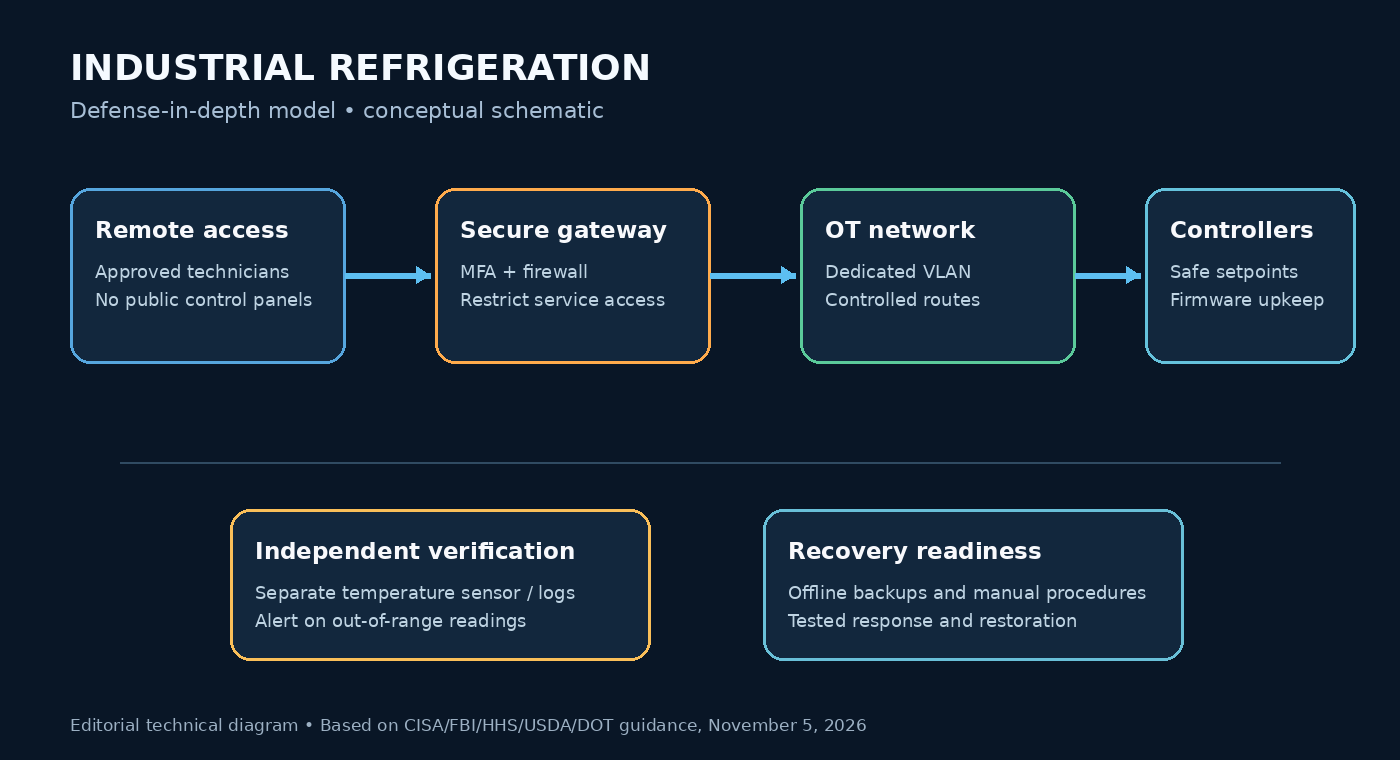
The agencies’ first recommendation is to remove refrigeration controllers from direct public-internet exposure. Where external maintenance remains essential, administrators should use a secured gateway, patched edge equipment and narrowly authorized connections. A dedicated operational-technology VLAN can separate machinery from general office systems, although VLAN separation must be reinforced by effective access controls and routing policies. Related coverage explains why firewall segmentation matters.
Facilities should replace default passwords, use strong authentication and deploy phishing-resistant multifactor authentication wherever supported. They should also inventory firmware, apply vendor fixes, plan replacement of end-of-support equipment and restrict which devices or IP addresses can issue configuration changes. The earlier BitcoinVersus.Tech analysis of publicly exposed industrial devices explains the underlying problem.
Independent temperature monitoring adds another layer. If a controller stops reporting truthful readings, operators still need a way to detect a dangerous storage condition. The joint guidance calls for reviewing setpoint boundaries, configuring alerts for deviations, retaining tested offline backups and collecting network traffic when controllers provide inadequate logs. Incident procedures should account for manual checks and the time required to move products safely.
The operational trade-off
Connectivity supports remote maintenance, centralized alarms and energy optimization. Removing every connection without planning could disrupt essential monitoring or vendor support, so access changes must preserve safety and continuity. Asset inventories, approved remote-access routes and tested recovery procedures can reduce risk while retaining required functions. The agencies provide recommended safeguards, not proof that all refrigeration products are compromised or that every facility has suffered an attack.
The immediate priority is verifying actual exposure, firmware support, temperature safeguards and independent alarms. Facilities observing suspicious activity can report it to CISA or the FBI’s Internet Crime Complaint Center.
Editor’s Note: Reporting verified against the joint CISA/FBI/HHS/USDA/DOT fact sheet dated November 5, 2026, the FDA cybersecurity notice and dated Reuters reporting. Attack details and outcomes are attributed; no perpetrator or common campaign is asserted. The cover and technical diagram are editorial illustrations, not photographs of compromised equipment. Both CISA videos are archival educational context. Public playback and video embedding permissions require independent verification.

To donate 5,000 sats, open the article on another display and scan the original QR code with a compatible Bitcoin wallet. On mobile, use a second screen or a supported wallet image-scanning feature. Verify the destination 3C9o19EH5HSiwEPyCTmEKzxhNCbo2X6TTb before sending.
We volunteer daily to ensure the information on this platform is Verifiably True. If you would like to support the research, please scan QR code.
BitcoinVersus.tech provides informational technology journalism, not operational security assurance. Consult current manufacturer advisories and qualified facility engineers before changing production controls.


Leave a Reply