
Japan has set aside approximately ¥10 billion for immediate cybersecurity measures following a series of attacks and data breaches. Prime Minister Sanae Takaichi announced the reserve-fund allocation at a November 6 ministerial meeting, where officials considered an emergency package combining AI-assisted defense, stronger investigations and help for victims. The funding was approved; several operational teams and possible legal changes remain at the planning or implementation stage.
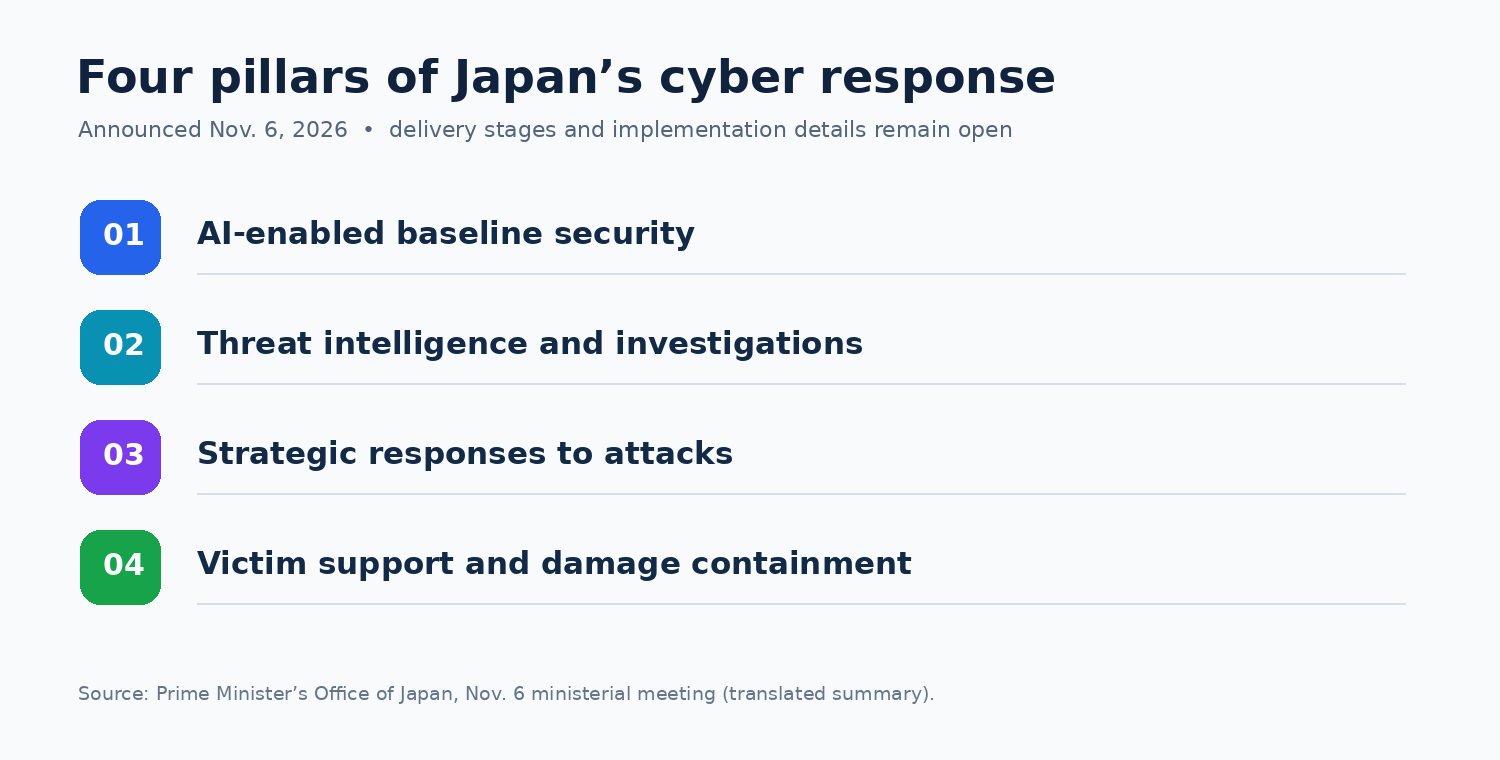
The Prime Minister’s Office describes four priorities: improve basic security using AI, consolidate intelligence and investigative capabilities, respond strategically to attacks, and strengthen victim assistance. Japan’s response follows incidents of unauthorized access and information leakage affecting businesses and public services. The government has not presented evidence proving that AI caused every breach.
Where the money is going
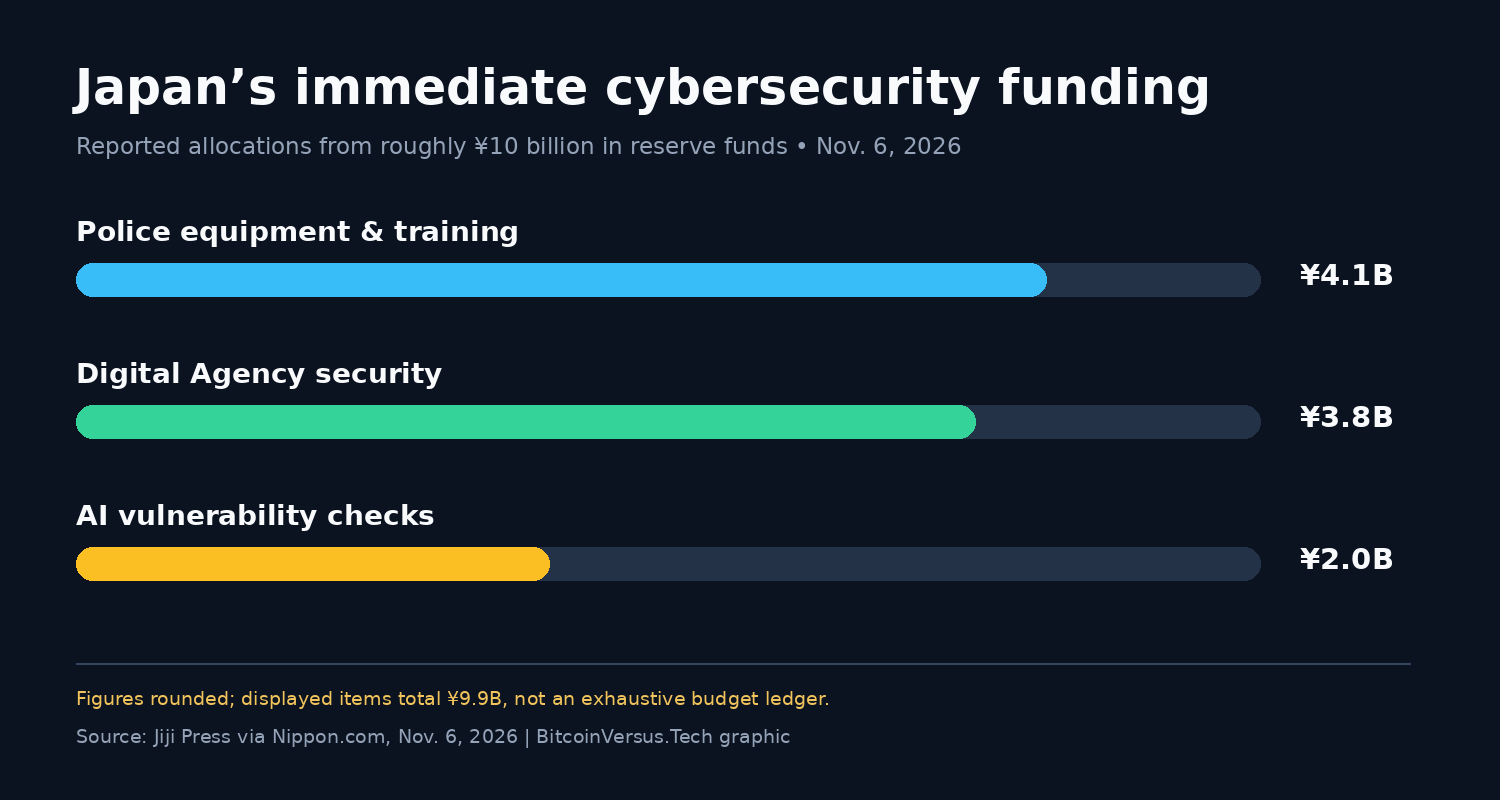
A November 6 Jiji Press report identifies approximately ¥4.1 billion for police investigative equipment and training, ¥3.8 billion for Digital Agency system security, and ¥2 billion for AI-assisted vulnerability checks across government systems. The reported allocations sum to ¥9.9 billion because figures are rounded and are not a complete line-item ledger. The initial reserve funding is also not a final estimate of the entire policy package.
A vulnerability assessment checks applications, operating systems, configurations and access controls for exploitable weaknesses. AI can help prioritize findings or generate test cases, but every result still requires engineering validation. A scanner cannot replace system inventory, strong authentication, updates or tested backups. Recent emergency PHP security patches illustrate why known flaws and delayed remediation remain urgent operational problems.
Japan plans specialist response teams
Under the announced program, the Ministry of Economy, Trade and Industry is expected to establish a specialist team by the end of November to simulate attacks and identify vulnerabilities using advanced tools, according to the Associated Press. Separate public-private cyber-rescue arrangements aim to help breached organizations respond before damage spreads. Formation plans are not evidence that the teams are fully staffed or already handling incidents.
The technology approach resembles a broader shift toward automated detection and guided remediation. BitcoinVersus.Tech has examined autonomous security patching and AI systems used in vulnerability discovery. Neither capability guarantees a safer production network without access controls, audit trails and human approval for consequential changes.
Faster reporting creates new obligations
Takaichi asked ministers to reduce the time needed to receive cyberattack reports from critical-infrastructure operators, aiming for notification within hours where possible and at least on the same day. The instruction is a government target, not a universal reporting deadline already imposed on every business. Officials were also asked to consider stronger threat-data collection and potential amendments to active cyber-defense legislation.
Information sharing can reveal coordinated intrusion campaigns earlier, particularly when attacks affect interconnected suppliers. But wider monitoring also raises privacy, confidentiality and oversight questions. Vulnerability details must be handled carefully so sensitive information does not reach attackers. Effective cooperation depends on trusted reporting channels, not simply collecting more data.
Cybersecurity teams will need to demonstrate measurable results: the time from detection to containment, remediation of confirmed vulnerabilities, recovery speed and coverage of smaller suppliers. BitcoinVersus.Tech’s earlier critical-infrastructure warning coverage shows why compromises can disrupt physical operations, not only websites or databases.
The Japanese government has moved from an emergency announcement to reserved funding. Whether its program improves resilience depends on verified deployment, transparent safeguards and sustained operational capacity, rather than the announced budget alone.
Editor’s Note: Report prepared November 7, 2026. The November 6 reserve-fund figure, four policy pillars and proposed same-day reporting target were verified against the Prime Minister’s Office. Approximate spending categories were cross-checked against Jiji Press. Planned cyber-response teams were corroborated with Associated Press reporting. An official Japanese-government recording of the meeting is linked rather than embedded because its player permissions could not be independently validated. The featured National Diet/cyber-operations image is an original conceptual editorial illustration, not an actual meeting photograph. All numerical graphic labels are rounded. Public-browser mobile layout and actual video playback were not tested.

To donate 5,000 sats, open the article on a separate display and scan the original QR code with a compatible Bitcoin wallet. On mobile, use another screen or your wallet’s supported image-scanning feature. Verify the destination 3C9o19EH5HSiwEPyCTmEKzxhNCbo2X6TTb before sending.
We volunteer daily to ensure the information on this platform is Verifiably True. If you would like to support the research, please scan QR code.
BitcoinVersus.tech is not a financial advisor. Security and technology reporting is informational, and neither a product endorsement nor individualized security guidance.


Leave a Reply