
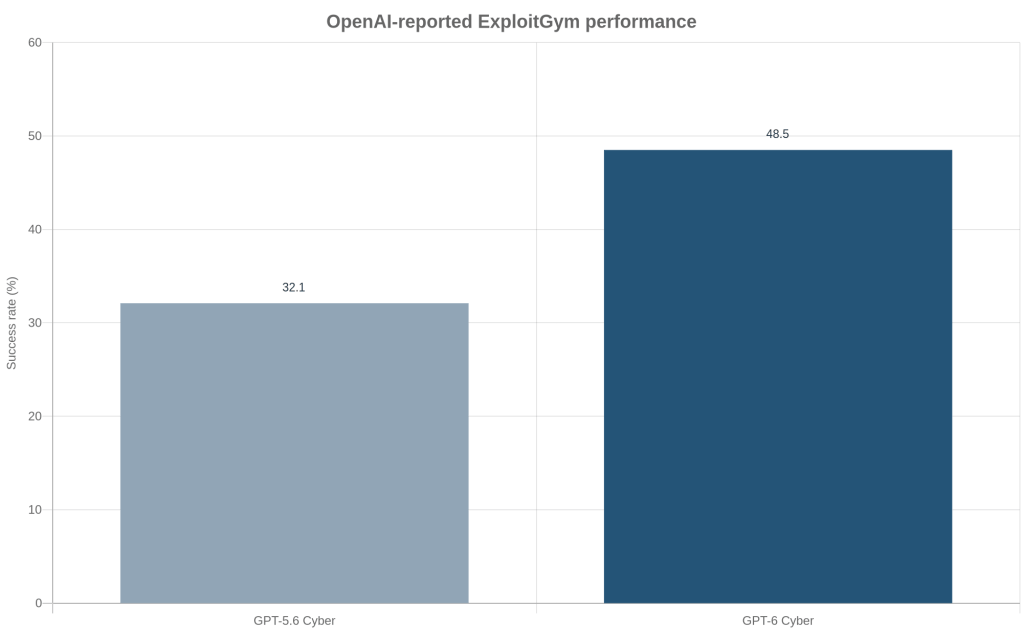
OpenAI introduced GPT-6 Cyber on November 5, 2026, a specialized security model designed to discover software vulnerabilities, validate their exploitability and help researchers build fixes within authorized environments. Its official launch report says the model scored 48.5% on ExploitGym, compared with 32.1% for GPT-5.6 Cyber. Access initially goes to a limited group of approved Daybreak Red users through the API and Codex, rather than the general public.
The announcement extends a wider move toward AI-driven security audits, including earlier work described in BitcoinVersus.Tech’s Google AI cybersecurity benchmark report. Published scores reflect particular controlled test environments and cannot establish how frequently a model would find a useful exploit in arbitrary production software.
Benchmark gains and authorized boundaries
ExploitGym evaluates whether an agent can exploit a specified vulnerability. The 16.4-percentage-point increase equals an approximately 51% relative improvement, according to the announced results. In a separate remote-exploit benchmark, OpenAI says GPT-6 Cyber completed 95% of controlled tasks; it also scored 40.3% vulnerability recall on a simulated web penetration-testing evaluation, against 32.0% for GPT-6 Astra. Evaluations use different targets and denominators, so the scores should not be merged.
More capable security agents also create a question of scope. OpenAI reported that GPT-6 Cyber avoided exploiting intentionally vulnerable, unauthorized supporting services in 99.93% of a honeypot evaluation without a deployment prompt, rising to 100% with a scope reminder. The previous cyber model scored 94.49% without that reminder. Even a high controlled-test compliance rate is not a universal guarantee of proper agent behavior, and human supervision remains necessary. A separate Bitcoin Core AI-found security flaws investigation shows how evidence, maintainers and patch release must connect after discovery.
Linux and Firefox findings reach maintainers
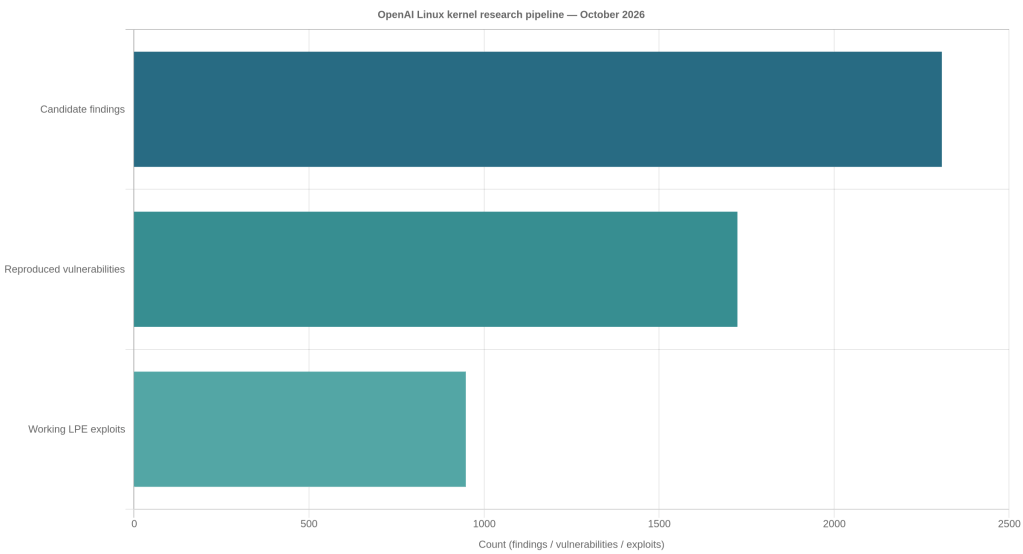
The November 4 Linux research report describes an automated pipeline scanning 2,308 candidate findings, reproducing 1,724 vulnerabilities and identifying 948 distinct local privilege-escalation cases with working exploits and proposed patches. The end-to-end run cost approximately $1.21 million in API credits. The claims concern a controlled research environment, not real-world compromises. Some patches were already upstream, while other reports required maintainer review.
OpenAI also says its researchers found 81 previously unknown Firefox vulnerabilities categorized as high severity by Mozilla and identified 30 older issues whose severity warranted reassessment. Mozilla reportedly began releasing fixes after disclosure. The results reinforce the need to distinguish an AI-generated finding from a tested flaw and an accepted patch, a process also central to our earlier AI-assisted Linux kernel vulnerability coverage.
Deployment is restricted to vetted defenders
OpenAI assigned GPT-6 Cyber a Critical cybersecurity capability classification under its Preparedness Framework. The rating describes potential model capability and associated safety controls, not a claim that the model is inherently dangerous in every application. Daybreak Red access requires approval; OpenAI describes IP allowlisting, monitoring, sandboxed workflows and extra restrictions around critical industrial systems.
Candidate patches must still be assessed for regressions, disclosure timing and compatibility. Separate Brotli vulnerability reporting illustrates why downstream maintainers need verified mitigations rather than raw exploit descriptions. Software vendors and open-source teams may benefit from faster discovery, but higher finding volumes can overwhelm maintainers if triage quality falls.
The next tests are independently reproduced findings, accepted patches, reliable containment and transparent disclosures. Developers can also pair agent-generated research with established CodeQL static analysis workflows and conventional human review. No general-public deployment date or cross-vendor field performance figure was provided.
BitcoinVersus.tech is not a financial advisor. This media platform reports on technical and financial subjects purely for informational purposes.
We volunteer daily to improve the credibility of the information on this platform. If you would like to support the research, please donate here: 3C9o19EH5HSiwEPyCTmEKzxhNCbo2X6TTb

Scan the donation code from another device if your phone cannot scan its own screen.
Editor’s Note. Model capabilities, benchmark results, Linux and Firefox findings, and access controls are attributed to OpenAI’s November 4–5, 2026 technical publications. Controlled demonstrations do not establish real-world attack rates or independent model performance. Both charts use sourced company-reported measurements and the featured cover is editorial illustration. No verified playable YouTube or native X embed was identified.


Leave a Reply