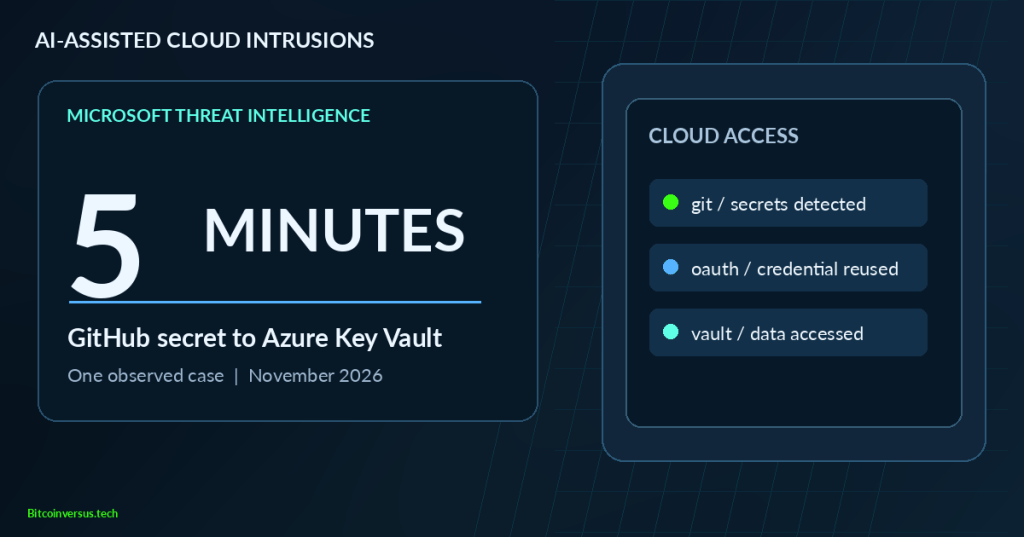
Cloud applications often authenticate through service principals, software identities that let programs reach storage, databases and other protected services. Their credentials can become dangerous when developers accidentally commit secrets to public repositories. Microsoft Threat Intelligence reported on November 5, 2026, that AI-assisted intrusions exploited the exposure, including one observed case progressing from a GitHub secret search to Azure Key Vault data theft in five minutes. The report describes real malicious activity, not a simulated benchmark.
Microsoft Learn — “Configure and use secret scanning in your GitHub repository | GH-500 | Episode 4,” published January 26, 2026. Official security tutorial explains prevention and detection of exposed credentials; the video is background instruction, not footage of the reported intrusion.
From Public Code to Cloud Resources
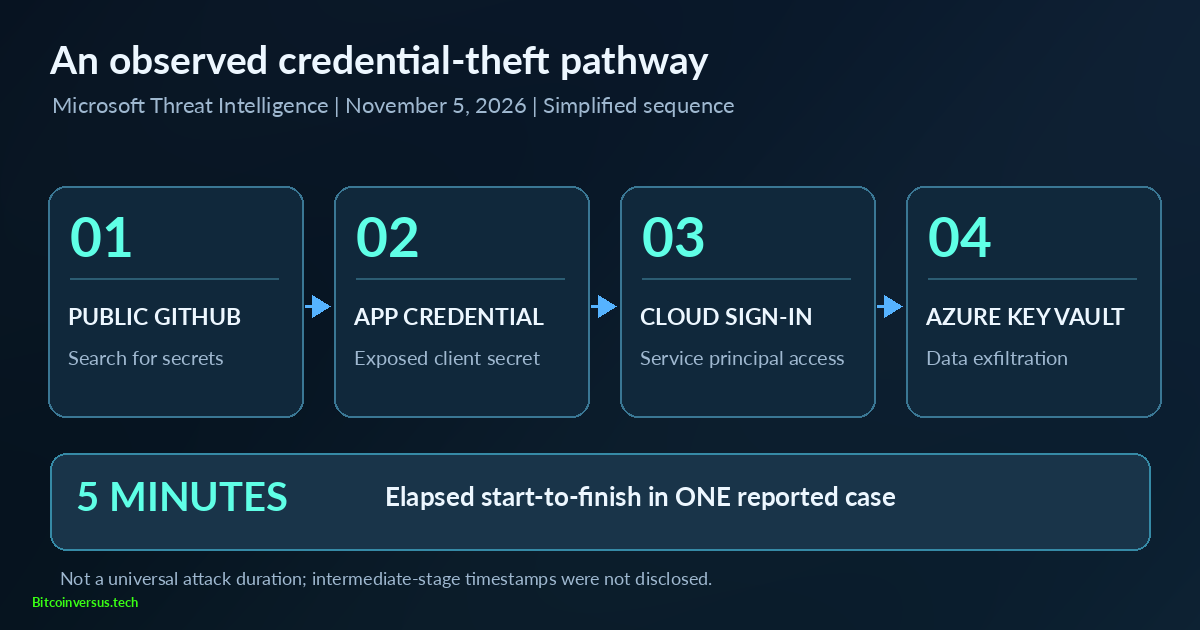
Microsoft said investigators first observed threat actors using agentic AI tooling to search GitHub repositories in August 2026. Rather than manually reviewing code one repository at a time, automated workflows searched for application secrets and cloud-service credentials, then evaluated whether discovered material could support further access. The site’s earlier Git and GitHub explainer describes how code and revision histories can remain accessible after publication.
By October 28, Microsoft observed successful application-identity sign-ins across dozens of applications and multiple tenants. In some cases, compromised credentials belonging to a multitenant application allowed access to downstream customer environments. Investigators documented subsequent searches of cloud resources and attempts to retrieve credentials from storage, application settings and Key Vault. The five-minute interval describes one case from GitHub discovery to exfiltration, not a measured average for every intrusion.
Machine-Speed Cloud Activity
Microsoft documented cloud API requests that adapted after failures. One batch using an unsuitable API version returned errors; a revised batch for the same vault paths succeeded about 28 seconds later. Other operations were retried roughly 60 and 80 seconds after initial errors. The sequence suggests automated troubleshooting, but observed retries alone do not establish that every decision was made autonomously without human input.
A separate Microsoft report published November 6 linked the agentic offensive framework ARTEX to activity by Storm-3358, a Cambodia-based financially motivated group targeting financial organizations, particularly in Southeast Asia. Microsoft described scanning, exploitation and remote-access malware installation alongside conventional tools. The group-focused report adds context to evolving AI-assisted threats; it does not establish that Storm-3358 conducted the five-minute Key Vault incident.
Why Removing a Leaked Secret Is Not Enough
An exposed application secret may remain valid after a repository commit is deleted. Microsoft advises organizations to revoke or rotate leaked credentials, inspect associated access and limit application privileges. The risk illustrates why GitHub’s secret-scanning improvements and API-key push protection matter: detection before publication reduces exposure, while incident response must address credentials already copied elsewhere.
GitHub’s push-protection documentation explains how supported secrets can be blocked at commit time. Microsoft’s Safe Secrets Standard recommends managed identities, workload identity federation and minimizing long-lived credentials. Operators should also audit noninteractive application sign-ins and access to Key Vault and storage resources.
The Boundaries of the Evidence
The five-minute figure illustrates a single observed attack progression. Microsoft did not provide an overall victim count, average attack duration or verified financial-loss estimate for the GitHub-to-Key-Vault activity. Automated credential abuse can accelerate familiar security failures without demonstrating a novel vulnerability in GitHub or Azure Key Vault themselves. Additional perspective appears in the site’s coverage of agent isolation on Windows and the distinct GPT-6 Cyber vulnerability research launch.
Sources: Microsoft Threat Intelligence, November 5, 2026; Microsoft Threat Intelligence, November 6, 2026; GitHub documentation; Microsoft Safe Secrets Standard.
BitcoinVersus.Tech Editor’s Note
Reporting distinguishes Microsoft’s observed activity from editorial interpretation and from the separate Storm-3358 financial-sector investigation. The five-minute interval concerns one case, not an industry-wide mean or laboratory benchmark. The 1200 × 630 featured cover and in-story pathway diagram are original editorial illustrations, not photographs, Azure console captures or forensic timelines. The Microsoft Learn video is independently sourced educational context.
We volunteer daily to ensure the information on this platform is Verifiably True. If you would like to support the research, please scan QR code.

Support independent reporting with an optional donation of 5,000 satoshis. Scan the original QR code from a separate screen using a Bitcoin wallet, or use a compatible saved-image scanner on mobile. Verify destination 3C9o19EH5HSiwEPyCTmEKzxhNCbo2X6TTb and payment amount before sending.
BitcoinVersus.Tech is not a financial advisor. Financial coverage is provided purely for informational purposes.


Leave a Reply