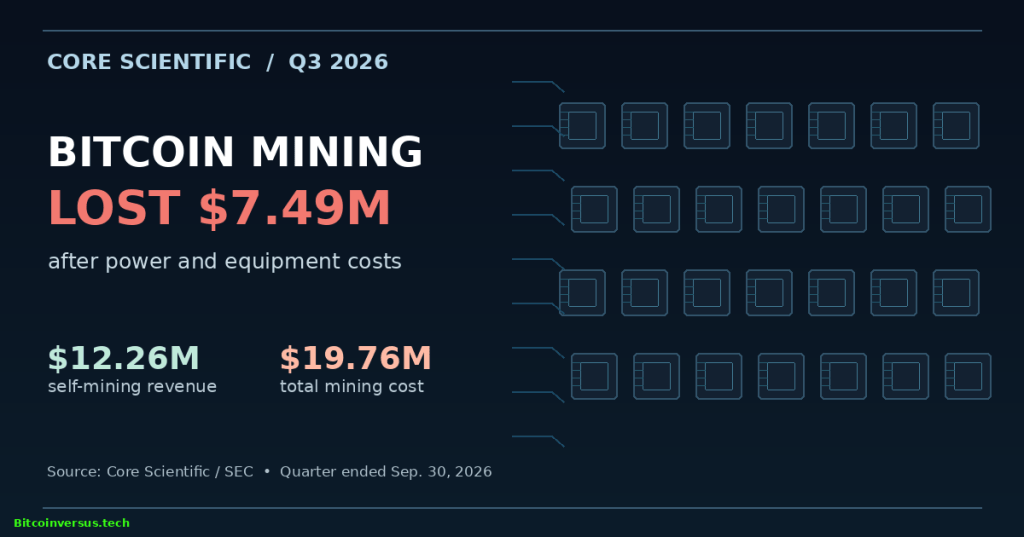
Bitcoin mining converts electricity into SHA-256 computations, but operating a profitable mine requires more than covering the monthly power bill. Application-specific integrated circuits lose value over time, and facilities incur labor, maintenance and operating expenses even when miners continue generating block-reward revenue.
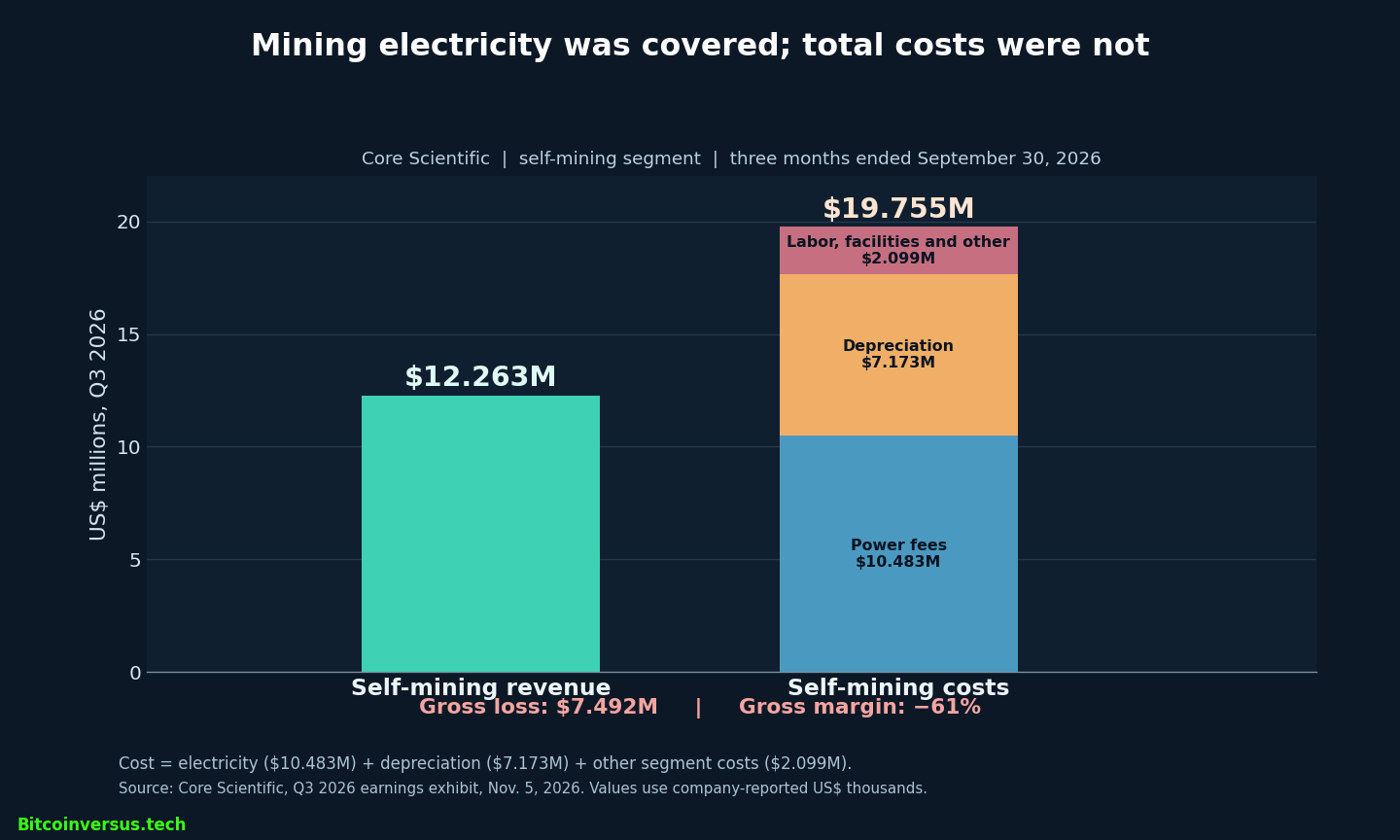
Core Scientific’s November 5, 2026 earnings exhibit filed with the SEC provides a stark example. During the quarter ended September 30, self-mining generated $12.263 million in revenue against $10.483 million in power fees. Yet total mining cost reached $19.755 million, producing a $7.492 million gross loss and a reported negative 61% gross margin.
Core Scientific’s former chief development officer Russell Cann discusses the company’s mining-to-AI transition in a December 18, 2024 interview with Blockspace’s Bitcoin Stock Show. Original interview: Blockspace Media. Historical context only; the video is not the November 2026 earnings call.
Power coverage did not mean profitability
The $1.780 million difference between revenue and power fees is only an electricity-level comparison, not a full operating profit or a cash-flow measure. Quarterly depreciation contributed another $7.173 million of expense. Employee compensation, facility operations and other segment items totaled $2.099 million.
Adding $10.483 million of power fees, $7.173 million of depreciation and $2.099 million of remaining costs produces $19.755 million. Subtracting the amount from $12.263 million of revenue explains the $7.492 million loss. Depreciation is a noncash accounting expense, but it reflects the cost allocation for equipment that must eventually be replaced or retired.
The mining margin worsened even as losses narrowed
Self-mining revenue was $57.438 million in the comparable 2025 quarter, when the reported segment gross margin was negative 3%. By Q3 2026, revenue had declined approximately 78.6%, while the margin fell to negative 61%. The dollar gross loss widened from $2.000 million a year earlier to $7.492 million.
The company is reducing its mining fleet and converting power infrastructure to high-density computing. Earlier BitcoinVersus.Tech coverage documented management’s planned mining exit. The latest cost breakdown explains why a miner can appear to cover electricity yet still destroy accounting value.
Industry comparisons also require careful definitions. TeraWulf’s mining cost assessment separates electricity and depreciation, while Riot’s curtailment credits show how grid-program income can change results without improving ASIC hashrate.
AI colocation generated a very different margin
Core Scientific reported $215.432 million in colocation revenue and $128.373 million in segment gross profit, equivalent to a 60% reported gross margin. Those figures apply to a different business that sells data center space, power and services. Company-wide profitability cannot be inferred by simply comparing the two gross margins; customer concentration and substantial construction spending remain risks.
The quarterly Form 10-Q says one colocation customer generated 93% of consolidated quarterly revenue. Management expects mining operations to continue winding down and hosted mining to conclude by year-end. The timing remains forward-looking rather than a completed shutdown.
For operators still running ASIC fleets, hashprice, energy efficiency and network difficulty remain essential unit economics. But power-only break-even calculations omit depreciation, repairs, staffing, site overhead and financing. Mining companies need to disclose which costs their profitability figures actually include.
Sources and accounting methodology
Core Scientific Q3 2026 earnings exhibit (SEC, November 5, 2026); Core Scientific Form 10-Q for the period ended September 30, 2026; company results announcement (November 5). Calculations use segment figures reported in thousands of US dollars; gross margin uses reported segment revenue as denominator. Historical video interview was published December 18, 2024.
Editor’s Note: The report differentiates self-mining, hosted mining and AI colocation. Revenue above power fees does not establish net profitability or positive operating cash flow. Depreciation is noncash and cannot be equated with an immediate replacement purchase. The featured cover uses a stylized, non-photographic ASIC illustration and does not depict a documented Core Scientific mine. The historical interview is not presented as earnings-call evidence.
Support BitcoinVersus.Tech
To contribute an optional 5,000 satoshis, scan the approved BitcoinVersus.Tech donation QR below with a compatible Bitcoin wallet. On a phone, display the article on another device or use a wallet’s supported saved-image scanning feature. Verify the destination and amount before authorizing payment.

We volunteer daily to ensure the information on this platform is Verifiably True. If you would like to support the research, please scan QR code.


Leave a Reply