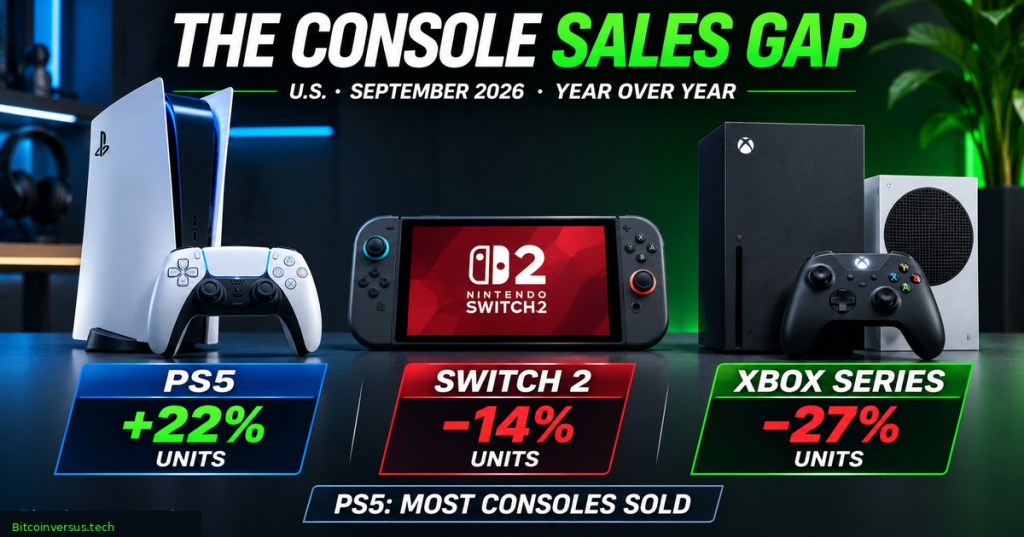
Console sales are measured in two ways that can tell different stories: the number of machines purchased and the dollars consumers spent acquiring them. When buyers select pricier models or retailers raise prices, hardware revenue can grow even while fewer consoles change hands. September’s U.S. gaming market delivered a sharp example, with PlayStation 5 gaining buyers as Xbox Series and Nintendo Switch 2 lost ground year over year.
Circana’s September 2026 market report, published October 28, found PS5 hardware unit sales rose 22% from its September 2025 reporting period. Switch 2 units fell 14%, while Xbox Series X|S units declined 27%. Sony led all U.S. hardware platforms in both unit sales and spending for the month. The figures compare each product family against its own year-earlier level; they are not market shares or absolute console shipment counts.
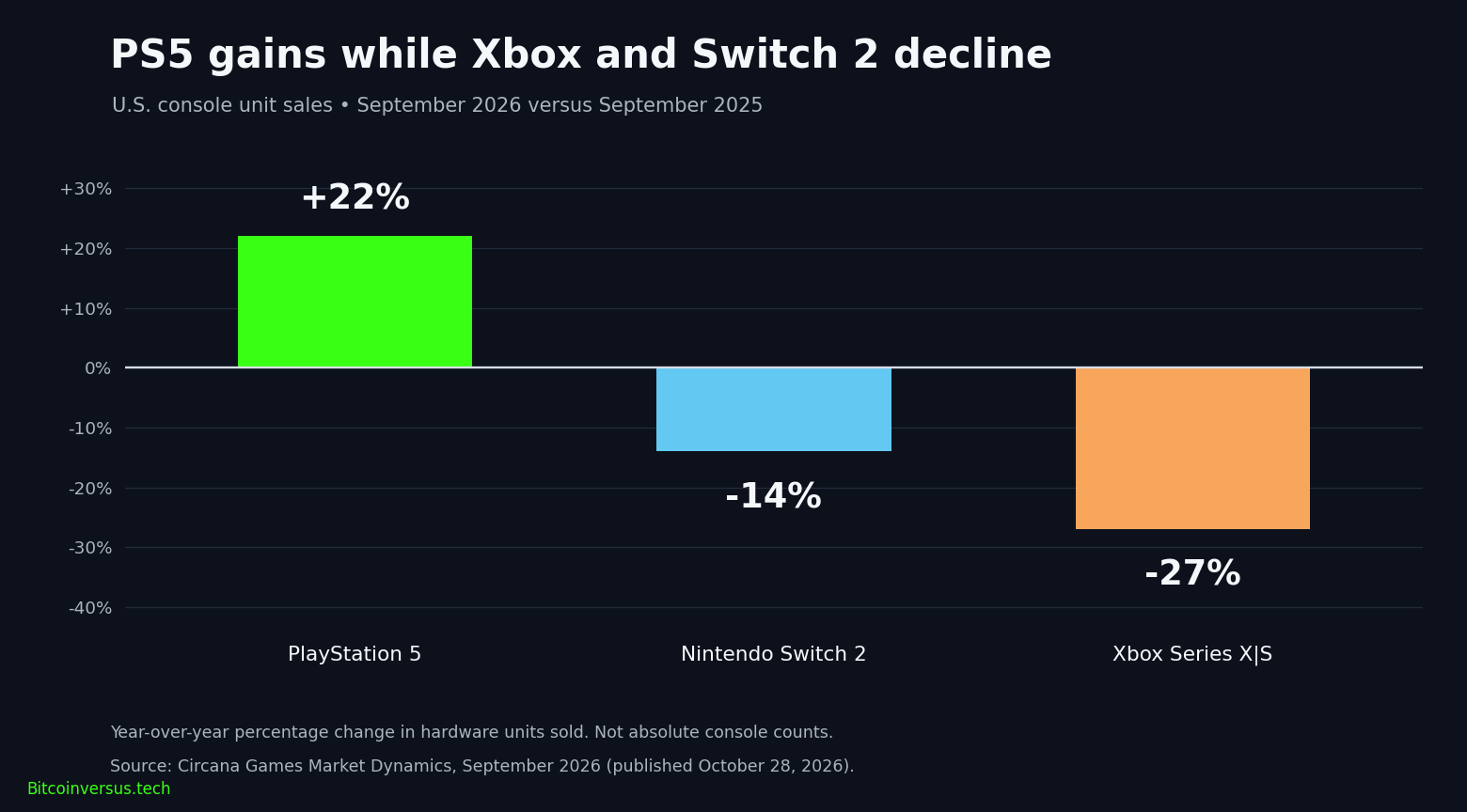
Sony gained sales while its rivals declined
PS5 also delivered the strongest increase in consumer hardware dollars: 43% above the corresponding 2025 month. Nintendo Switch 2 hardware spending fell 12%, and Xbox Series spending slipped just 2% despite the much sharper decline in Xbox units. Circana said the Xbox ecosystem reached its lowest September console unit volume on record. The statement concerns one calendar comparison month, not an all-time annual sales total.
The divergence makes the Xbox result especially important. A 27% decline in units means consumers bought substantially fewer consoles, even though spending on those consoles was nearly level year over year. Earlier reporting on Microsoft’s next Xbox plans examines future hardware possibilities; the September data measure present sales of existing Xbox Series devices, not future designs.
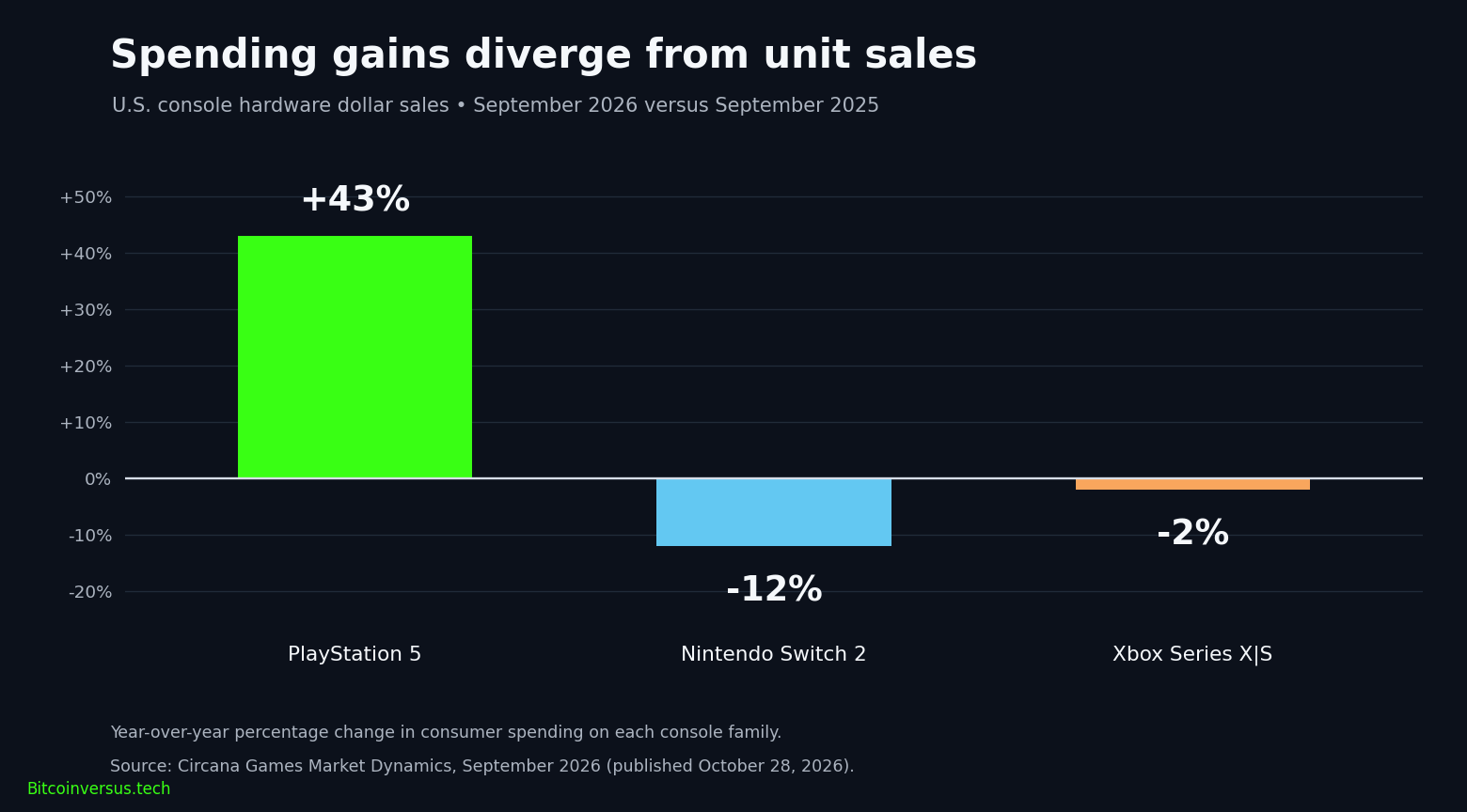
The price-mix calculation explains the apparent contradiction
Dollar spending equals units purchased multiplied by average spending per unit. Dividing each reported spending-growth factor by its unit-growth factor implies a roughly 17% increase in average dollars per PS5 sold, about 34% for Xbox Series, and roughly 2% for Switch 2. For PS5, the calculation is 1.43 ÷ 1.22 − 1 ≈ 17.2%. Estimates use rounded percentage changes; individual console prices, model mix, discounts and bundles remain unspecified in the published summary.
Overall U.S. hardware units declined 3%, yet spending increased 12% to $362 million. Even with the September rebound, hardware spending for 2026 through September was 9% below the corresponding 2025 period, at about $2.9 billion. A strong month does not erase a weaker nine-month trend.
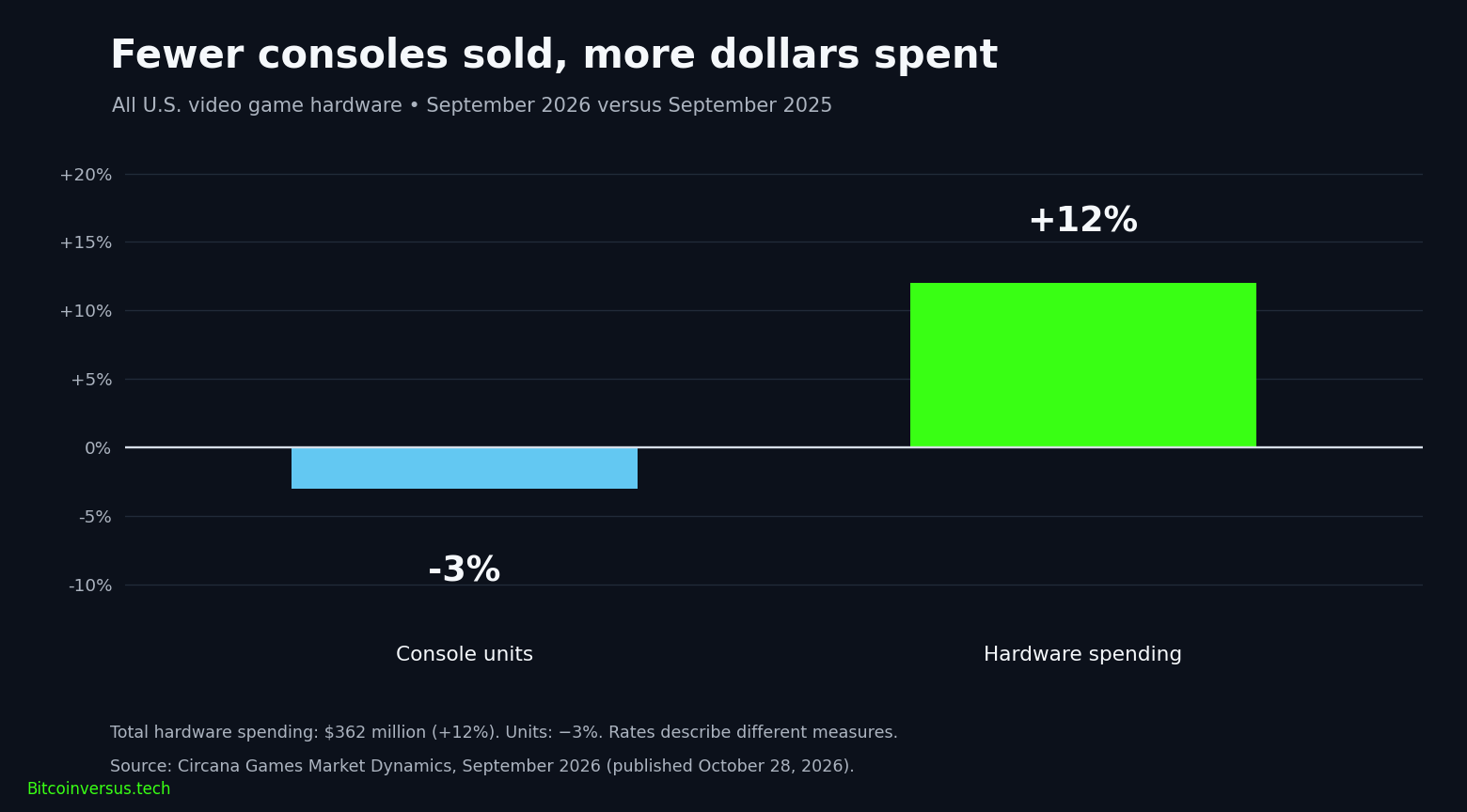
Wolverine led the software rankings
Circana ranked Marvel’s Wolverine first in U.S. full-game dollar sales for September, ahead of NBA 2K27 and EA Sports FC 27. It was the strongest Sony-published launch month by full-game dollar sales since Helldivers II in February 2024. The coincidence with PS5 hardware growth supports a launch-window explanation, but the report does not quantify precisely how many consoles were purchased because of Wolverine.
Marvel’s Wolverine official launch trailer, published September 17, 2026 by the verified Marvel Entertainment YouTube channel. The trailer illustrates September’s leading software release, not console-sales measurements.
Software performance matters because consoles compete as ecosystems. Earlier BitcoinVersus.Tech coverage compared the 2026 sports-game sales race; Sony’s image-upscaling upgrades and Switch 2 graphical improvements represent other ways platforms try to retain players. None of those separate announcements establishes a causal effect on the September sales figures.
Across games, hardware and accessories, Circana estimated $4.756 billion in September U.S. spending, 1% below a year earlier. Game content represented about $4.177 billion, down 2%; accessories reached $218 million, up 10%. Dollar values are rounded, and digital sales include projections where Circana identifies them.
A separate Nintendo earnings report addresses a longer corporate period and should not be confused with Circana’s U.S. September retail tracking. The clearest conclusion remains local and measurable: PS5 gained unit demand, Xbox and Switch 2 lost units, and higher dollars per machine helped keep total hardware spending positive despite fewer purchases.
Primary sources: Circana, September 2026 Games Market Dynamics (published October 28); Circana hardware and content market summary; Marvel Entertainment, official Wolverine launch trailer (September 17). Cross-check: Video Games Chronicle, October 22.
Editor’s Note: All U.S. console unit and spending changes are attributed to Circana’s September 2026 reporting period. Dollar-per-unit growth is calculated from rounded changes and is not an independently verified manufacturer price increase. The report does not disclose absolute platform-specific unit counts in its public summary. The charts were built from source figures with zero baselines. The featured cover is AI-generated conceptual artwork using console likenesses, not a documentary photograph. The Wolverine trailer is official, historical context; its presence is not proof that the game caused all hardware growth. Independent video playback has not been verified.
Support BitcoinVersus.Tech
To support independent technology reporting, scan the original donation QR below for an optional 5,000-satoshi contribution. On a phone, display the code on another screen and scan with a compatible Bitcoin wallet, or import the saved QR image if supported. Verify the destination and amount before confirming payment.

We volunteer daily to ensure the information on this platform is Verifiably True. If you would like to support the research, please scan QR code.


Leave a Reply