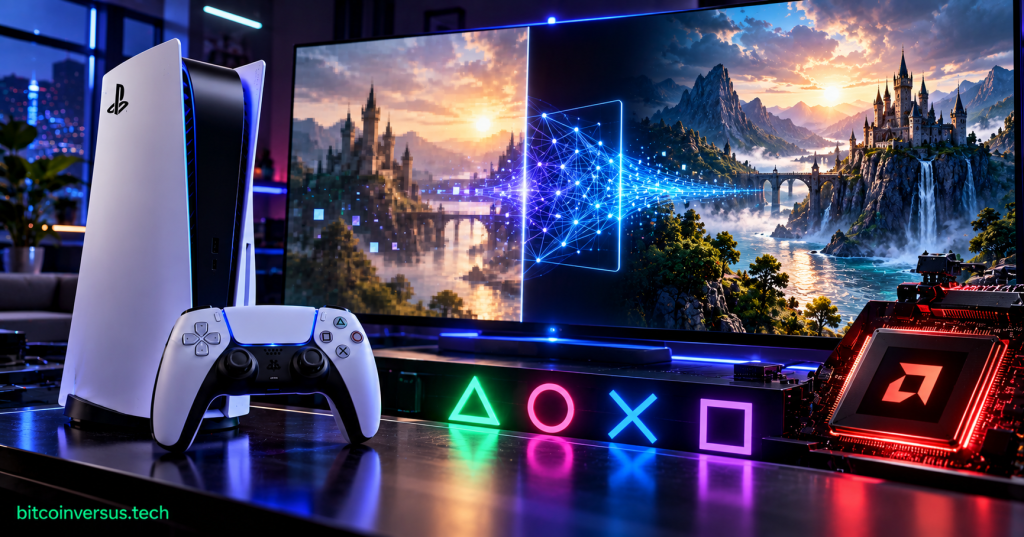
Sony is bringing machine-learning image reconstruction to the standard PlayStation 5 with Quick Spectral Super Resolution, or QSSR, a new AI upscaling library designed to deliver sharper and more stable images without requiring a PS5 Pro.
In its October 1 engineering announcement, Sony Interactive Entertainment said QSSR was born from Project Amethyst, its graphics collaboration with AMD. The technology uses a streamlined neural-network architecture plus a hand-tuned implementation designed specifically around the performance limits of the base PS5.
Sony is shrinking AI upscaling to fit older console hardware
The challenge is that the standard PS5 was not built with the dedicated machine-learning hardware available in the PS5 Pro. Sony therefore could not simply copy PlayStation Spectral Super Resolution, or PSSR, onto the older console and expect the same performance.
Instead, QSSR is a separate performance tier. Sony says PSSR remains the higher-end solution on PS5 Pro, while QSSR gives the standard PS5 a lighter model intended to improve image detail and temporal stability at a lower compute cost.
Tom’s Hardware independently reports that QSSR is designed to let games render internally at lower resolutions while reconstructing a sharper final image, giving developers another way to balance frame rate, rendering cost and image quality on the original PS5 hardware.
Marvel’s Wolverine and Ghost of Yōtei are first
Marvel’s Wolverine and Ghost of Yōtei are the first two games to receive QSSR as an additional graphics option. Sony says both titles were patched on October 1, and the company plans to offer the QSSR library broadly to PlayStation developers rather than keeping it limited to first-party studios.
That matters because console upscaling is becoming part of the rendering pipeline rather than an optional visual filter. Developers can spend fewer GPU cycles rendering every pixel natively and use reconstruction to recover detail afterward, potentially freeing more of the frame budget for geometry, lighting, simulation or higher frame rates.
BitcoinVersus recently covered The Witcher 3 Remastered and its path-tracing upgrade, another example of modern game graphics leaning increasingly on reconstruction and specialized rendering techniques rather than brute-force native resolution alone.
Digital Foundry shows what the neural network is actually fixing
Digital Foundry’s hands-on analysis focuses on the details that conventional screenshots often hide: temporal stability, fine geometry, sub-pixel detail, foliage and the shimmering artifacts that can appear when a game reconstructs moving images from lower internal resolutions.
The analysis is especially relevant because QSSR is running on a console that lacks the dedicated ML acceleration Sony added to PS5 Pro. That forces the base console implementation to lean heavily on more conventional GPU math while still trying to preserve the neural-network benefits of the larger PSSR approach.
This is also an AMD story
QSSR comes out of Project Amethyst, Sony’s collaboration with AMD on machine-learning graphics. That makes the technology interesting beyond PlayStation because the companies are effectively exploring how neural image reconstruction can be adapted across different levels of GPU hardware rather than being reserved only for new flagship silicon.
The same software-versus-hardware tradeoff appears across gaming platforms. BitcoinVersus recently examined Valve bringing SteamOS gaming to ARM64 hardware, where platform software is also being stretched across hardware architectures that were not originally the center of PC gaming.
And on the PlayStation side, BitcoinVersus covered AnyPS5’s attempt to run PS5 games natively on PC, another reminder that the boundaries between console hardware, software translation and platform-specific optimization are becoming more technically interesting.
QSSR could extend the useful life of the base PS5
The biggest practical implication is longevity. As games become more demanding, developers usually face a choice between lowering internal resolution, reducing visual features or accepting lower frame rates. A better reconstruction method gives them another lever.
QSSR will not turn a standard PS5 into a PS5 Pro. Sony is explicit that PSSR remains the higher-quality solution on the more capable console. But bringing a streamlined neural upscaler to the installed base changes what developers can reasonably target without requiring players to replace their hardware.
That is why QSSR is more than a graphics toggle. It is a software upgrade to the console’s rendering budget, and if enough developers adopt it, AI reconstruction could become a standard part of how the original PS5 survives the later years of its generation.
BitcoinVersus.Tech
Advertisement
Editor’s Note:
We volunteer daily to ensure the credibility of the information on this platform is Verifiably True. If you would like to support to help further secure the integrity of our research initiatives, please donate here: 3C9o19EH5HSiwEPyCTmEKzxhNCbo2X6TTb
BitcoinVersus.tech is not a financial advisor. This media platform reports on financial subjects purely for informational purposes.


Leave a Reply