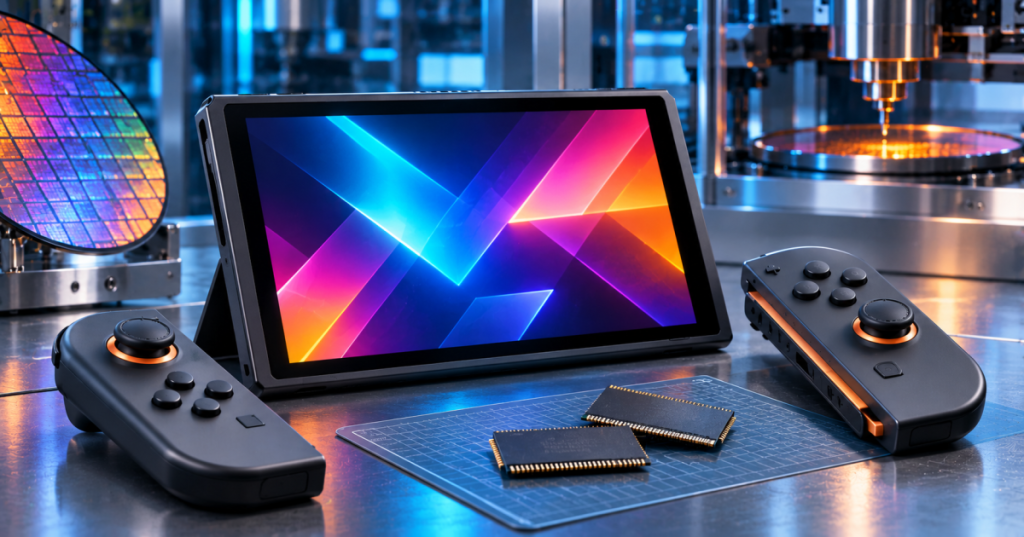
Nintendo’s November 5, 2026 earnings presentation shows Switch 2 hardware sell-in falling to 2.67 million units during the July–September quarter, compared with 4.54 million a year earlier. The roughly 41% year-over-year decline follows hardware price increases and rising memory-component costs. However, Nintendo did not identify a single factor explaining the entire shipment decline.
For the six months ended September 30, Switch 2 shipments totaled 6.49 million units, down 37.4% from 10.36 million a year earlier. The company maintained its existing 16.5 million-unit hardware sales forecast for the full fiscal year ending March 2027. The figures measure Nintendo’s sell-in to outside customers and distributors, rather than exclusively purchases by consumers at retail.
Nintendo of America’s official April 2025 Switch 2 overview trailer introduces the console hardware and controllers. The historical product video is not footage of the November 2026 financial results.
Higher prices meet softer hardware demand
Nintendo’s May 8 price revision raised the U.S. Switch 2 suggested retail price from $449.99 to $499.99, effective September 1, 2026. It also revised prices in Japan, Canada and Europe, although effective dates and product configurations differed by market. Rising production costs and changing market conditions were part of the company’s stated rationale.
Nintendo’s 2027 fiscal forecast accounts for approximately ¥100 billion of cost-of-sales pressure from rising components—especially memory—and tariffs together. That estimate is not a measured loss caused solely by DRAM, and it should not be confused with the price increase itself. The hardware-cost pressure connects directly to earlier BitcoinVersus.Tech coverage explaining RAM, VRAM and game-console storage.
Software sales climb while console shipments fall
Switch 2 software sell-in increased 18.8% to 24.49 million units during April–September. Nintendo reported 2.42 million copies of Splatoon Raiders and 1.17 million of Star Fox, while established releases including Mario Kart World continued selling. Those are first-half totals or title-level sales, not figures for the July–September quarter alone.
Across the company, six-month revenue fell 12.1% to ¥966.0 billion, even as operating profit rose 49.1% to ¥216.5 billion. Nintendo attributed the profitability improvement to the greater mix of software sales and a first-quarter U.S. tariff refund, among other factors. A rise in profit therefore does not establish stronger console demand.
Nintendo of America’s June 2026 Star Fox launch trailer illustrates one first-party Switch 2 title included in Nintendo’s software-sales discussion. The clip predates the earnings release.
What Nintendo expects next
The company kept its annual Switch 2 forecast at 16.5 million systems, below the 19.86 million sold in the preceding fiscal year. The projection assumes further growth in the installed base as Nintendo promotes new and existing releases. The Switch 2 version of Minecraft and other publisher titles add to the library, although Nintendo’s own guidance does not guarantee that software releases will reverse the recent quarterly hardware decline.
Memory manufacturers are also balancing consumer electronics against demand from AI servers. Earlier BitcoinVersus.Tech reporting covered Samsung’s AI-memory business, while a separate CXL memory-pooling explainer describes how data centers are seeking larger and more flexible memory capacity. Neither article demonstrates a direct allocation shortage for Nintendo’s specific suppliers.
Reporting on President Shuntaro Furukawa’s remarks indicates Nintendo believes it can secure sufficient memory and is not currently preparing another Switch 2 price increase. The financial results nevertheless show the challenge for console makers: protecting margins while persuading consumers to buy hardware after a price hike. Earlier discussion of console generations and long hardware lifecycles provides useful market context.
Editor’s Note: Nintendo’s November 5 financial results and investor presentation provide the primary unit-sales, profit and forecast figures. CNBC and Associated Press provide independent context. The 41% decline refers to quarterly hardware sell-in, not six-month sales; the ¥100 billion cost assumption combines components and tariffs. The featured art is conceptual, and both official videos predate the financial results.

For mobile scanning, open the article on another screen and scan the original QR code with a compatible Bitcoin wallet. Verify the destination before donating 5,000 sats: 3C9o19EH5HSiwEPyCTmEKzxhNCbo2X6TTb.
We volunteer daily to ensure the credibility of the information on this platform is Verifiably True. If you would like to support our work and help further secure the integrity of our research initiatives, please scan the QR code below to donate 5,000 sats.
BitcoinVersus.tech is not a financial advisor. This media platform reports on financial subjects purely for informational purposes.


Leave a Reply