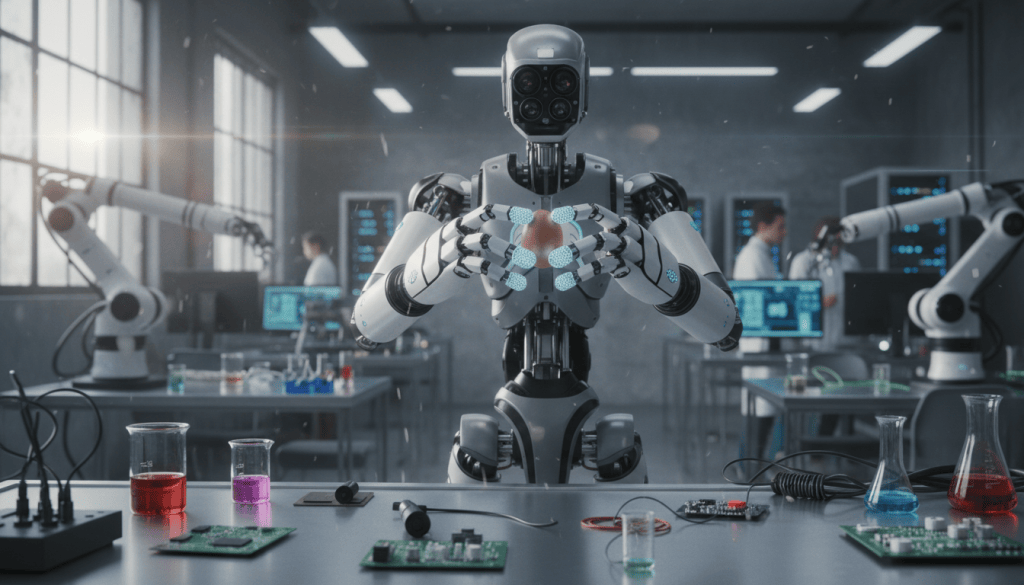
Panasonic Holdings announced on November 5 that its researchers and collaborators developed T-Rex, a tactile-reactive robot manipulation system that combines vision, language and fingertip feedback. In laboratory evaluations covering 12 contact-intensive tasks, the system achieved a 65% average success rate, compared with 35% for the strongest baseline in the researchers’ comparison. The team plans to present its work at the Conference on Robot Learning in Austin, Texas, November 9–12.
Vision-language-action models translate camera observations and instructions into robot movements. Cameras can identify an object, but a gripper also needs to detect slipping, pressure and deformation after contact. Related research on human motion and tactile training data addresses the same gap between visual understanding and reliable physical manipulation.
Two control loops for one pair of hands
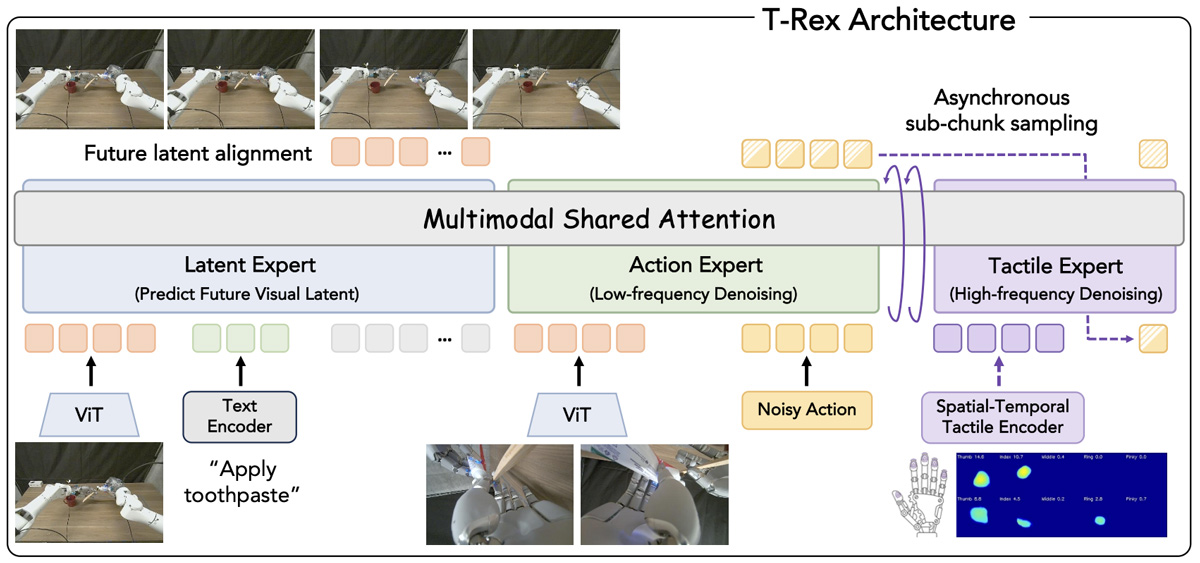
According to Panasonic’s technical announcement, T-Rex generates its broader action sequence from visual and language inputs at approximately five updates per second. A separate tactile correction mechanism operates at approximately 20 updates per second. Faster touch-based corrections allow the controller to react to changing contact conditions without waiting for a complete visual planning cycle.
The architecture separates broad task planning from local feedback, a useful distinction when a robot handles fragile objects or manipulates small parts. The approach also complements work on contact planning for humanoid robots, where physical stability and reliable contact transitions influence task success.
Training and measured results
The researchers report collecting more than 7,700 bimanual manipulation episodes totaling about 100 hours, using more than 200 objects and 22 action types. Data include camera observations, hand movements, fingertip force and deformation signals, and instructions. Pretraining also used 22,889 hours of human first-person video, followed by robot-specific training and approximately 100 demonstrations per evaluated task.
Tasks included page turning, egg transfer, toothpaste application, key operation, card extraction and light-bulb insertion. The research project’s demonstration gallery provides original robot rollout videos and comparisons. The reported average fell to 42% when tactile information was removed. The difference supports the researchers’ conclusion that touch feedback materially improved results in the evaluated setup, although performance on unfamiliar industrial workflows remains unproven.
The project describes 16 randomized trials per task. The reported 65% figure is a macro-average across the 12 tasks, not a guarantee that any particular operation succeeds at that rate. Evaluation on one research platform does not establish robustness across different robot hands, sensors, objects or factory conditions.
Potential uses and remaining questions
Panasonic identifies delicate assembly, component insertion and fragile-item logistics as potential applications. Related force-sensing robot hand development also targets the challenge of reliable physical contact. The findings are research results, not evidence of commercial deployment. A separate robotics manipulation study likewise illustrates why task-specific testing is essential before laboratory performance can be generalized.
Researchers still need to demonstrate durability, recovery from failures, safe operation around workers and performance under changing lighting, object geometry and sensor wear. The next milestone is the conference presentation and subsequent independent evaluation. The technical paper and project demonstrations provide a starting point for examining the model and experimental methods.
BitcoinVersus.Tech Editor’s Note: We volunteer daily to ensure the credibility of the information on this platform is Verifiably True. If you would like to support to help further secure the integrity of our research initiatives, please donate using the QR code provided

For best QR-code scanning results, please scan this donation code from a desktop or larger screen. Mobile screens may prevent camera recognition. Verify the receiving address 3C9o19EH5HSiwEPyCTmEKzxhNCbo2X6TTb before sending.
Disclaimer: BitcoinVersus.Tech is not a financial advisor. This media platform reports on financial subjects purely for informational purposes.


Leave a Reply