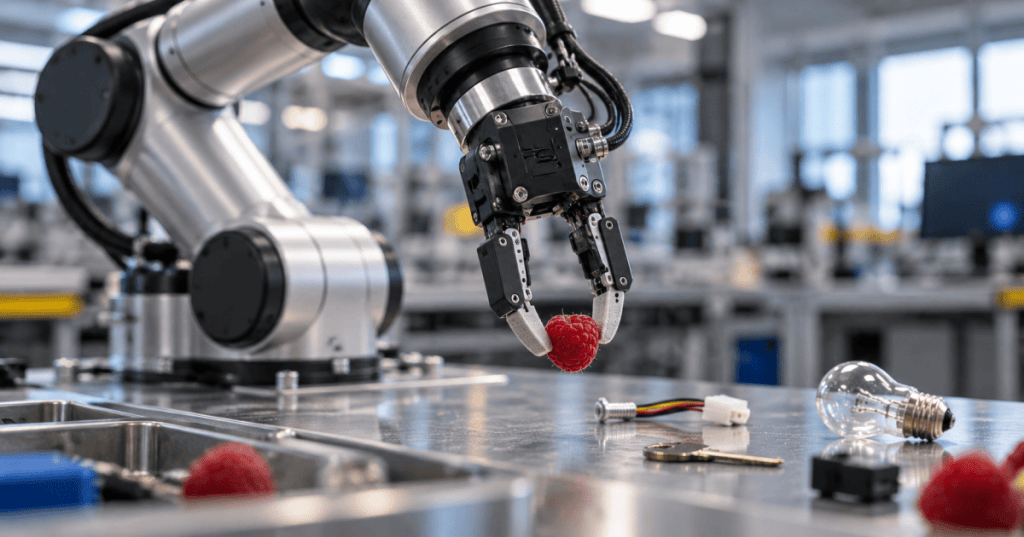
October 21, 2026 — Cambridge, Massachusetts. Eka Robotics announced a $150 million Series A led by Andreessen Horowitz (a16z) and F-Prime. TechCrunch reports a $1.45 billion post-money valuation. The company develops robotic grippers that combine vision, contact-force sensing and reinforcement learning to handle varied objects quickly.
Key Takeaways
- Founders Pulkit Agrawal, an MIT professor, and Tuomas Haarnoja, formerly at Google DeepMind, are developing physical AI for dexterous manipulation.
- Eka reports 1,500 object picks per hour, compared with its selected human benchmark of approximately 600.
- The funding will support further training, additional tasks and industrial customer deployments.
- The speed claims describe particular demonstrations and tests, not independently established performance across entire factory shifts.
How Robots Learn To Feel
Eka calls its approach Vision-Force-Action (VFA). Cameras locate objects, while force-sensitive grippers measure contact and adjust movement as objects shift or resist. The model learns physical interactions through simulated practice and reinforcement learning, then transfers skills to real hardware. It differs from vision-language-action models that emphasize interpreting images and instructions. For the engineering fundamentals, see our robot force-control lesson and report on tactile robot fingertips.
The following YouTube program discusses Eka’s original April robot demonstration beginning at 05:40. It predates the new financing announcement.
The Speed Claim Needs Context
Eka says its robot can pick objects weighing up to one kilogram and achieve more than 95% successful picks, according to TechCrunch’s October 20 reporting. Its 1,500-versus-600 comparison is roughly 2.5 times the selected human rate. Performance under changing materials, prolonged duty cycles, failures, maintenance and worker safety remains to be established in public production data.
An earlier robotics-industry social post highlights Eka’s approach. It is contextual footage, not independent certification of the throughput figures.
What Comes Next
Eka’s industrial pilots reportedly include pick-and-place and wire-handling applications. It says current grippers are rated for five million cycles, with a 20-million-cycle target. The critical next evidence is shift-long throughput, reject rates, task-transfer speed and operating cost. As BitcoinVersus.Tech explored in our 2023 AI-and-robotics workforce report, productivity claims matter most when repeatable outside controlled demonstrations.
Sources: Eka’s October 20 announcement; a16z’s investor statement; TechCrunch’s valuation and demonstration reporting.
BitcoinVersus.Tech Editor’s Note: We volunteer daily to ensure the credibility of the information on this platform is Verifiably True. If you would like to support to help further secure the integrity of our research initiatives, please donate using the QR code provided

For best QR-code scanning results, please scan this donation code from a desktop or larger screen. Mobile screens may prevent camera recognition.


Leave a Reply