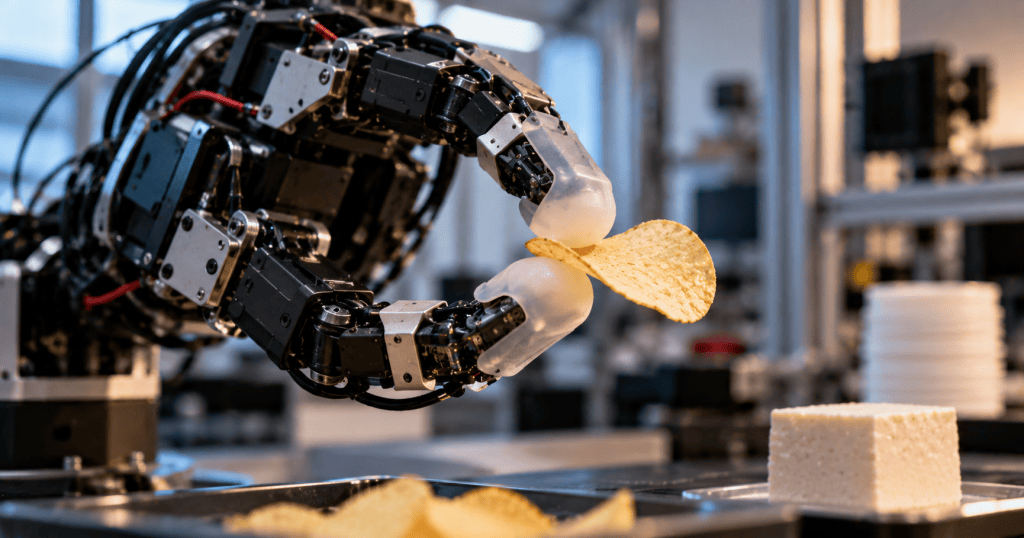
Carnegie Mellon University researchers have built robotic fingertips that can sense how hard they are squeezing, detect tiny vibrations through a plastic fingernail, and use that information to handle fragile objects such as potato chips and tofu.
The work comes from Carnegie Mellon’s Robotics Institute and extends the team’s DeltaHands platform. CMU says the new fingertips combine force sensing and vibration sensing so a robot can react to contact rather than depending only on cameras.
A Strain Gauge Measures Squeezing Force
Each fingertip uses a strain gauge to measure how much force the robot applies while pinching an object. That gives the controller direct feedback about grip pressure instead of forcing it to estimate contact from motor position alone.
That matters when an object can deform or break easily. A potato chip, pill, tofu cube, paper cup, or thin sheet does not tolerate the same grip force as a rigid tool or metal part. The robot needs to know when it has made contact and whether it is squeezing too hard.
A Plastic Fingernail Listens For Microvibrations
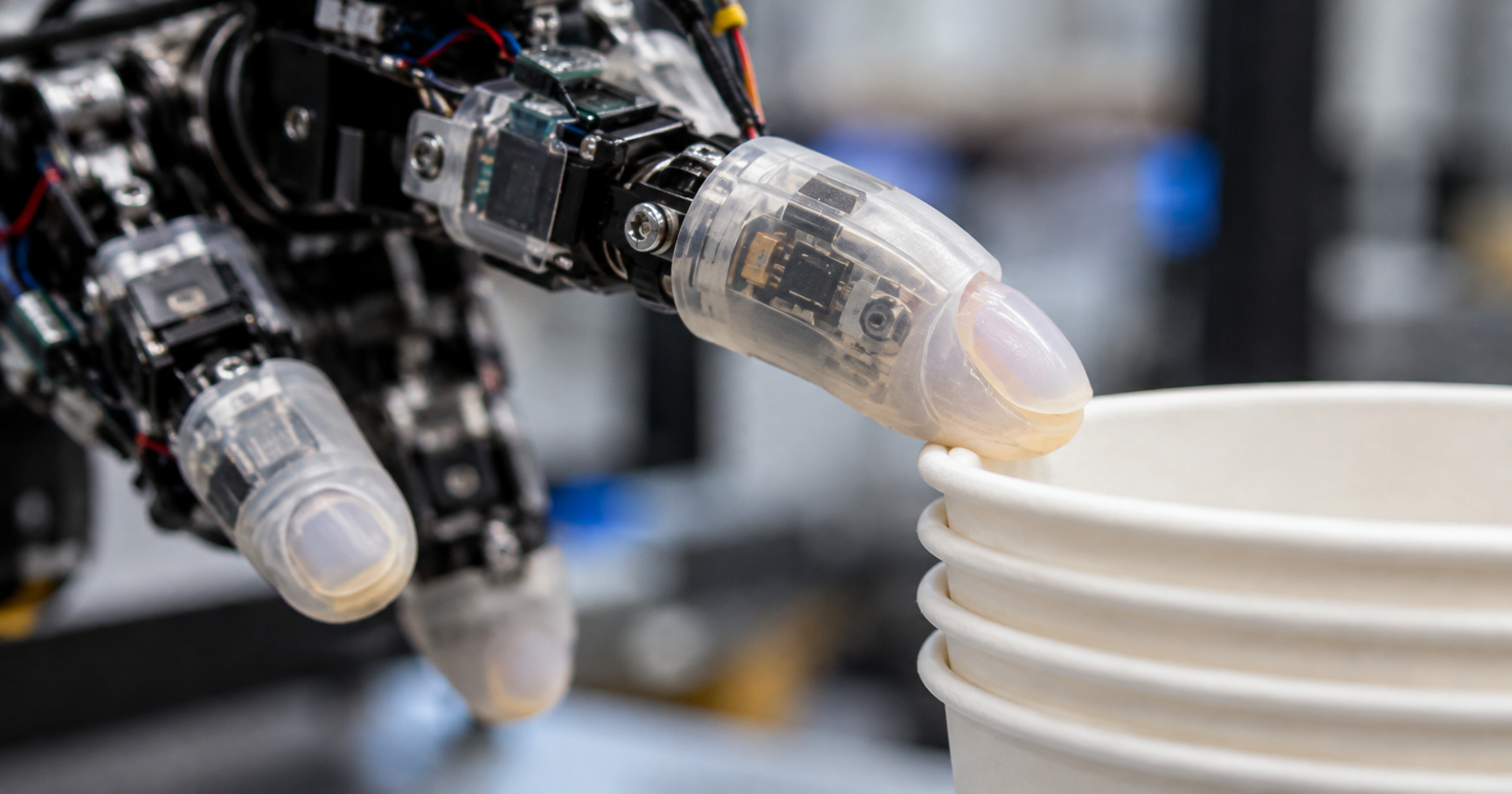
The second sensor is a contact microphone mounted behind a small plastic fingernail. When the fingertip slides over a surface, hits an edge, or begins to slip, those interactions create tiny vibrations that travel through the nail.
The microphone captures those high-frequency vibrations. The robot can then distinguish physical events that may be difficult to see with a camera, including fine texture changes, hidden edges, and the start of a slipping grasp.
The Silicone Skin Adds Grip
The sensor package is wrapped in soft silicone. That outer layer improves friction and makes the fingertip more forgiving during contact. The design does not try to reproduce a human finger perfectly; it borrows the useful combination of compliant skin, force sensing, and a hard nail-like structure.
CMU reports that the complete fingertip costs less than $100 in components, compared with roughly $800 to assemble a similar sensing setup from commercial parts. The significance is not the price itself but the fact that tactile sensing can be added to a configurable research hand without turning every finger into an expensive custom instrument.
The Robot Could Count Cups Without Seeing The Edges Clearly
To test the fingertips, the researchers asked the hand to count and separate stacked paper cups. The plastic nail could slide along the cup rims while the microphone detected the small vibration changes created by each edge.
That is a useful demonstration because visual sensing can become unreliable when one object blocks another. Touch provides another channel. A robot can physically explore the stack and detect structure that a camera cannot see directly.
It Could Also Tell Materials Apart
The team also moved the fingertips across materials such as coarse fabric and wax paper. Different surfaces produced different vibration signatures, allowing the system to infer what kind of material it was touching.
This is one reason tactile sensing matters for general-purpose robots. Two objects can look similar while behaving very differently under contact. A bag of rubber bands and a box of nails, for example, may require different grip force and different handling even if their containers look alike.
Touch Is Becoming A Bigger Part Of Robot Dexterity
BitcoinVersus.Tech has been following the same shift across multiple robot-hand designs. Sharpa paired a dexterous robot hand with tactile sensing and a haptic glove, while Amazon’s Vulcan warehouse robot added touch sensing for contact-heavy manipulation. ETH Zurich even built a robot hand that can use its fingers as legs.
The common direction is clear: cameras are not enough for fine manipulation. A robot that works around people and ordinary objects needs to know when contact happens, how force is changing, whether something is slipping, and what the surface feels like.
The Fingertips Were Tested On Fragile Objects
The CMU team tested the system on delicate objects including tofu cubes and potato chips. Those tests force the controller to balance two competing requirements: squeeze hard enough to hold the object, but not hard enough to crush it.
The researchers also demonstrated slip detection. When an object begins moving inside the grasp, the vibration signal can warn the controller before the object falls completely, giving the robot a chance to adjust its grip.
What Comes Next
The team plans to expand sensing beyond the fingertips and into more of the DeltaHands structure. That could give future versions a richer picture of contact across an entire grasp instead of only at the ends of the fingers.
The larger goal is not a robot hand that copies a human hand exactly. It is a robot hand that can gather enough physical information to manipulate real objects safely and reliably—even when vision alone does not explain what is happening.
Editor’s Note
The featured image and body image are separate original photorealistic editorial illustrations created specifically for this story. The YouTube video is embedded as a responsive native Gutenberg player, and the Reddit discussion is embedded directly in the article. No normal story text is placed inside cards, panels, callouts, or text boxes.
BitcoinVersus.Tech content is provided for informational and educational purposes.


Leave a Reply