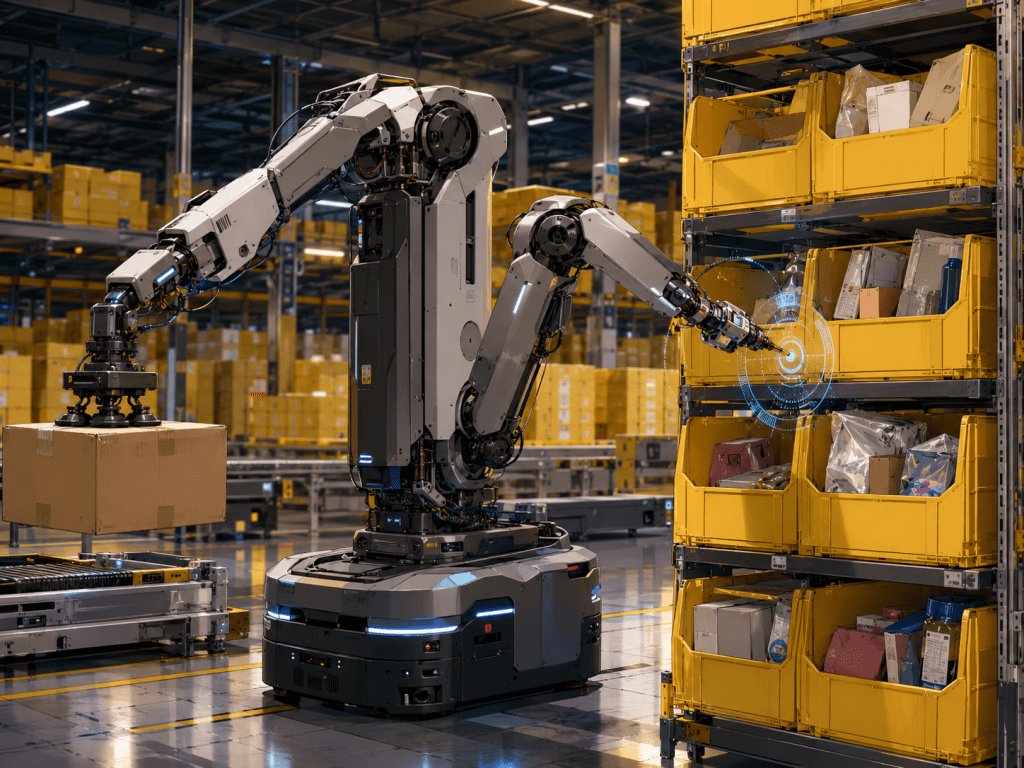
Amazon’s Vulcan robotic system represents a major step forward in warehouse automation because it can detect physical contact while handling products.
Unlike traditional industrial robots that primarily depend on cameras, fixed movement paths, and predetermined gripping forces, Vulcan combines computer vision with force sensors that help it determine when it has touched an object and how much pressure it should apply.
Amazon initially introduced the system in May 2025 and has since continued expanding the technology within its fulfillment network.
The robot has been demonstrated inside Amazon’s fulfillment center in Spokane, Washington, where it picks and stows products in the fabric compartments of tall yellow inventory pods.
These tightly packed compartments are difficult for conventional machines because the robot must move around existing merchandise, create space and insert another item without crushing or displacing nearby products.
Vulcan’s tactile feedback allows its robotic arm to recognize unexpected contact and adjust its movement instead of simply stopping or forcing its way through an obstruction.
The force sensors continuously measure the physical interaction between the tool, the storage pod and surrounding merchandise, giving the control system information that vision alone cannot provide.
How the Vulcan Robot Works
Vulcan uses specialized end-of-arm tooling, three-dimensional force sensors, suction equipment, cameras and AI-driven control algorithms. One tool can push or rearrange products inside a storage compartment, while another arm uses suction to grip and move the selected item.
This combination of mechanical engineering, electrical sensing, machine learning and motion-control software enables Vulcan to handle approximately 75% of the product types found in a typical Amazon fulfillment center.
The robot has also completed hundreds of thousands of picking and stowing operations during its development and deployment. Human employees remain responsible for products or situations the robot cannot reliably process.
Reducing Physically Difficult Warehouse Tasks
Amazon is initially using Vulcan to work with inventory stored in the highest and lowest sections of its storage pods.
These locations can require employees to climb ladders, reach overhead, bend repeatedly or crouch near the floor. Assigning some of these movements to a robotic system could reduce repetitive physical strain while allowing employees to concentrate on products stored within the more accessible middle section of the pod.
Amazon maintains that Vulcan is intended to work alongside employees rather than completely automate warehouse operations.
As additional robotic systems enter fulfillment centers, the company expects demand for technical positions involving robotic installation, monitoring, maintenance and troubleshooting.
However, Vulcan also illustrates how automation can transfer specific picking and stowing duties away from human workers, making its long-term effect on warehouse employment dependent on how quickly new technical roles develop compared with the tasks being automated.
A Mechatronic System Built Around Touch
From an engineering perspective, Vulcan is a mechatronic system that connects mechanical actuators, force-feedback sensors, machine vision, robotic controllers and artificial intelligence.
Its mechanical arm produces movement, its electrical sensors measure contact forces, and its software interprets those measurements to modify the robot’s path in real time. This closed-loop process allows the machine to respond to variations that were not completely defined before the movement began.
Amazon reportedly spent approximately three years developing Vulcan with a team that grew to around 250 people, although the company has not publicly disclosed the total development cost.
The system was first deployed in Spokane and Hamburg, Germany, and Amazon has indicated that additional units will be introduced across the United States and Europe. In June 2026, the company confirmed that Vulcan was being expanded to more European fulfillment sites as part of a broader robotics investment.
Vulcan does not possess a biological sense of touch. Instead, it uses force and torque measurements as machine-readable tactile feedback.
That distinction is important, but the achievement remains significant: warehouse robots are beginning to move beyond simply seeing and locating products toward physically understanding how their tools interact with cluttered, unpredictable environments.
BitcoinVersus.Tech Editor’s Note:
We volunteer daily to ensure the credibility of the information on this platform is Verifiably True. If you would like to support to help further secure the integrity of our research initiatives, please donate here: 3C9o19EH5HSiwEPyCTmEKzxhNCbo2X6TTb
BitcoinVersus.tech is not a financial advisor. This media platform reports on financial subjects purely for informational purposes.


Leave a Reply