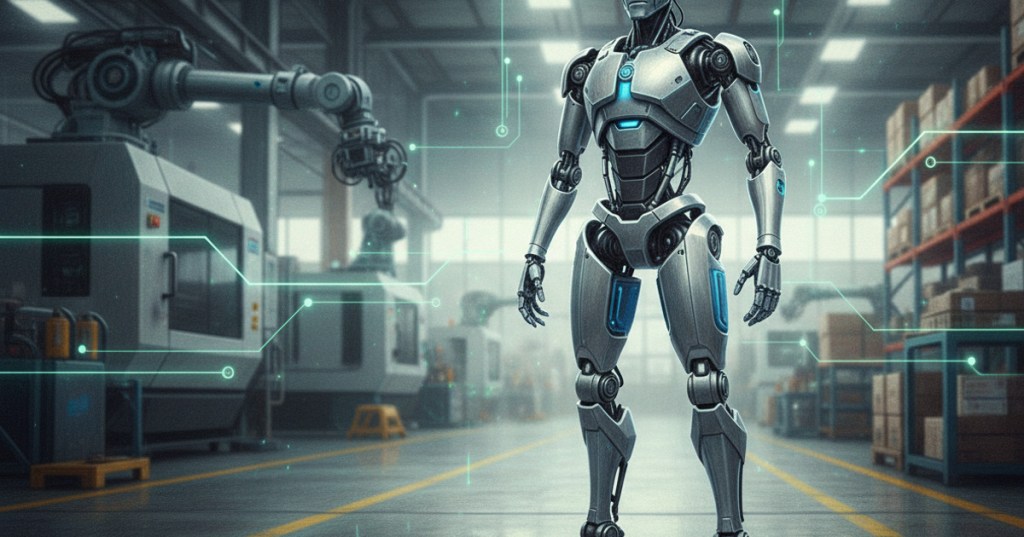
Boston Dynamics has put one of Amazon’s most experienced artificial-intelligence product leaders in charge just as its robots move from spectacular demos toward factory-scale work. Rohit Prasad, the longtime Amazon executive who helped build Alexa and later led the company’s Nova foundation-model effort, became Boston Dynamics CEO on October 7, 2026.
The appointment is less about changing the company’s famous robot hardware than about accelerating the software and intelligence layer on top of it. In its official announcement, Boston Dynamics said Prasad will lead its next phase of Physical AI innovation and commercialization. Reuters independently confirmed the appointment and reported that he succeeds Robert Playter, who stepped down in February.
Why Rohit Prasad Fits Boston Dynamics Right Now
Prasad spent 12 years at Amazon, eventually serving as senior vice president and head scientist for Alexa and Artificial General Intelligence. Boston Dynamics says he helped take Alexa from an early consumer-AI project into a service used across hundreds of millions of households, then led development of Amazon’s Nova family of enterprise AI models.
That background matters because Boston Dynamics is no longer trying to prove that robots can walk, jump, recover balance, or manipulate objects. Its harder problem is turning those capabilities into systems that can understand changing environments, interpret goals, plan actions, recover from mistakes, and deliver repeatable economic value. That is the same shift now visible across the broader humanoid-robotics market: hardware is necessary, but intelligence increasingly decides whether a machine becomes a product.
Atlas Is Becoming a Software Problem as Much as a Robot Problem
The new electric Atlas already shows how this transition is happening. Boston Dynamics has continued improving the machine’s hands, whole-body control, balance, and industrial manipulation, while Hyundai has built a broader manufacturing plan around training and eventually deploying the platform in real production environments.
That means Atlas must do more than reproduce a rehearsed motion. A useful factory humanoid has to perceive what changed, decide what matters, choose a safe action, and complete the task even when the environment is imperfect. Those are AI-system problems layered on top of mechanical design, motor control, sensors, compute, and safety constraints.
Boston Dynamics has already been building the surrounding infrastructure. The company opened an Atlas factory training center intended to accelerate manufacturing-task development, while the broader industry is pouring money into robot training data, simulation, and foundation models that can generalize across tasks.
Spot Shows the Same Shift Toward AI-Driven Work
The strategy is not limited to humanoids. Boston Dynamics’ Spot 5.2 update pushed the quadruped further into software-defined industrial inspection, including workflows where AI agents can dispatch robots to collect information from the factory floor.
That is a useful preview of what “Physical AI” can mean in practice. A software agent can decide that a motor, gauge, thermal hotspot, or production area needs inspection, while a mobile robot becomes the physical endpoint that moves through the facility and gathers the real-world data. The intelligence and the machine are no longer separate products; they become one operational system.
Hyundai Wants Scale, Not Just Impressive Demos
Boston Dynamics also has something many robotics startups do not: an industrial parent with large-scale manufacturing, logistics, and mobility operations. Reuters reported earlier this year that Hyundai Motor Group aims to build capacity for 30,000 robot units annually by 2028 and begin deploying robots across its manufacturing sites.
That gives Prasad a very different challenge from the one he faced at Amazon. Alexa was primarily a cloud-and-device AI service. Boston Dynamics has to make intelligence work inside machines that carry motors, batteries, joints, sensors, safety limits, maintenance requirements, and real consequences when software gets something wrong.
It also puts robot safety closer to the center of the product roadmap. A model that makes a bad text prediction can be annoying. A model that makes a bad physical prediction around people, vehicles, tooling, or production equipment can damage hardware or create a safety event.
The CEO Change Signals a New Phase
Boston Dynamics spent decades becoming the company people associate with robots that move better than expected. Prasad’s appointment suggests the next competitive question is whether those machines can also think, adapt, and work reliably enough to justify widespread deployment.
The hardware advantage still matters. Atlas’ dexterity, Spot’s mobility, and Stretch’s logistics focus give Boston Dynamics a strong physical foundation. But the company is clearly betting that the next leap comes from connecting that hardware to stronger perception, planning, learned behavior, and AI-driven orchestration.
If Prasad can translate his experience scaling consumer and enterprise AI into repeatable robot autonomy, Boston Dynamics may enter a new phase: less emphasis on proving what a robot can do once, and more emphasis on proving what thousands of robots can do every day.
BitcoinVersus.Tech
Advertisement
BitcoinVersus.Tech covers robotics, artificial intelligence, semiconductors, data centers, energy, Bitcoin mining hardware, and the systems connecting them.
Editor’s Note
We volunteer daily to help keep the information on this platform verifiably accurate. If you would like to support independent research and publishing, donations can be sent to: 3C9o19EH5HSiwEPyCTmEKzxhNCbo2X6TTb
BitcoinVersus.tech is not a financial advisor. Content is provided for informational purposes.


Leave a comment