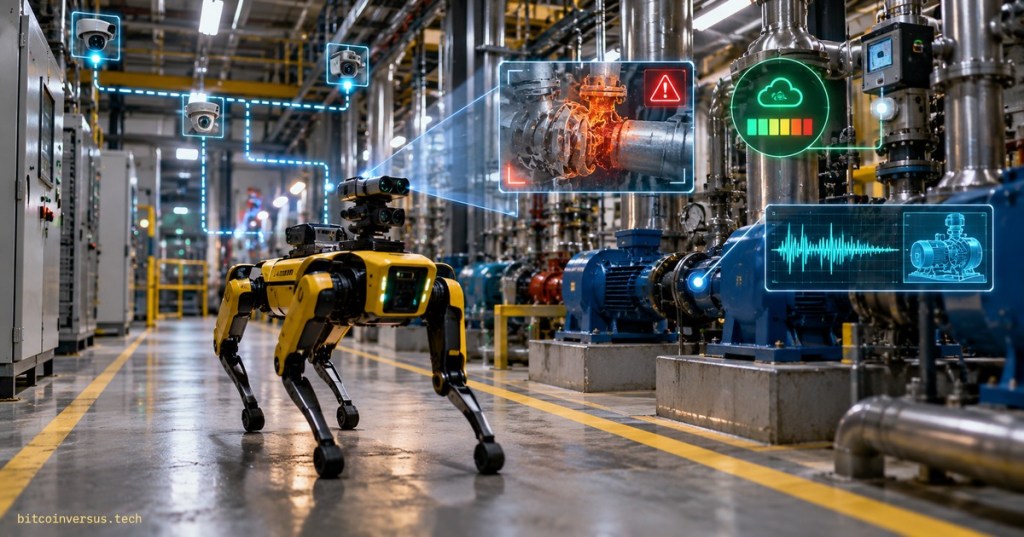
Boston Dynamics has pushed its Spot robot deeper into the software-defined factory with Spot and Orbit 5.2, an update that lets outside sensors and enterprise systems trigger robot inspections instead of waiting for a person to manually decide where Spot should go next.
Boston Dynamics says Spot 5.2 reorganizes Orbit around industrial assets, opens the platform to external inputs such as PLC sensors and security cameras, and lays the groundwork for an MCP layer that can let AI agents autonomously dispatch Spot when business logic calls for another look. UPI’s September report describes the same shift as part of Hyundai Motor Group’s wider physical-AI strategy: connect factory data, AI reasoning and mobile robots into one operating loop.
Spot is moving from scheduled patrols to event-driven inspections
The important change is not a faster leg or a new camera. It is the decision path that tells the robot when to move. In a traditional inspection workflow, a fixed sensor can raise an alarm, a human reviews it, and someone decides whether more evidence is needed. Spot 5.2 is designed to shorten that loop.
Orbit can now ingest outside signals and connect them to a physical action. If a pump sensor reports an abnormal condition, an AI agent can use that context to dispatch Spot to the equipment for additional inspection. If a security camera sees movement in a restricted area, the same architecture can send the robot to investigate without relying on a fixed patrol schedule.
That is a different layer of autonomy from simply replaying a mapped route. BitcoinVersus.Tech recently covered how Boston Dynamics is training Atlas inside Hyundai’s factory environment. Spot 5.2 shows the complementary software side: the robot fleet becomes part of the plant’s decision system rather than a separate machine collecting isolated data.
Boston Dynamics summarized the release in its official Spot and Orbit 5.2 post on X, describing the update as a connective layer for agentic workflows across industrial systems.
Gemini-powered inspections now include video and site scans
Orbit AIVI already uses Google Gemini for visual inspection tasks, but Spot 5.2 broadens what the robot can examine. The update adds video inspections for conditions that can be difficult to diagnose from one still image, including dripping water, slipping conveyor lines and warning lights that change over time.
Site Scans extend the idea beyond one known asset. Spot can analyze 360-degree site imagery for temporary risks such as spills, people inside restricted zones or suspicious objects while it moves through the facility. Boston Dynamics also added support for monitoring more than 20 gas types, visual vibration analysis and partial-discharge detection for high-voltage equipment.
The factory AI stack is becoming physical
Most enterprise AI still lives on screens: dashboards, copilots, alerts and software agents. Spot 5.2 is interesting because it gives that software a mobile sensor platform that can physically move toward a problem, gather more evidence and return the result to the same enterprise systems that triggered the mission.
That direction overlaps with the zero-shot robotics race BitcoinVersus.Tech has been tracking. Figure’s Helix 2.5 is being tested across unseen environments without retraining, while Spot’s new architecture approaches autonomy from the opposite direction: start with a commercially deployed inspection robot and connect it more deeply to real operational data.
The same divide is visible in open robotics. RoboParty’s RP1 is pushing a full-stack open-source humanoid model, while Boston Dynamics is building around a proprietary robot, fleet platform and industrial integration layer. Both approaches are trying to solve the same problem: how to turn AI decisions into reliable physical work.
Why Spot 5.2 matters for field operations
For operators, the practical value is faster escalation. A fixed sensor can tell you that something changed. A robot can move to the asset, collect video, thermal, acoustic, gas or visual evidence, and give maintenance teams a richer picture before a technician enters the area.
The challenge is that more autonomous dispatch also increases the importance of trustworthy triggers, permissions and failure handling. If an AI agent can send a robot into the plant, operators need clear rules for what data can trigger action, which missions are allowed, how conflicting signals are resolved and when a human must remain in the loop.
Spot 5.2 does not make the factory fully autonomous. It does make the boundary between enterprise software and physical robotics thinner. That may be the more important milestone: AI agents are beginning to gain a path from a sensor alert, through reasoning, to a machine that can physically go and inspect the problem.
BitcoinVersus.Tech
Advertisement
Editor’s Note
If you value independent technology reporting, consider supporting BitcoinVersus.Tech with a Bitcoin donation: 3C9o19EH5HSiwEPyCTmEKzxhNCbo2X6TTb
BitcoinVersus.tech is not a financial advisor. This media platform reports on financial subjects purely for informational purposes.


Leave a Reply