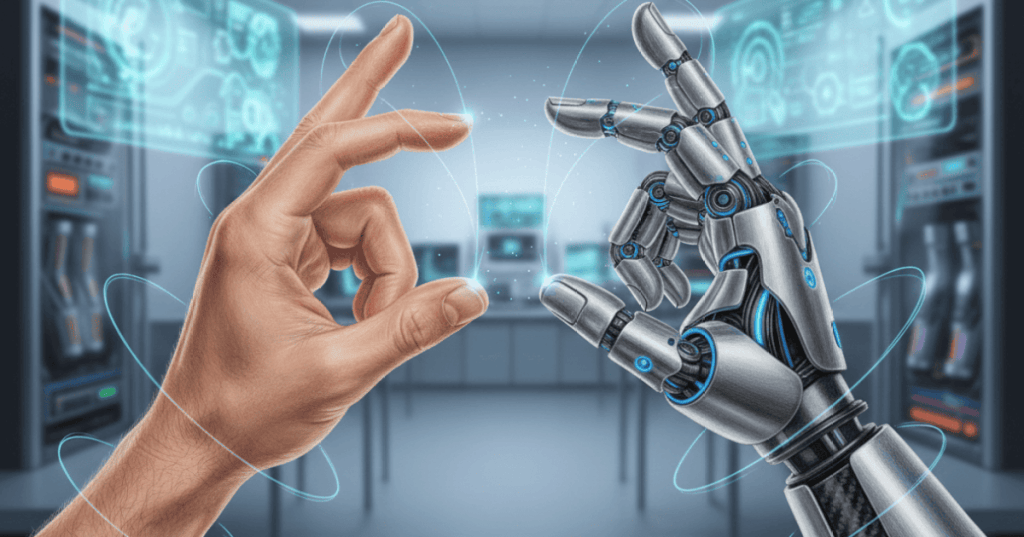
Robots can watch humans move, but copying that motion safely is much harder than it looks. A human hand, arm or body has different joints, limits, weight distribution and contact forces than a robot.
SPIDER, a robotics system developed by researchers from FAIR at Meta and Carnegie Mellon University, is designed to close that gap. Instead of treating human motion as something a robot should imitate frame by frame, SPIDER runs the motion through physics and converts it into trajectories the robot can actually execute.
The new release turns thousands of human demonstrations into robot trajectories
The project’s official SPIDER documentation says the September 22 release contains 7,876 successful trajectories generated from 2,885 source episodes. The release covers multiple human-motion datasets and four dexterous robot hands: Allegro, XHand, Inspire and Sharpa.
That matters because robot training data is expensive. A lab can collect demonstrations directly on a robot, but every new hand, arm or humanoid body introduces another hardware-specific data problem. Human video and motion capture are far easier to collect at scale.
The difficult part is making that human data physically useful to a machine.
Researcher Chaoyi Pan’s SPIDER announcement on X shows the project’s core idea: human demonstrations become physics-informed robot motion rather than simple visual imitation.
Why a robot cannot simply copy a human
A human demonstration usually gives researchers position and motion information. It does not automatically tell the robot how much force to apply, whether its joints can reach the same pose, whether the contact sequence is stable or whether the robot would fall, collide or lose its grip.
SPIDER first uses the human demonstration to establish the structure of the task. It then uses physics-based sampling and contact guidance to search for a version of that motion that fits the target robot’s body and dynamics.
The underlying SPIDER research paper reports that the method works across nine humanoid and dexterous-hand embodiments and six datasets. The researchers report an 18% success-rate improvement over standard sampling and roughly 10× faster generation than reinforcement-learning baselines for the evaluated retargeting tasks.
Human motion can become a reusable robotics dataset
The larger implication is that one human demonstration can become useful beyond one robot.
SPIDER can retarget motion across different embodiments and then vary conditions such as object size, terrain, external forces and contact patterns. That turns a human action into a starting point for many physically feasible robot examples instead of one fixed recording.
This connects directly to another trend BitcoinVersus.Tech has been following. Skild S1 can use a single video demonstration to attempt a previously unseen robot task. SPIDER attacks a related problem from another direction: how to transform human examples into motion that makes physical sense for a machine.
Better motion data could reduce one of humanoid robotics’ biggest bottlenecks
Humanoid development increasingly depends on large, diverse motion datasets. But collecting those datasets with teleoperation rigs, motion-capture systems and real hardware is slow and expensive.
BitcoinVersus.Tech recently covered how Innodata built a sub-millimeter motion lab for humanoid robot training. That kind of high-quality capture can provide precise human movement, while systems like SPIDER can help convert captured movement into robot-specific trajectories.
The same issue becomes even more important as lower-cost humanoid hardware spreads. Berkeley’s open-source Humanoid Lite project shows how robot bodies are becoming more accessible. If the hardware becomes easier to obtain, reusable motion data and training pipelines become the next bottleneck.
Physics is the bridge between watching and doing
The useful idea behind SPIDER is simple: videos show what humans did, but physics determines what a robot can do.
By combining the structure of human demonstrations with simulated physical constraints, researchers can generate training data that is closer to real robot behavior before every motion has to be collected on expensive hardware.
That could make the enormous supply of existing human motion data far more valuable to robotics. Instead of teaching every new robot from zero, future systems may increasingly start with what humans already know how to do—and use physics to translate it into a machine’s body.
BitcoinVersus.Tech
Advertisement
Editor’s Note
We volunteer daily to ensure the credibility of the information on this platform is Verifiably True. If you would like to support to help further secure the integrity of our research initiatives, please donate here: 3C9o19EH5HSiwEPyCTmEKzxhNCbo2X6TTb
BitcoinVersus.tech is not a financial advisor. This media platform reports on financial subjects purely for informational purposes.


Leave a Reply