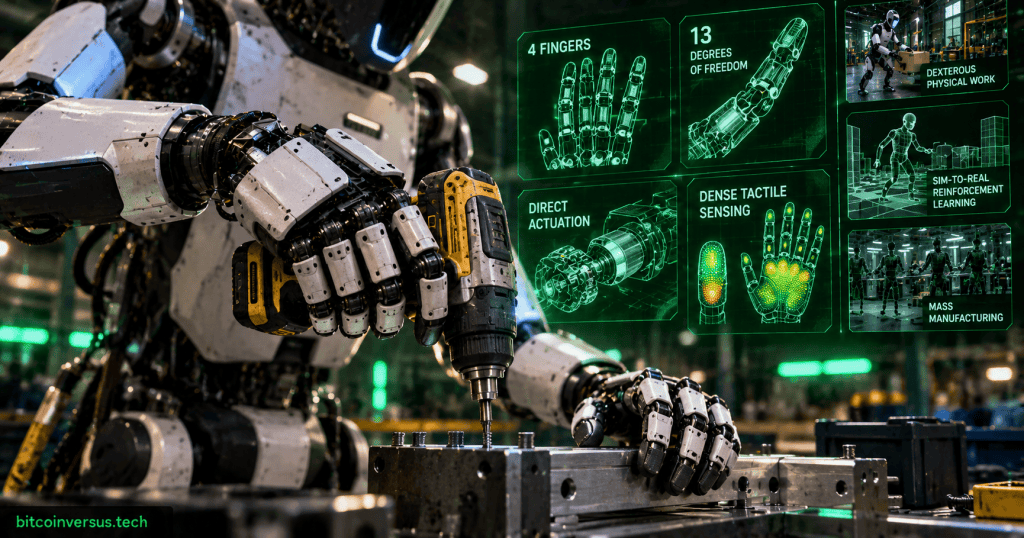
Boston Dynamics is rebuilding one of the hardest parts of a humanoid robot around a simple goal: make the hand useful enough for real work and simple enough to manufacture at scale. The new Atlas hand has four fingers, 13 degrees of freedom, dense tactile sensing and direct-drive actuators designed for manipulation rather than basic grasping.
In Boston Dynamics’ October 1 engineering write-up, the company says the new hand nearly doubles the previous generation’s seven degrees of freedom while staying rugged, repairable and easy to simulate for reinforcement learning. IEEE Spectrum’s robotics coverage emphasizes the trade-off behind the design: Boston Dynamics is prioritizing reliability, manufacturability and tool use over making Atlas look exactly like a human.
The new Atlas hand is built to manipulate, not just hold
The previous Atlas hand was optimized around grasping objects of different shapes. The new generation is intended to do more after the object is already in the hand: reposition it, recover from a slipping grip, operate triggers and use common tools.
That is a major distinction for humanoid robotics. Picking up a box is mostly about force and geometry. Using a drill, tightening hardware or handling an irregular tool requires finer control, finger independence and tactile feedback.
Boston Dynamics director of robot behavior Alberto Rodriguez showed the design in his Atlas hand post on X, describing the hand as directly actuated, built for high-fidelity simulation and designed for dexterous physical work.
Four fingers beat five when the fifth finger does not earn its complexity
The most visually obvious change is also one of the most practical: Atlas does not have a pinky. Boston Dynamics says the team tested whether a fifth finger was really necessary by taping their own pinkies to their ring fingers during ordinary tasks. The conclusion was that the extra finger did not justify the added actuators, parts, failure points and manufacturing complexity.
The thumb gets four degrees of freedom while each of the other three fingers gets three. That gives the hand 13 total degrees of freedom and enough finger splay to oppose one finger against another, stabilize tool handles and operate triggers.
Direct-drive joints make the hand easier to model and repair
Boston Dynamics also avoided delicate tendon and cable systems crossing the joints. Each actuator is packaged directly into the joint, which makes the mechanical response easier to model in simulation and reduces exposed components that can stretch or break.
That matters because modern humanoid control increasingly depends on policies learned in simulation. A hand that behaves very differently in simulation than it does in the real world makes reinforcement learning less useful. Designing the hardware for sim-to-real transfer turns mechanical architecture into part of the AI stack.
BitcoinVersus.Tech recently covered how Boston Dynamics is also connecting Spot 5.2 to AI-agent factory inspection workflows. Atlas’ new hand pushes the same strategy deeper into physical manipulation rather than inspection alone.
Humanoid hands may decide which robots actually make it into factories
Walking gets the attention, but manufacturing economics may be decided by manipulation. A humanoid that can move through a plant but cannot reliably turn a tool, reposition a part or recover from a bad grip still needs a human nearby for many high-value tasks.
That is why the hand race is spreading across the industry. BitcoinVersus.Tech recently examined Unitree’s G1 using autonomous whole-body control with UnifoLM-X2, another example of humanoids moving from choreographed motion toward learned physical behavior.
Meta is attacking the problem from the data side. Our report on Meta SPIDER turning human motion into robot training data shows how demonstrations can become reusable training signals. Boston Dynamics is designing Atlas’ hand so those learned behaviors can transfer onto hardware that is rugged enough for industrial use.
The design target is not a perfect human hand — it is a scalable robot tool
Boston Dynamics is making a product decision as much as a robotics decision. A perfectly human-looking hand can be mechanically elegant but expensive, fragile and difficult to repair. Atlas’ new design accepts a more industrial appearance in exchange for larger actuators, fewer failure points and more straightforward serviceability.
IEEE Spectrum reports that Boston Dynamics is already thinking about what must change if the company eventually wants to manufacture these hands at very high volume. That question is more important than whether the hand looks natural: a humanoid cannot scale into factories if its most important tool is too fragile or costly to maintain.
Atlas is getting closer to the part of humanoid robotics that actually matters
Humanoid robots have spent years proving they can walk, jump, balance and recover. The next phase is less cinematic. Robots need to manipulate the messy collection of tools, parts and fixtures that human workplaces already use.
Atlas’ new hand is an attempt to solve that problem without copying human anatomy literally. If the four-finger design can survive factory duty, learn reliably in simulation and perform useful tool work, the missing pinky may end up looking less like a compromise and more like an engineering advantage.
BitcoinVersus.Tech
Advertisement
Editor’s Note
If you value independent technology reporting, consider supporting BitcoinVersus.Tech with a Bitcoin donation: 3C9o19EH5HSiwEPyCTmEKzxhNCbo2X6TTb
BitcoinVersus.tech is not a financial advisor. This media platform reports on financial subjects purely for informational purposes.


Leave a Reply