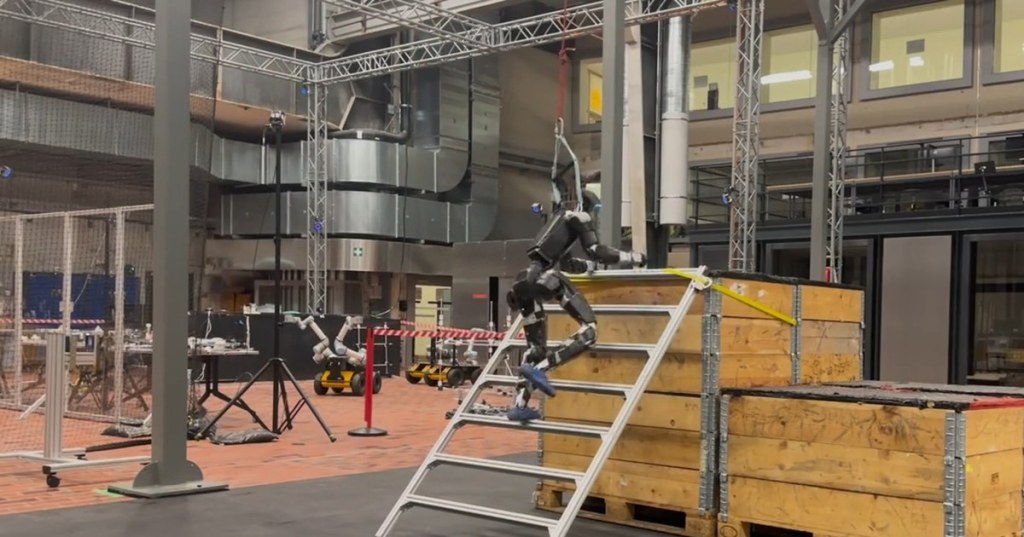
November 2, 2026 — Researchers at ETH Zurich and collaborators have demonstrated a Unitree G1 humanoid climbing ladders, vaulting obstacles and recovering after falls using a single learned mobility controller. Their October 22 research preprint introduces Attention-based Contact Planning (ACP), which decides where the robot should touch its surroundings before coordinating its movements.
Rather than replaying a motion sequence for each task, ACP uses contact targets as an intermediate instruction. The team’s official project page documents demonstrations spanning ladders, narrow footholds, stairs and getting up from the ground.
How Contact Planning Works
Training began with 13.2 minutes of recorded human movement adapted to the robot’s body, then continued through reinforcement learning. That figure describes the source motion recordings, not the total training time. Related work on human-motion training data shows why realistic movement examples are valuable for robotics.
Onboard, a planner examines a LiDAR-derived terrain map, body sensors and a target. It predicts contact locations for nine body parts over the next 1.5 seconds; another network converts them into commands for 23 joints. Both run at 50 Hz. This emphasis on versatile obstacle traversal offers a different technical perspective from the high-impact Unitree demonstrations previously covered here.
What the Benchmark Actually Shows
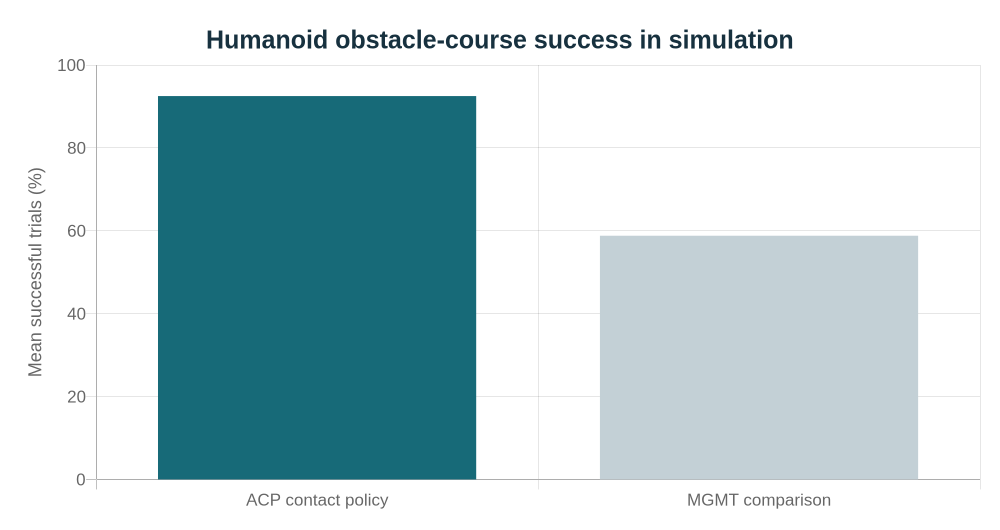
Across eight combined obstacle courses in simulation, ACP averaged a 92.5% success rate versus 58.8% for the MGMT motion-generation-and-tracking comparison. That is a 33.7-percentage-point difference, calculated from the reported averages. Researchers evaluated 1,000 episodes per method on each course; the figures do not measure reliability on physical ladders.
From Demonstrations to Repeatable Field Performance
The project also publishes physical vaulting and recovery footage. Unlike robot learning through simulated soccer, these clips show how a trained controller behaves on a real humanoid, although a montage cannot establish its long-run failure rate.
ACP remains a research system, not a commercial autonomy guarantee. The authors identify limits in overhead contacts and manipulation, while navigation beyond local goals is outside the study. Such constraints matter when comparing ACP with open-stack humanoid platforms and industrial robot-hand designs. The next meaningful milestone is independently repeatable physical testing across unfamiliar obstacles, including recorded failures and recovery attempts.
BitcoinVersus.Tech Editor’s Note: We volunteer daily to ensure the credibility of the information on this platform is Verifiably True. If you would like to support our work and help further secure the integrity of our research initiatives, please scan the QR code below to donate 5,000 sats. For best results, scan the QR code from a laptop or larger screen.

Bitcoin donation address: 3C9o19EH5HSiwEPyCTmEKzxhNCbo2X6TTb. On mobile, open the QR on another screen or use your wallet’s saved-image scanner.
BitcoinVersus.tech is not a financial advisor. This media platform reports on financial subjects purely for informational purposes.


Leave a Reply