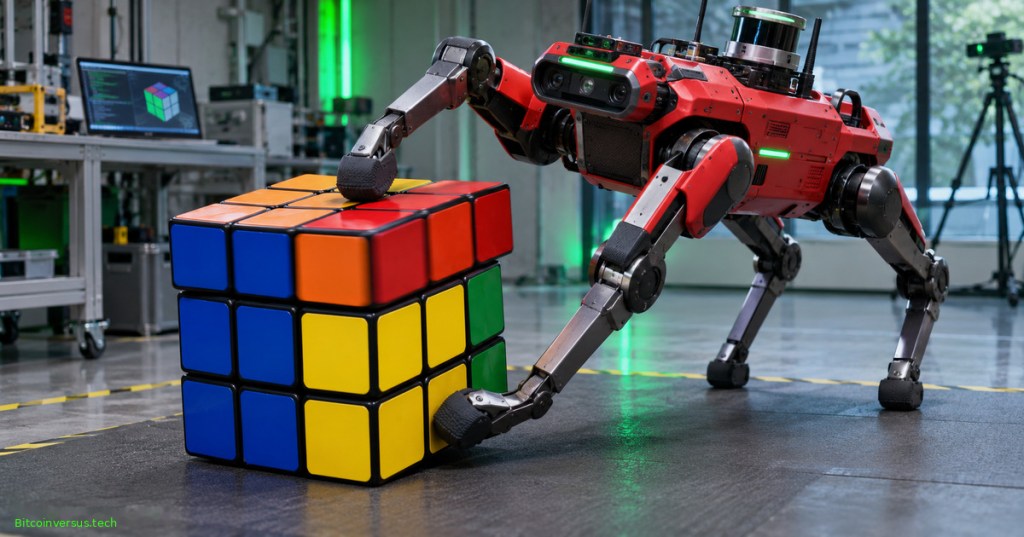
A four-legged robot has solved a giant Rubik’s Cube without a hand or robotic arm. ETH Zurich’s Robotic Systems Lab and an NVIDIA-affiliated collaborator used an ANYmal-D robot to recognize a scrambled puzzle, calculate a solution and execute the necessary movements with its feet. The October 17, 2026 research preprint reports three complete autonomous solutions on physical hardware, each requiring about 30 movement steps over eight to nine minutes.
The demonstration explores pedipulation: using a walking robot’s legs for precise manipulation while maintaining balance. The cube measured 40 centimeters on each edge and weighed 4.6 kilograms. A rotation error can invalidate a later move, making the assignment more demanding than a single push or button press.
Full autonomous cube-solving demonstration. Source: ETH Zurich Robotic Systems Lab, official research project video.
The Robot Scans, Plans, Pins and Turns
An onboard RGB-D camera captures both color and depth. The perception pipeline identifies the cube, reconstructs its position and gathers the colored stickers visible from different angles. The robot walks around the puzzle and flips it to expose faces its cameras could not initially see.
A conventional Rubik’s Cube-solving algorithm computes the target arrangement. A separate planner translates the solution into movements available to ANYmal: repositioning, flipping the entire cube, or rotating two layers while the bottom stays fixed. During a layer turn, one front foot pins the base and the other pushes the upper layers through 90 degrees.
The manipulation controller was trained with reinforcement learning in simulation. Researchers first developed expert policies with detailed training-state information, then trained deployable controllers using camera depth and the robot’s joint sensors. The approach connects robot-learning simulation research with real-world movement, where friction and object position can disrupt even a correct plan.
Hardware Trials Show the Difficult Part
The team measured four elementary skills across 15 physical trials each. Both forward and backward cube flips succeeded in all 15 attempts. Counterclockwise layer rotation succeeded 13 times, while clockwise rotation succeeded 10 times. The latter figures represent approximately 86.7% and 66.7%, respectively, in small task-specific samples.
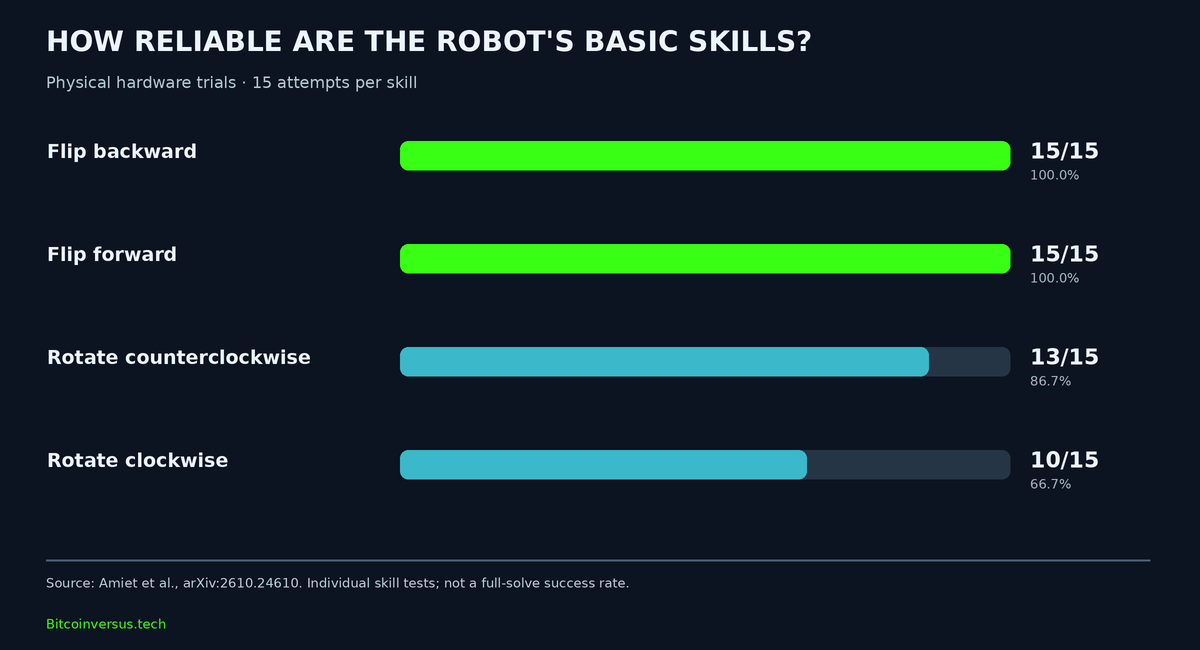
Rotation failures generally involved overshooting the desired angle. The research also reports three successful complete solutions, but does not establish an overall full-solve success rate across all attempted runs. Results for isolated skills cannot be multiplied or substituted for independently measured end-to-end reliability.
Visual recognition achieved 100% indoor and 98.7% outdoor facelet classification accuracy in the researchers’ evaluation sequences. The percentages measure observed sticker classification, not the proportion of outdoor full-cube solves. The system also needs sufficient floor friction, room to reposition and accurate contact with the cube.
Why a Robot Dog Solving a Puzzle Matters
A research quadruped reusing its legs as tools could eventually operate doors, move obstacles or interact with industrial equipment without a separate manipulator. BitcoinVersus.Tech previously examined industrial and research robot dogs, including ANYbotics’ commercial inspection machines. The cube demonstration uses research hardware and is not an announced commercial feature.
Related efforts emphasize different forms of physical intelligence. ETH Zurich’s humanoid contact-planning research focuses on safe movement over obstacles, while Panasonic’s tactile-control system studies delicate fingertip interaction. Coordinating a robot’s whole body to manipulate an articulated object adds another challenge.
The authors’ official project and October 17 preprint document the experimental system. The next meaningful advance would be repeated, independently assessed performance with unfamiliar objects, changing terrain and documented failure recovery. Three demonstrated solutions show technical feasibility, not unrestricted autonomy.
BitcoinVersus.Tech Editor’s Note: The reported trials are attributed to the ETH Zurich and NVIDIA research team. The 2026 paper is a preprint; demonstrations do not establish industrial readiness. The featured image is an original editorial visualization, not a photograph of the experiment. The research video belongs to ETH Zurich’s Robotic Systems Lab.
Support Independent Technology Reporting
Donate an optional 5,000 satoshis by scanning the approved BitcoinVersus.Tech QR code. On mobile, open the article on another screen or use a wallet capable of scanning an image. Verify the receiving Bitcoin address 3C9o19EH5HSiwEPyCTmEKzxhNCbo2X6TTb and the payment amount before confirming.

We volunteer daily to ensure the information on this platform is Verifiably True. If you would like to support the research, please scan QR code.
BitcoinVersus.Tech is not a financial advisor. Coverage of financial subjects is provided for informational purposes only.


Leave a Reply