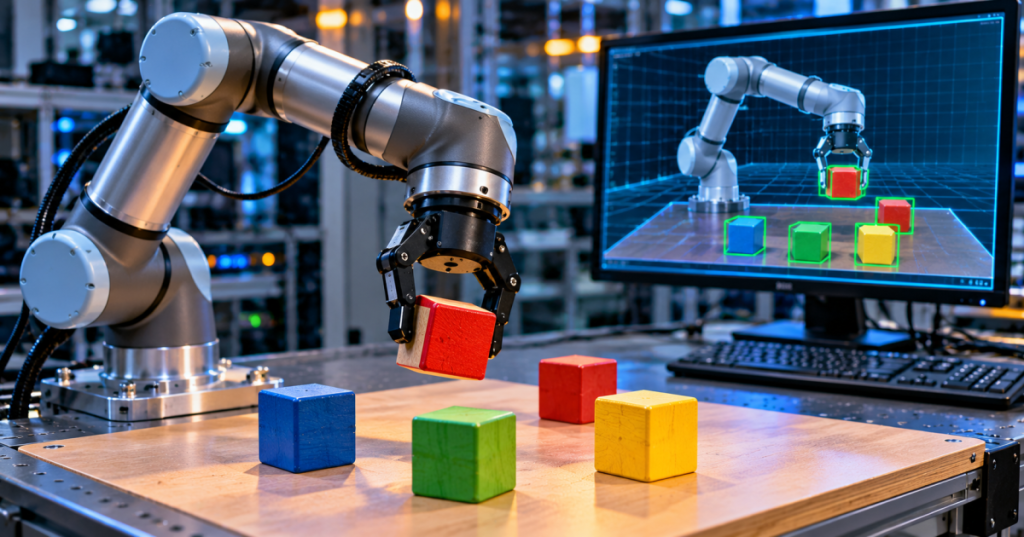
The Allen Institute for AI (Ai2) released ToyBlocks on November 6, 2026, an open-source robotics research framework accompanied by 85,336 simulated manipulation demonstrations. The initial dataset includes approximately 1,600 hours of simulated robot execution and 144 million recorded frames. Ai2 designed the system to identify why robot-learning models fail, not to claim that block-stacking robots have achieved general-purpose autonomy. The institute’s technical announcement includes real-robot experiments alongside simulation results.
ToyBlocks belongs to Ai2’s proposed FoundationWorlds approach: small, controlled environments where researchers can modify task instructions, training examples, physical properties and evaluation conditions independently. A robotic arm pushes, rotates, flips and stacks marked wooden blocks. Letters and images on different faces force the machine to inspect objects, reason about hidden information and plan multi-step actions.
Training data without manually steering every movement
ToyBlocks combines NVIDIA Isaac Lab simulation, reinforcement learning and task-and-motion planning. Automatically generated examples let researchers alter object geometry, tabletop height, material friction and camera appearance. Ai2 reports generation at up to 24 times real-time speed on one graphics processor, rather than requiring an operator to demonstrate every motion physically.
The public repository includes simulation assets, task generators, training and evaluation code, and two example model families built around Molmo 2 and ManiFlow. Core code is Apache-2.0 licensed, while downloaded assets and submodules may have separate licenses. The initial data release is available now; larger datasets and fuller integrated reinforcement-learning training remain announced future work.
AI agents learn to use their own robot skills
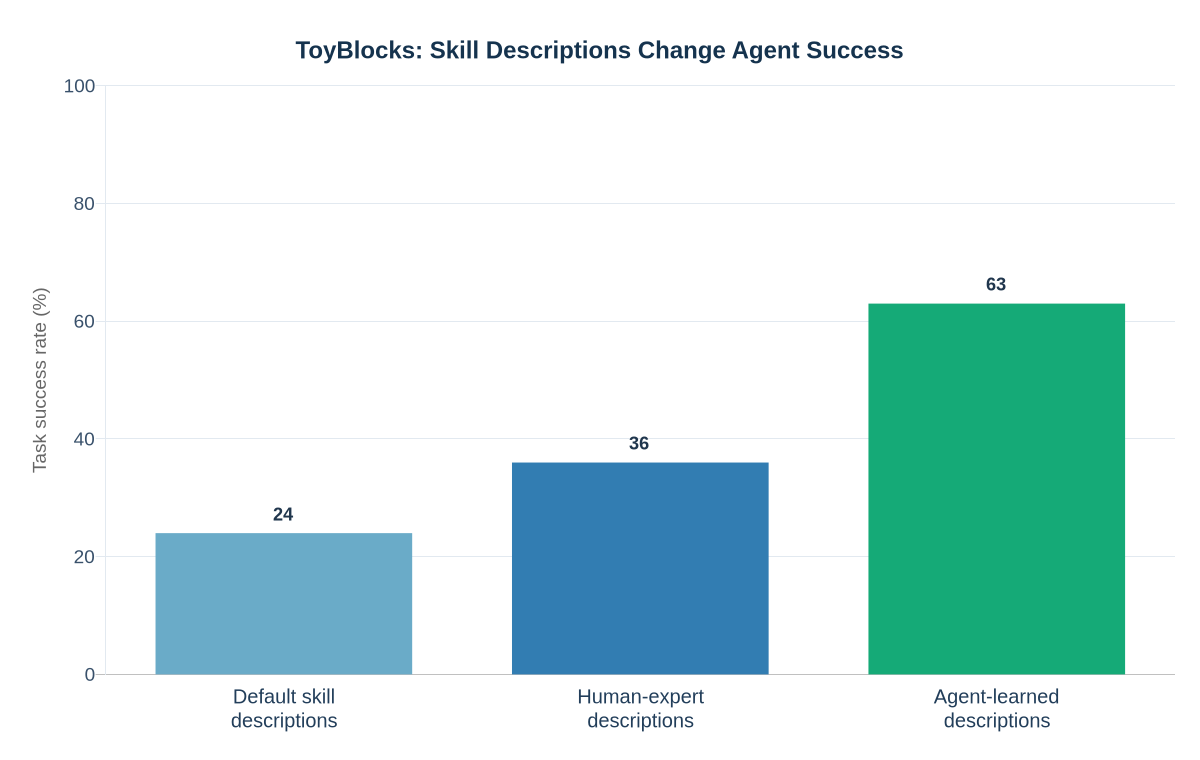
In Ai2’s controlled search-and-spell evaluation, an agent received tool descriptions explaining how to pick, flip and rotate blocks. It succeeded in 24% of tasks using default descriptions, 36% with expert-written descriptions, and 63% after learning descriptions through its own experiments. Success meant correctly constructing a target three-letter word or identifying an impossible task. Results reflect that specific test, not overall industrial robot reliability.
The test also exposed errors in recognizing similar letters and positioning blocks. Such failures are important for applications beyond toy stacking: a manipulator can choose the right object but rotate it incorrectly, or execute a safe-looking plan using a mistaken observation. Earlier BitcoinVersus.Tech coverage of robot memory correction and interactive robot simulation models examines related uncertainties.
Physical trials reveal a modest simulation gap
Ai2 trained a Molmo 2 planner and ManiFlow action policy in simulation before transferring them to a physical Franka FR3 robotic arm. The combined system completed 111 of 200 simulated episodes (55.5%) and 15 of 30 physical episodes (50.0%) in its easiest three-block spelling setup. The real-world sample was substantially smaller, so the 5.5-percentage-point difference does not establish a universal sim-to-real performance penalty.
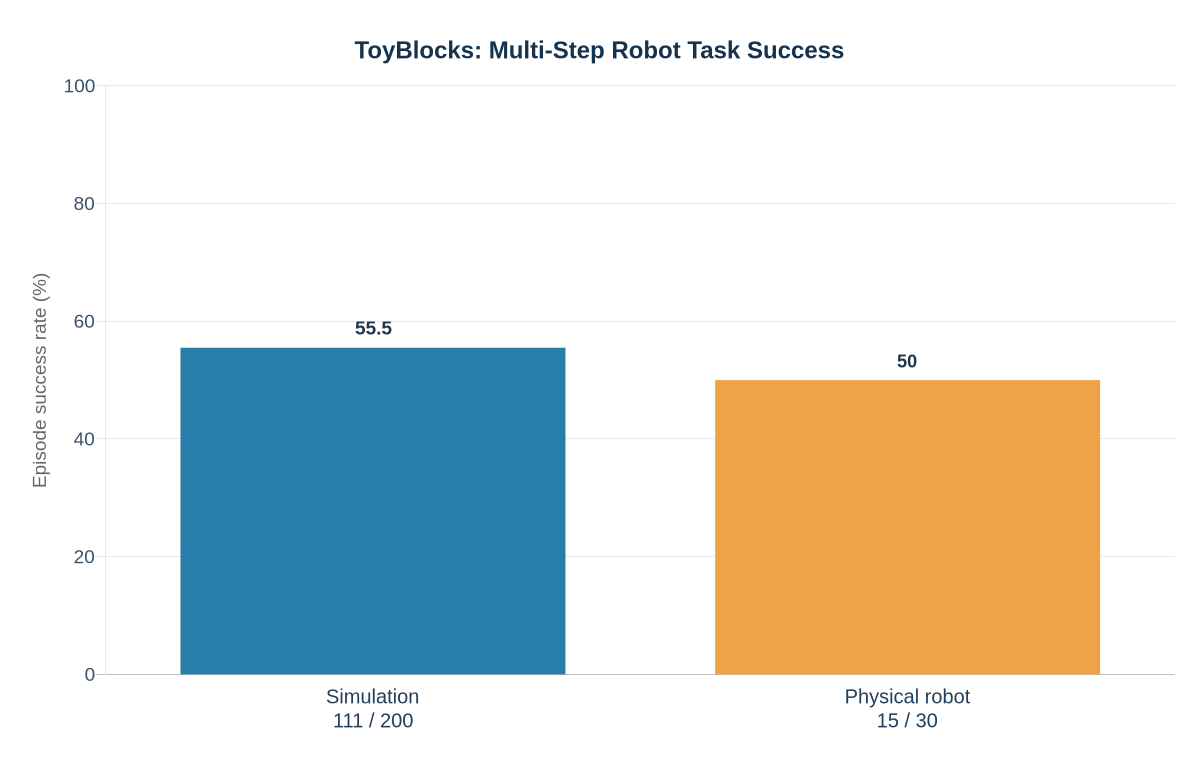
Individual manipulation skills performed at approximately 80% success in both settings, higher than the longer multi-step tasks. Ai2’s researchers used system identification, randomized simulated conditions and multiple cameras to improve transfer. Any real-world trial requiring operator intervention for unsafe movement was counted as failure.
Earlier BitcoinVersus.Tech reporting examined NVIDIA Isaac-trained insertion tasks, open robotics development toolchains and a buildable open-source humanoid kit. ToyBlocks adds a reproducible evaluation environment, but tabletop experiments do not validate performance in cluttered factories, homes or unpredictable outdoor settings.
The research remains an early benchmark, with narrow tasks, limited physical trials and uncertain generalization. Its significance lies in linking accessible datasets, failure analysis and real-robot measurements—providing a foundation for testing whether future robotics systems become more dependable rather than merely more impressive in demonstrations.
Primary sources: Ai2’s November 6 ToyBlocks release and evaluation results; ToyBlocks source code and licensing; project documentation and generation metrics; and NVIDIA Omniverse’s official Isaac Lab demonstration.
Editor’s Note: Performance figures, release counts and trial results are attributed to Ai2’s November 6, 2026 announcement. The 55.5% simulated and 50.0% physical task outcomes come from different numbers of trials and should not be treated as population-wide reliability estimates. The featured image is conceptual artwork, and the NVIDIA video is background material rather than a ToyBlocks demonstration.
Support BitcoinVersus.Tech
Support the research with an optional 5,000-satoshi donation using the original approved BitcoinVersus.Tech QR below. Mobile readers can open the article on another screen and scan with a compatible Bitcoin wallet; verify the recipient and amount before confirming payment.

We volunteer daily to ensure the information on this platform is Verifiably True. If you would like to support the research, please scan QR code.


Leave a Reply