Humanoid robots can walk and balance in controlled demonstrations, but completing spoken instructions in unfamiliar rooms remains difficult. Researchers at Apple reported on November 4, 2026, that their HALO autonomy system successfully completed 91% of 360 single-skill tests across six real environments never mapped or used for training. The experimental system was demonstrated on a Unitree G1 humanoid, not an announced Apple consumer robot.
A Thousand Simulated Homes Supply the Training Data
HALO stands for Humanoid Autonomy, Learned in simulation, running Onboard. Robot training ordinarily depends on human-controlled demonstrations or manually captured movement. HALO instead generated approximately 300 hours of vision, language and motion data in 1,000 procedurally created homes, combining motion synthesis with simulated camera views. The team reports that generating the corpus used 250 NVIDIA H100 GPUs for 48 hours; model training required additional hardware. The approach differs from the human-motion conversion described in BitcoinVersus.Tech’s Meta SPIDER coverage.
A vision-language orchestrator interprets requests about every two seconds. A motion generator updates five-second whole-body plans approximately three times per second, while a tracking controller issues motor targets at 50 hertz. The robot uses onboard cameras and depth sensing rather than a pre-scanned floor plan. Apple’s hardware setup included a Mac mini M4 Pro in a rear enclosure and the G1’s existing computing hardware.
Six Skills, 360 Physical Trials
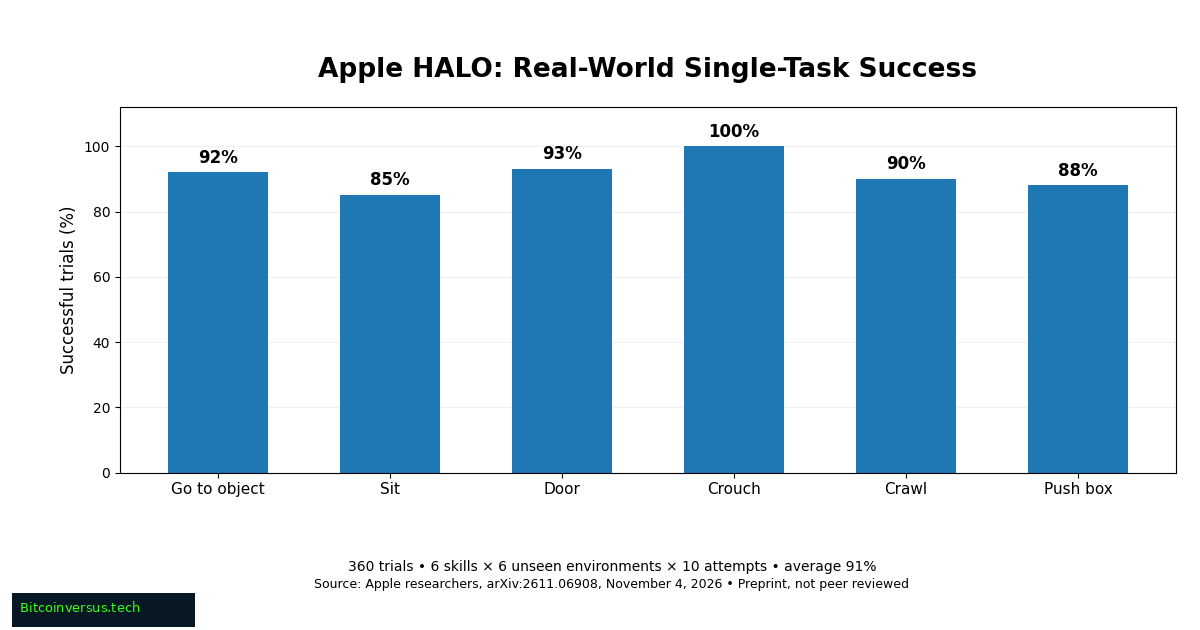
The researchers tested walking to named objects, sitting, stepping through partly open doors, crouching and crawling beneath obstacles, and pushing boxes. Each of the six skills was attempted ten times in each of six previously unseen real environments, producing 360 trials. Crouching succeeded in all tested real-world attempts; sitting reached 85%, and box pushing reached 88%. Across the six skill categories, the mean was 91%.
Longer Tasks Expose the Remaining Gap
The most consequential limitation appears when the robot must combine skills. In one real environment, three chained-task sequences averaged 70% success, versus 91% across isolated skills. Walking through a door and reaching an object succeeded ten times out of ten; crouching and sitting achieved six out of ten, while crouching, approaching a box and pushing it succeeded five out of ten. The multi-step sample was smaller and used only one real environment, limiting direct comparisons.
HALO does not demonstrate household cleaning, reliable object grasping, human-safe navigation certification or uninterrupted commercial operation. Its demonstrations focus on whole-body movement and limited physical interaction. Researchers also acknowledge that new skill templates require human design and that the system lacks tactile feedback. BitcoinVersus.Tech’s Ludo Robotics report addresses social cues, while commercial humanoid deployments require different evidence of reliability and productivity.
The released research code may support reproducibility, but the paper is an arXiv preprint, not peer-reviewed evidence of a deployable product. The training and evaluation tasks differ from other published humanoid benchmarks. Related simulation-based robotics datasets show why scalable data generation is an important research direction; Meta’s reported prototype reflects a separate hardware-development effort.
Primary sources: Hu and colleagues, “Perceptive Humanoid Motion from Simulation,” November 4, 2026; Apple HALO research demonstrations and methodology; released project code.
BitcoinVersus.Tech Editor’s Note
Published November 9, 2026 (site date; prepared November 8, U.S. Pacific). The 91% result reflects the authors’ six single-skill tests across 360 real-world attempts, not an independently reproduced reliability or safety benchmark. The 70% result comes from smaller multi-step tests in one environment. The study remains a research preprint; no Apple consumer humanoid has been announced. The featured cover is conceptual artwork, not a photo from the experiment. Both in-story videos are linked to verified file paths from the Apple researchers’ official project site; live playback on WordPress has not been independently confirmed.
We volunteer daily to ensure the information on this platform is Verifiably True. If you would like to support the research, please scan QR code.

Support independent reporting with an optional 5,000-satoshi donation. Scan the original QR from another screen using a Bitcoin wallet, or use a compatible saved-image scanner on mobile. Verify destination 3C9o19EH5HSiwEPyCTmEKzxhNCbo2X6TTb and amount before payment.
BitcoinVersus.Tech is not a financial advisor. Financial coverage is provided purely for informational purposes.


Leave a Reply